To Kill a Mockingbird
Comprehensive Storyform
The following analysis reveals a comprehensive look at the Storyform for To Kill a Mockingbird. Unlike most of the analysis found here—which simply lists the unique individual story appreciations—this in-depth study details the actual encoding for each structural item. This also means it has been incorporated into the Dramatica Story Expert application itself as an easily referenced contextual example.
Story Dynamics
8 of the 12 essential questions
- Change
- Main Character Resolve
Scout changes when she realizes Boo Radley has saved Jem’s and her life, and he is a man who is a friend, not a man to fear.
- Start
- Main Character Growth
Scout lacks open-mindedness as she sees issues in black and white. Her tolerance of individual differences starts when she can understand another person’s point of view.
- Do-er
- Main Character Approach
Scout attempts to solve a problem by first taking action, an approach that often gets her into trouble. As an example, she is reprimanded when Miss Caroline wants to lend the poor but proud Walter Cunningham lunch money, and Scout jumps in to explain that it is not the Cunningham way:
I would have saved myself some inconvenience and Miss Caroline subsequent mortification, but it was beyond my ability to explain things as well as Atticus, so I said, “You’re shamin’ him, Miss Caroline. Walter hasn’t got a quarter at home to bring you, and you can’t use any stovewood.” Miss Caroline stood stock still, then grabbed me by the collar and hauled me back to her desk. “Jean Louise, I’ve had about enough of you this morning,” she said. “You’re starting off on the wrong foot in every way…” (Lee, 1960, p. 24) - Male
- Main Character Mental Sex
Scout considers each problem she comes up against as a separate issue, not realizing the connections that make up a bigger picture.
- Decision
- Story Driver
Atticus decides to take Tom Robinson’s case even though he is certain to lose; the jury decides Tom Robinson is guilty of raping Mayella although evidence points to the contrary; Aunt Alexandra decides to move into the Finch household and exert her influence over the children; Heck Tate decides against arresting Boo Radley for Bob Ewell’s death “‘It ain’t your decision, Mr. Finch it’s all mine’” (Lee, 1960, p. 303); and so forth.
- Optionlock
- Story Limit
There is no time limit in the effort of bringing Tom Robinson to justice. Even after a verdict of “guilty,” Atticus plans to appeal. This last option is exhausted when Tom Robinson is fatally shot in an attempt to escape incarceration.
- Failure
- Story Outcome
The court demands its witnesses to give their honest recollection of what happened on November 21 at the Ewell’s shack in order that justice may be served. This goal is not achieved; Bob and Mayella Ewell lie about what they remember, and as they have lied to the sheriff, Heck Tate, his memory is biased; Tom Robinson tells what really happened but is still found guilty of a crime he did not commit.
- Good
- Story Judgment
Once Scout accepts Boo, she is finally able to comprehend her father’s lesson of stepping in someone else’s shoes to understand their perspective, “Atticus was right. One time he said you never really know a man until you stand in his shoes and walk around in them. Just standing on the Radley porch was enough” (Lee, 1960, p. 308).
Overall Story Throughline
""The Trials and Tribulations of Tom Robinson""
- Mind
- Overall Story Throughline
In an attempt to avoid the changing times, the small town southerners of Maycomb County hold onto their fixed attitudes regarding race, class, and gender by indulging in the myths they have perpetuated; the children have a fixed attitude concerning Boo Radley and Mrs. Dubose; “The Radley Place was inhabited by an unknown entity the mere description of whom was enough to make us behave for days on end; Mrs. Dubose was plain hell…neighborhood opinion was unanimous that Mrs. Dubose was the meanest woman who ever lived.” (Lee, 1960, pp. 7, 39)
- Memory
- Overall Story Concern
Aunt Alexandra is concerned with the Finches remembering their social position:
I never understood her preoccupation with heredity. Somewhere, I had received the impression that Fine Folks were people who did the best they could with the sense they had, but Aunt Alexandra was of the opinion, obliquely expressed, that the longer a family had been squatting on one patch of land the finer it was. (Lee, 1960, p. 143); Scout forces Mr. Cunningham to remember who she is, thus shaming him into disbanding the mob out to get Tom Robinson; Mayella wants to forget she made sexual overtures to a black man, “‘Tom Robinson was a daily reminder of what she did. What did she do? She tempted a Negro’” (Lee, 1960, p. 225). Jem enjoys gum that Boo Radley has placed in a tree, “...the fact that everything on the Radley Place was poison having slipped Jem’s memory” (Lee, 1960, p. 67); and so forth. - Falsehood
- Overall Story Issue
Thematic issues revolving around falsehood are explored in various ways in To Kill a Mockingbird. It is especially evident that falsehood, in the guise of myth is a way of life in Maycomb.
- Truth
- Overall Story Counterpoint
Although there is very little truth expressed in the society that makes up Maycomb, it is shown to be advantageous.
- Overall Story Thematic Conflict
Falsehood vs.TruthLee explores the conflict that occurs when the fabrication of reality as an accepted way of life collides with the truth. As an example, when Dill comments on Miss Rachel’s excessive drinking, Aunt Alexandra reprimands him, “‘Don’t talk like that, Dill,’ said Aunt Alexandra. ‘It’s not becoming to a child. ‘It’s-cynical.’ ‘I ain’t cynical, Miss Alexandra. Tellin’ the truth’s not cynical, is it’” (Lee, 1960, p. 236).
- Inequity
- Overall Story Problem
When a Negro is falsely accused of rape, the townspeople judge him guilty based on his color, creating obvious problems for the defendant and his family, and the fair-minded adults and children who are disgusted by prejudice and hypocrisy:
“There’s something in our world that makes men lose their heads-they couldn’t be fair if they tried. In our courts, when it’s a white man’s word against a black man’s, the white man always wins. They’re ugly, but those are the facts of life.” (Lee, 1960, p. 243) - Equity
- Overall Story Solution
Atticus addresses the jury with a passionate speech on equality as he entreats them to come up with a “not guilty” verdict:
...there is one way in this country in which all men are created equal-there is one human institution that makes a pauper the equal of a Rockefeller, the stupid man the equal of an Einstein and the ignorant man the equal of a college president. That institution, gentlemen, is a court…and in our courts all men are created equal. (Lee, 1960, pp. 266-267) - Projection
- Overall Story Symptom
Atticus discusses with the children, that because of the lengthy period of time and the magnitude of the way whites have treated Negroes unfairly, what will probably happen in the future:
“There’s nothing more sickening to me than a low-grade white man who’ll take advantage of a Negro’s ignorance. Don’t fool yourselves-it’s all adding up, and one of these days we’re going to pay the bill for it. I hope it’s not in you children’s time. (Lee, 1960, pp. 243-244) - Speculation
- Overall Story Response
The townspeople are happy with the “guilty” verdict, believing it will keep the Negro community in its place.:
“Well, coming out of the court-house that night Miss Gates…was talking with Miss Stephanie Crawford. I heard her say it’s time somebody taught ‘em a lesson, they were gettin’ way above themselves, an’ the next thing they think they can do is marry us.” (Lee, 1960, p. 272)
Calpurnia explains to Miss Rachel’s cook why Atticus refuses to speculate what will happen after he appeals Tom Robinson’s case, “‘First thing you learn in a lawin’ family is that there ain’t any definite answers to anything. Mr. Finch couldn’t say somethin’s so when he doesn’t know for sure it’s so’” (Lee, 1960, p. 259).
Dill is sickened by the racism in the community and determines the only way he can live with it in the future is to become an entertainer:
“‘I think I’ll be a clown when I get grown…there ain’t one thing in this world I can do about folks except laugh, so I’m gonna join the circus and laugh my head off’” (Lee, 1960, p. 238). - Suspicion
- Overall Story Catalyst
Tom Robinson’s lack of suspicion gets him into trouble in the first place; he willingly walks into Mayella’s home thinking she needs his help. When she accosts him, he runs and is caught by Bob Ewell who claims he tried to rape his daughter, which begins the story of Tom Robinson’s trial. Atticus’s success in planting the seeds of doubt in the townspeople’s mind about Bob Ewell’s honesty causes the varmint to seek revenge, accelerating the story to its climactic moment when Bob Ewell attempts to murder the Finch children, “‘...he knows in his heart that very few people in Maycomb really believe his and Mayella’s yarns’” (Lee, 1960, p. 275); and so forth.
- Prediction
- Overall Story Inhibitor
Judge Taylor postpones Tom Robinson’s trial until summer session in hopes of diffusing the anticipated volatile feelings surrounding the case; Atticus’s foresight in selecting a juror who is not automatically prone to judging a Negro man “guilty” slows the jury’s deliberation process; and so forth.
- Subconscious
- Overall Story Benchmark
Basic drives and desires are the means by which progress is measured in the Objective Story. It is established in the beginning of the story that the community has put up with the white trash family, the Ewell’s, for years without it having too much effect on the sleepy town. Yet, the trial that shatters the peace of Maycomb comes about because Bob Ewell’s daughter’s increasing loneliness drives her to commit a desperate act. Mayella Ewell’s “‘desires were stronger than the code she was breaking, she persisted in breaking it…she did something unspeakable: she kissed a black man’” (Lee, 1960, pp. 224-225); Bob Ewell makes progress in his drive for revenge against those he thinks have harmed him. He terrorizes Helen Robinson, intimidates Judge Taylor, and moves on to murder the Finch children; the more Mrs. Dubose is motivated to free herself from morphine addiction, the more pain she is in and the more hateful she becomes-serving to teach the children a lesson in moral courage; Tom Robinson has a basic drive to be a free man, but any progress Atticus could have made toward that end is halted when Tom is killed while escaping prison; and so forth.
- Overall Story Throughline Synopsis
The events in Harper Lee’s “To Kill A Mockingbird” are told from the point of view of six-year-old Scout Finch, as she witnesses the transformations that take place in her small Alabama town during a controversial trial in which her father agrees to defend a black man who is unjustly accused of raping a white woman. The narrative voice, however, is that of a mature woman, looking back on these events from the perspective of adulthood. Her story depicts the gradual moral awakening of the two children as they come to appreciate their father’s courage and integrity in resisting the pressures of small-town bigotry and injustice. They come to realize that things are not always what they seem and that the individual must sometimes be willing to defend unpopular views if he believes that he is doing what is right. (Angyal, 1986, p. 1677)
- Overall Story Backstory
The Objective Story Problem of Inequity is the root of the story’s problems in terms of inequality between race, class, and sex. As stated by Sova (1993):
A variety of prejudices combine to form the character of the town of Maycomb and to influence the development of the author’s narration. Essential to the novel, of course, is the matter of race, which makes the words of a lower-class white woman, from a known ne’er-do-well family, readily accepted when set against those of a Negro whose character many of the townspeople would previously have vouched for…The people of Maycomb cannot allow the white woman’s accusation go unanswered. To do so would make the white element less secure in its assumed superiority.
Race is not the only factor by which people are divided into various social levels in Maycomb. Class is almost an equally important aspect in creating the caste system according to which Maycomb functions. The divisions are clear…The role of caste…is intertwined with that of superstition, education, and race separating individuals from each other. Rational thinking has little or no role in determining the social placement of black or white, Finch or Cunningham. To a large extent, it is just the way things “have always been,” and in order to maintain their sense of security, it is the way that people want things to stay.
One further area of prejudice is ...the treatment of women. For example, underlying the entire trial and ordeal of Tom Robinson is the premium which the southern male places on the virtue of white southern womanhood…So great is the belief that white men must “protect their woman” from the mythic, lusty onslaught of the hot-blooded “nigger” that the muddled testimony of a white woman of doubtful reputation remains superior to that of a stable, gentle, unassuming black man…
These three forms of prejudice-race, class, and sex-...create a graphic picture of a restrictive society which prefers to cling blindly to what has always been, rather than to change its ways and accept change and progress. (Sova, 1993, pp. 49, 51-53).
Additional Overall Story Information →
Main Character Throughline
Jean Louise (Scout) — Daughter, Narrator
- Physics
- Main Character Throughline
Scout is not one to sit still. She takes the initiative to speak up on behalf of Walter Cunningham to Miss Caroline; she steps forward into the group of men who are threatening Atticus; she jumps on her cousin in defense of her father’s reputation; she runs past Boo’s house to avoid capture by the ghost, “When I passed the Radley Place for the fourth time that day-twice at full gallup-my gloom had deepened to match the house” (Lee, 1960, p. 31).
- Understanding
- Main Character Concern
Scout is concerned with the meaning of adult’s words and actions as a way of understanding her world. She observes behavior that quite often bewilders her, but as she goes through a series of maturing experiences, she begins to comprehend that not all people act or believe as she has been raised to, and tolerance and respect for these differences are important.
- Interpretation
- Main Character Issue
As astute as Scout is in collecting sensory perceptions, she lacks the maturity to fully interpret what she sees or hears. As an example, when Aunt Alexandra forbids her to visit Calpurnia’s home, Scout doesn’t understand it is because her aunt does not believe races should socially mingle:
Aunt Alexandra had spoken. I was reminded vividly of the last time she had put her foot down. I never knew why. It was when I was absorbed with plans to visit Calpurnia’s house-I was curious, interested; I wanted to be her ‘company’, to see how she lived, who her friends were. I might as well have wanted to see the other side of the moon. (Lee, 1960, p. 247) - Senses
- Main Character Counterpoint
Although Scout doesn’t always understand what her senses are telling her, it doesn’t stop her from using them. For example, as a little girl, she looked at the written word long before she understood what the symbols meant:
I could not remember when the lines above Atticus’s moving finger separated into words, but I had stared at them all the evenings in my memory, listening to the news of the day, Bills To Be Enacted into Laws, the diaries of Lorenzo Dow-anything Atticus happened to be reading when I crawled into his lap every night. (Lee, 1960, p. 20) - Main Character Thematic Conflict
Interpretation vs.SensesScout is a highly sensitive child. Her ears and eyes are wide open but because of her age, Scout cannot render true meaning from all she observes. As she acquires more learning experiences, she becomes more adept at understanding what is really going on below her surface observations. For example, Atticus must correctly interpret for Scout the confusing incidents of her first day of school, yet much later on she is able to read Mr. Underwood’s editorial about the senseless killing of Tom Robinson and understand the meaning behind the words:
Then Mr. Underwood’s meaning became clear: Atticus had used every tool available to free men to save Tom Robinson, but in the secret courts of men’s hearts Atticus had no case. Tom was a dead man the minute Mayella Ewell opened her mouth and screamed. (Lee, 1960, p. 266) - Inequity
- Main Character Problem
Scout has a basic and fundamental sense of justice. This creates problems for her when she is confronted with what she feels is an unfair situation, ranging from Calpurnia scolding her to the racist attitudes of the townspeople.
- Equity
- Main Character Solution
Scout is given to understand that it is unlikely she will see parity between the races in her lifetime, however, she can strive for fairness in situations she can control-for example her constant battles with the cook; “Calpurnia’s tyranny, unfairness, and meddling in my business had faded to gentle grumblings of general disapproval. On my part, I went to much trouble, sometimes, not to provoke her” (Lee, 1960, p. 38).
- Order
- Main Character Symptom
Scout’s life has a certain order to it. She focuses on the difficulties she encounters while trying to make sense out of any changes to that order, for example when Jem begins to go through puberty, distancing himself from her; when Aunt Alexandra comes to live with them, and tries to turn the recalcitrant tomboy into a lady; when Dill doesn’t come to Maycomb for the summer as he usually does, “With him, life was routine, without him, life was unbearable” (Lee, 1960, p. 128); and so forth.
- Chaos
- Main Character Response
When Scout is faced with an unfair situation, she deals with it head on. When she is faced with random change that she cannot make sense out of, she becomes withdrawn.
- Interpretation
- Main Character Unique Ability
Scout correctly construes the meaning of Heck Tate’s words as his way of protecting Boo from what could be an unfair situation-like the one Tom Robinson suffered through-when he informs Atticus he has no intention of bringing Boo Radley in for Bob Ewell’s death:
“‘To my way of thinkin’, Mr. Finch, taking the one man who’s done you and this town a great service an’ draggin’ him with his shy ways into the limelight-to me, that’s a sin’” (Lee, 1960, p. 304). She reassures Atticus that not putting Boo on trial is the right and just decision:
Atticus sat looking at the floor for a long time. Finally he raised his head. “Scout,” he said “Mr. Ewell fell on his knife. Can you possibly understand?”...“Yes sir, I understand,” I reassured him. “Mr. Tate was right.” Atticus disengaged himself and looked at me. “What do you mean?” “Well, it’d be sort of like shootin’ a mockingbird, wouldn’t it?” (Lee, 1960, p. 304) - Situation
- Main Character Critical Flaw
The fact that Scout is a child in an adult world makes it virtually impossible for her thoughts on what is fair and equitable to carry any weight with the people who could effect change.
- Obtaining
- Main Character Benchmark
Each time Scout goes through a new learning experience, she achieves more of an understanding of her world and the different people who populate it. As an example, although she initially believed Mrs. Dubose to be a vindictive and mean woman, Scout learns how courageous the old lady was when she learns from her father of her bitter fight to overcome morphine addiction:
She had her own views about things, a lot different from mine…I wanted you to see something about her-I wanted you to see what real courage is…it’s when you know you’re licked before you begin but you begin anyway and you see it through no matter what…Mrs. Dubose won…(Lee, 1960, p. 124) - Main Character Description
The feisty, tomboyish six-year-old daughter of Atticus; narrator of the story
- Main Character Throughline Synopsis
“The events of To Kill a Mockingbird are told from the point of view of six-year-old Scout Finch, as she witnesses the transformations that take place in her small Alabama town during a controversial trial” (Angyal, 1986, p.1677). Scout struggles to understand the complex issues of social prejudice: her own biased feelings against a mysterious neighbor, and the townspeople’s prejudicial attitudes regarding race, class, and gender.
- Main Character Backstory
Scout was born into a household where treating people fairly is paramount. It is because of this she is able to recognize when an injustice is done, to her or to someone else:
“You ain’t fair,” I said, “you ain’t fair.” Uncle Jack’s eyebrows went up. “Not fair? How not?” “You gonna give me a chance to tell you? I don’t mean to sass you, I’m just tryin’ to tell you.” I took a deep breath. “Well in the first place you never stopped to gimme a chance to tell you my side of it-you just lit right into me. When Jem and I fuss Atticus doesn’t ever just listen to Jem’s side of it, he hears mine too…”(Lee, 1960, p. 95)
Additional Main Character Information →
Influence Character Throughline
Arthur (Boo) Radley — Mysterious Neighbor
- Psychology
- Influence Character Throughline
Boo Radley must maneuver within the confines of the way people think about him. In what he felt was Boo’s best interest, his father had shut him up in the house. Keeping Boo hidden away creates a mystique fueled by ignorance and fear to surround Boo, serving to undermine his efforts to function in the outside world, and especially to make friends with the neighborhood children.
- Conceptualizing
- Influence Character Concern
In order to make friends with the children without frightening them, Boo comes up with the idea of leaving them gifts in a tree.
- Circumstances
- Influence Character Issue
Boo Radley is very unhappy with his environment. He is a recluse, and the implication is that is it is not by his own choice. He makes several attempts to alleviate his lonely state by trying to befriend the children. He eventually is able to make a positive impact on the children; they come to understand he is not a monster, and the circumstances surrounding his life were and are beyond his control.
- Situation
- Influence Character Counterpoint
A reasonable evaluation of Maycomb finds Boo Radley as only one of its many eccentrics.
- Influence Character Thematic Conflict
Circumstances vs.SituationBoo’s living situation is one of a desolate recluse, which leaves him emotionally deprived of friendship.
- Desire
- Influence Character Problem
Boo’s drive to befriend and protect the children is a problem for him because, in the Radley family way of doing things, his older brother wants him to keep to himself. As an example, after discovering Boo has been putting gifts in a tree for Scout and Jem, Nathan Radley fills the knot-hole with cement to stop him from continuing.
- Ability
- Influence Character Solution
When the children are in danger of being killed, Boo is able to save their lives, which enables him afterward to come forward and meet them, “He turned to me and nodded towards the front door. ‘You’d like to say good night to Jem, wouldn’t you, Mr. Arthur? Come right in’” (Lee, 1960, p. 305).
- Projection
- Influence Character Symptom
The probability that Scout will never meet Boo is a problem for her, as she will never learn to accept him until she does:
But I still looked for him each time I went by. Maybe someday we would see him…It was only a fantasy. We would never see him. He probably did go out when the moon was down and gaze at Miss Stephanie Crawford. I’d have picked somebody else to look at, but that was his business. He would never gaze at us. (Lee, 1960, p. 267) - Speculation
- Influence Character Response
Scout spends a considerable amount of time fantasizing about ever meeting Boo, as she looks for him each time she passes by his house, “‘You aren’t starting that again, are you?’ said Atticus one night, when I expressed a stray desire just to have one good look at Boo Radley before I died. ‘If you are, I’ll tell you right now: stop it’” (Lee, 1960, p. 267).
- Circumstances
- Influence Character Unique Ability
Boo must carry Jem back to the Finch’s for medical attention. These circumstances result in Scout, in her own home, to literally confront her personal problem-the man she has prejudiced herself against.
- Senses
- Influence Character Critical Flaw
Boo has been made an invisible being by his family. As no-one can see or hear him, his efforts at making friends are blocked.
- Becoming
- Influence Character Benchmark
As Boo overcomes his shyness toward the children he is able to envision ways to make friends with them.
- Influence Character Description
A thirty-three-year-old recluse who lives next door to the Finches.
- Influence Character Throughline Synopsis
As a young boy Boo Radley fell in with the wrong crowd causing his father to shut him away in their home. Boo is not seen or heard again for fifteen years until he coolly stabs his father’s leg with a pair of scissors, causing a scandal and contributing to the neighborhood legend of the Radley household horrors:
“‘You reckon he’s crazy?’ Miss Maudie shook her head. ‘If he’s not he should be by now. The things that happen to people we really never know. What happens in households behind closed doors, what secrets-’” (Lee, 1960, p. 51).
The children of the neighborhood are equal parts fascinated and terrified of Boo, but as time goes by, they come to realize he is only a shy recluse who has their best interests at heart. He watches their games, leaves them gifts, and ultimately saves their lives. - Influence Character Backstory
Boo’s desire to befriend the Finch children arises from his being shut away in his home for so many years. If he only had the wherewithal to cross the street and say “hey” he would have no problem, and therefore would potentially not serve as a person Scout would be prejudiced against, thus eliminating a way for Scout to recognize her own biases.
More Influence Character Information →
Relationship Story Throughline
""The Boo Next Door""
- Universe
- Relationship Story Throughline
As a set of external circumstances, Scout and Boo’s homes are situated near each other’s, “The Radley Place jutted into a sharp curve beyond our house” (Harper, 1960, p. 9); as a child with an active imagination and natural curiosity, Scout is intrigued with Boo’s (non) existence as a shut-in; it is also evident that Boo watches over Scout and the various predicaments she finds herself in.
- Past
- Relationship Story Concern
It is Boo Radley’s murky history that fascinates Scout. Since all she knows of him are the horror stories of his past, she would not think to make friends with him, which is exactly what Boo would like her to do.
- Destiny
- Relationship Story Issue
It is Scout’s destiny that the man she fears the most will be the one to save her life and truly teach her the lesson of understanding another person’s point of view.
- Fate
- Relationship Story Counterpoint
Because Boo is so determined to make friends with Scout, and because of the close proximity of their homes, it is inevitable the two will come into contact.
- Relationship Story Thematic Conflict
Destiny vs.FateScout and Boo will have chance encounters on the way to discovering each other as a friend.
- Inequity
- Relationship Story Problem
Scout and Boo’s relationship is unequal. Boo’s feelings of friendship for Scout are disproportionate to her feelings of revulsion for him.
- Equity
- Relationship Story Solution
Boo saving Scout’s and her brother’s life balances out their relationship. Boo is able to come forward and act on his feelings of friendship for the child; Scout is able to “‘climb into his skin and walk around in it’” (Lee, 1960, p. 33) and finally accept Boo as a human being, “‘Atticus, he was real nice…’..‘Most people are, Scout, when you finally see them’” (Lee, 1960, p. 309).
- Ability
- Relationship Story Symptom
Because of his shy ways, Boo is unable to come out of the house and meet young Scout in the usual neighborly fashion; because she is terrified of the ghost stories she has heard about Boo Radley, Scout is unable to say “hey” to her neighbor across the way.
- Desire
- Relationship Story Response
Boo is motivated to make friends with Scout, and continues to take steps to do so despite attempts by his family to stop him, and despite her obvious fear of him. As Scout grows up she is driven to learn how to see from another person’s point of view; Miss Caroline’s, Mrs. Dubose’s, and ultimately, Boo Radley’s.
- Interdiction
- Relationship Story Catalyst
Scout and Boo’s relationship moves forward when she realizes it is he who is leaving gifts in the tree, has protected her from the cold, and has mended her brother’s pants. Ultimately, Boo’s interference of Bob Ewell’s attempt to kill Scout and her brother accelerates their relationship as the two finally come face to face and Scout realizes Boo is indeed a friend.
- Evidence
- Relationship Story Inhibitor
The information Scout gathers about Boo supports her belief he is a ghoul which slows the friendship between the two:
“He goes out, all right, when it’s pitch dark. Miss Stephanie Crawford said she woke up in the middle of the night one time and saw him looking straight through the window at her…said his head was like a skull lookin’ at her…I’ve seen his tracks in our back yard many a mornin’, and one night I heard him scratching on the back screen…”(Lee, 1960, p. 14) - Future
- Relationship Story Benchmark
Boo’s intervention of Bob Ewell’s attempt to murder the Finch children ensures Scout’s future, giving rise to the dramatic growth in their relationship-Boo need not make any more attempts in the future to win Scout’s friendship, and Scout’s acceptance of Boo paves the way to her future as a compassionate woman.
- Relationship Story Throughline Synopsis
Scout’s fear mixed with curiosity leads to her spending a considerable amount of time thinking about (and running from) the mysterious Boo Radley:
Every night-sound I heard from my cot on the back porch was magnified three-fold; every scratch of feet on gravel was Boo Radley seeking revenge, every passing Negro laughing in the night was Boo Radley loose and after us; insects splashing against the screen were Boo Radley’s insane fingers picking the wire to pieces…(Lee, 1960, pp. 61-62). Scout gradually becomes aware that Boo wants to befriend her and her brother, by finding gifts he has left in the tree for them and covering her with a blanket when she is cold. Boo’s final heroic act of saving the children causes her to realize the man she thought of as a “haint” is just a man who is painfully shy and part of a family situation that does not allow for outside friendships. - Relationship Story Backstory
Boo’s lonely state and the superstitions about he and his family had been created before Scout was born, “The misery of that house began many years before Jem and I were born” (Lee, 1960, p. 10). Scout looks upon Boo Radley with suspicion and fear, exacerbated by the superstitions she has listened to from the time she was a child:
The Maycomb school grounds adjoined the back of the Radley lot; from the Radley chicken-yard tall pecan trees shook their fruit into the school yard, but the nuts lay untouched by the children: Radley pecans would kill you. A baseball hit into the Radley yard was a lost ball and no questions asked. (Lee, 1960, p. 9)
Additional Relationship Story Information →
Additional Story Points
Key Structural Appreciations
- Memory
- Overall Story Goal
The court demands its witnesses to give their honest recollection of what happened on November 21 between Tom Robinson and Mayella Ewell in order that justice might be served.
- Past
- Overall Story Consequence
In the interest of justice, witnesses are called to testify to provide an insight into what happened between Tom and Mayella. Bob Ewell’s version of the events that occurred is clearly a lie, and as a consequence he is not able to put the bad reputation he has had in the past with the townspeople behind him, “...He knows in his heart that very few people in Maycomb really believe his and Mayella’s yarns. He thought he’d be a hero but all he got for his pains was…was, okay, we’ll convict this Negro but get back to your dump.” (Lee, 1960, pp. 275-276); Rather than wait for his case to be put before the court of appeals, Tom Robinson, believing the past will not change attempts to escape prison and is shot down, “‘I guess Tom was tired of white men’s chances and preferred to take his own’” (Lee, 1960, p. 260); The Negroes in the community already suffer from their past history of slavery, and as Tom’s honest recollections of the events of November 21 do not result in justice, an opportunity for the Negro community to rise above their past is lost.
- Conceptualizing
- Overall Story Cost
The jury will have to imagine a Negro is telling the truth and white people are lying, a scenario the townspeople with a fixed attitude concerning race are not likely to envision; Tom loses his life when he comes up with a plan for escape and makes a run for freedom; Jem loses his idealistic view of Maycomb and must envision a new way to think about his neighbors, “It’s like bein’ a caterpillar in a cocoon, that’s what it is.” he said. “Like somethin’ asleep wrapped up in a warm place. I always thought Maycomb folks were the best folks in the world, least that’s what they seemed like.” (Lee, 1960, p. 237)
- Understanding
- Overall Story Dividend
In the attempt to achieve the goal, understanding of other matters is reached as an unexpected benefit. For example, Atticus understands the Negro community is thankful for his representation of Tom Robinson when special foodstuffs are delivered to his home:
Calpurnia said, “This was all ‘round the back steps when I got here this morning. They-they ‘preciate what you did, Mr. Finch. They-they aren’t oversteppin’ themselves, are they?” Atticus’s eyes filled with tears. He did not speak for a moment. “Tell them I’m very grateful,” he said. “Tell them-tell them they must never do this again. Times are too hard…” (Lee, 1960, p. 235)
Aunt Alexandra, upset at the state of her brother’s declining health because of the stress of the trial, begins to appreciate the meaning behind the selection of Atticus as Tom Robinson’s attorney as Miss Maudie comforts her:
“I mean this town…They’re perfectly willing to let him wreck his health doing what they’re afraid to do, they’re- “Be quiet, they’ll hear you,” said Miss Maudie. “Have you ever thought of it this way, Alexandra? Whether Maycomb knows it or not, we’re paying the highest tribute we can pay a man. We trust him to do right. It’s that simple.” (Lee, 1960, p. 261) - Subconscious
- Overall Story Requirements
It is Mayella’s deprivation of love and human kindness that drives her to tempt Tom to make love to her, “As Tom Robinson gave his testimony, it came to me that Mayella Ewell must have been the loneliest person in the world” (Lee, 1960, p. 211); Bob Ewell’s hatred toward Negroes and desire to cover up his own wrong doings toward his daughter motivate him to accuse Tom of the crime.
- Future
- Overall Story Prerequisites
Mayella prepared for the prospect of an assignation with Tom by saving her nickels for a year with the plan of sending her siblings out of the house for ice cream once he’d arrived.
- Becoming
- Overall Story Preconditions
Mayella must become a victim of her father’s abuse; Tom Robinson must become accused of the crime; and so forth.
- Obtaining
- Overall Story Forewarnings
Tom receives a “guilty” verdict and is sentenced to jail, resulting in his giving up on the justice system; Bob Ewell threatens those he thinks have caused harm to his reputation. When he hears of Tom’s death he said “it made one down and two more to go” (Lee, 1960, p. 266). Ewell tries to intimidate Judge Taylor in his home, and his third attempt to avenge the ruination of his reputation is to kill Atticus Finch’s children.
Plot Progression
Dynamic Act Appreciations
Overall Story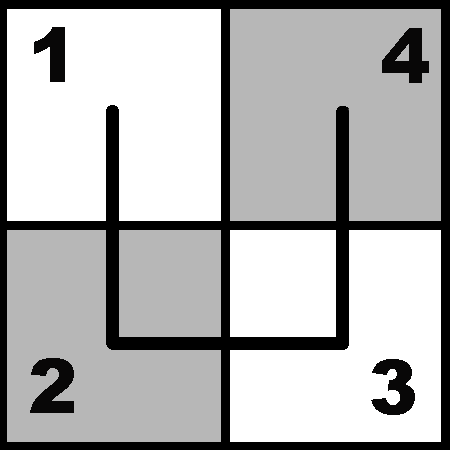
- Memory
- Overall Story Signpost 1
The townspeople have different recollections of the Radley family’s history; Scout describes her cook, the maternal figure of her youth, “She had been with us ever since Jem was born, and I had felt her tyrannical presence as long as I could remember” (Lee, 1960, p. 6); Scout has no recollection of her mother who had died when she was two, but her brother does, “He remembered her clearly, and sometimes in the middle of a game he would sigh at length, then go off and play by himself behind the car-house” (Lee, 1960, p. 6).
- Overall Story Journey 1 from Memory to Subconscious
As an example of how the Objective Story progresses from Memory to the Subconscious, Atticus recollects with Uncle Jack the way Maycomb always reacts to conflict between blacks and whites, and the primitive anger that accompanies it:
I hope and pray I can get Jem and Scout through it without bitterness, and most of all, without catching Maycomb’s usual disease. Why reasonable people go stark raving mad when anything involving a Negro comes up, is something I don’t pretend to understand (Lee, 1960 p. 98);
As Dill leaves to go home “he evidently remembered he was engaged to me, for he ran back out and kissed me swiftly in front of Jem” (Lee, 1960, p. 61); and so forth. - Subconscious
- Overall Story Signpost 2
Atticus’s fear for the safety of his children and neighbors causes him to shoot a rabid dog, “‘I guess he decided he wouldn’t shoot till he had to, and he had to today’” (Lee, 1960, p. 109); on the subject of Mrs. Dubose, the children’s essential feelings are clear, “Jem and I hated her” (Lee, 1960, p. 110).
- Overall Story Journey 2 from Subconscious to Conscious
The lynch mob’s anger and determination to hang Tom Robinson is diffused when they stop to consider the innocent words of a child.
- Conscious
- Overall Story Signpost 3
Jem and Scout contemplate Calpurnia’s life outside of their home, “That Calpurnia led a modest double life never dawned on me. The idea that she had a separate existence outside our household was a novel one, to say nothing of her having command of two languages” (Lee, 1960, p.138); Link Deas asks Heck Tate to consider a change of venue for the trial to avoid trouble; and so forth.
- Overall Story Journey 3 from Conscious to Preconscious
Atticus asks Mayella to “‘consider this calmly-’” (Lee, 1960, p. 205) when she babbles on her testimony; The jury considers all the evidence before them, evidence that clearly rules out Tom Robinson guilt, yet they give into their racist impulses and sentence him to jail.
- Preconscious
- Overall Story Signpost 4
Jem’s response to the “guilty” verdict is to cry; In response to the news of Bob Ewell’s death, “For once in his life, Atticus’s instinctive courtesy failed him: he sat where he was” (Lee, p. 294); Scout’s reaction to seeing the man she has feared for so many years is to “run instinctively to the bed where Jem was sleeping…” (Lee, 1960, p. 298); and so forth.
Main Character
- Doing
- Main Character Signpost 1
Scout play acts with Jem and Dill; Scout acts as a tomboy when she tackles Walter Cunningham:
“Catching Walter Cunningham in the school yard gave me some pleasure, but when I was rubbing his nose in the dirt Jem came by and told me to stop” (Lee, 1960, p. 25). - Main Character Journey 1 from Doing to Obtaining
Scout’s growth from doing to obtaining is marked by how she reacts when provoked. When Cecil Jacobs calls Atticus a nigger-lover, she jumps him. When cousin Francis taunts her about her father defending Tom Robinson, Scout, “split my knuckle to the bone on his front teeth. My left impaired, I sailed in with my right…” (Lee, 1960, p. 93). By the end of Journey #1 she has achieved a bit more maturity as she tries to keep hold of her temper, “Scout’s got to learn to keep her head and learn soon, with what’s in store for her these next few months. She’s coming along, though. Jem’s getting older and she follows his example a good bit now” (Lee, 1960, p. 97).
- Obtaining
- Main Character Signpost 2
Scout has acquired and put to use curse words in hopes of obtaining her father’s permission to drop out of school, “I was proceeding on the dim theory, aside from the innate attractiveness of such words, that if Atticus discovered I had picked them up at school he wouldn’t make me go” (Lee, 1960, p. 87).
- Main Character Journey 2 from Obtaining to Learning
Scout acquires information that puts her father’s actions into perspective, even though she still doesn’t quite understand it:
This was news, news that put a new light on things: Atticus had to, (defend Tom Robinson) whether he wanted to or not. I thought it odd that he hadn’t said anything to us about it-we could have used it many times in defending him and ourselves. (Lee, 1960, p. 180) - Learning
- Main Character Signpost 3
Scout learns what she can from her older brother, ...“everything he read he passed along to me, but with this difference: formerly, because he thought I’d like it; now, for my edification and instruction” (Lee, 1960, p. 152); she experiences what it is like to visit a different church and congregation; she learns more about the “Finch Family” from Aunt Alexandra; she learns what rape is from her father; and so forth.
- Main Character Journey 3 from Learning to Understanding
Scout contemplates her recent experiences and believes there is not much more about life she need understand, “As I made my way home, I felt very old…I thought Jem and I would get grown but there wasn’t much else left for us to learn, except possibly algebra” (Lee, 1960, p. 308).
- Understanding
- Main Character Signpost 4
Scout cannot comprehend how her teacher can hate Hitler for persecuting the Jews, yet countenance the townspeople’s racist attitude toward the Negro community; Scout can’t understand people bitterly opposing Atticus for defending a Negro-and looking askance upon the “bad example” he is setting for his children-yet re-electing him to the state legislature without any opposition; Scout appreciates that Jem is growing to be a man; and so forth.
Influence Character
- Being
- Influence Character Signpost 1
Boo Radley appears to the townspeople to be:
...a malevolent phantom. People said he existed but Jem and I had never seen him. People said he went out at night when the moon was high, and peeped in windows. When people’s azaleas froze in a cold snap, it was because he had breathed on them. Any stealthy crimes committed in Maycomb were his work. (Lee, 1960, p. 9) - influence Character Journey 1 from Being to Becoming
Boo’s impact on the children changes from them looking at him as being a horror locked away from the light of day to becoming a strange and curious friendly spirit:
“...he’s crazy, I reckon, like they say, but Atticus, I swear to God he ain’t ever harmed us, he ain’t ever hurt us, he coulda cut my throat from ear to ear that night but he tried to mend my pants instead”...It was obvious that he had not followed a word Jem said, for all Atticus said was, “You’re right. We’d better keep this and the blanket to ourselves. Some day, maybe, Scout can thank him for covering her up.” “Thank who?” I asked. “Boo Radley. You were so busy looking at the fire you didn’t know it when he put the blanket around you.” My stomach turned to water and I nearly threw up. (Lee, 1960, pp. 79-80) Once Jem realizes Boo is the one leaving gifts for the children, he is able to overcome his fear of Boo and decides to write him a thank you note to continue this new line of communication, ”’ Dear sir,’ said Jem. ‘We appreciate the-no, we appreciate everything which you have put into the tree for us. Your very truly, Jeremy Atticus Finch’” (Lee, 1960, p. 68). - Becoming
- Influence Character Signpost 2
Although the children still think of Boo as a frightening phantom, his actions have transformed him into more of a friendly ghost than an evil apparition ready to cause them harm.
- Influence Character Journey 2 from Becoming to Conceiving
As Boo becomes more human in the children’s eyes, they cannot conceive of why he has remained in what must be a miserable existence:
“‘Why do you reckon Boo Radley’s never run off?’ Dill sighed a long sigh and turned away from me. ‘Maybe he doesn’t have anywhere to run off to…’” (Lee, 1960, p. 159). - Conceiving
- Influence Character Signpost 3
The children spend countless hours devising ways to meet Boo Radley:
Dill had hit upon a fool-proof plan to make Boo Radley come out at no cost to ourselves (place a trail of lemon drops from the back door to the front yard and he’d follow it like an ant). (Lee, 1960, p. 159) - Influence Character Journey 3 from Conceiving to Conceptualizing
Up until Scout and Jem are really in danger, the ideas Boo has come up with to make friends with the children have left his identity ambiguous. Once he sees Bob Ewell terrorizing them, he devises and implements a plan to save them, that in turn reveals to the children the man who has watched over them for many years.
- Conceptualizing
- Influence Character Signpost 4
Boo has the idea “his” children are in danger and comes up with a way to protect them.
Relationship Story
- Future
- Relationship Story Signpost 1
Scout fears Boo Radley and believes if she comes into contact with him (an event Jem and Dill attempt to make come about) she will have no future, “‘You all’ve gone crazy, he’ll kill us’” (Lee, 1960, p. 52).
- Relationship Story Journey 1 from Future to ProgressAs Scout grows up and continues to mature, she tires of teasing Boo, "...when I was well into the second grade at school and tormenting Boo Radley became passe..." (Lee, 1960, p. 110)
- Progress
- Relationship Story Signpost 2
Scout and Boo’s relationship advances in a positive way when Boo takes steps to protect the child. Although she does not realize it until after the fact, Boo has covered her with a blanket to keep the chill of while she watches Miss Maudie’s house burn.
- Relationship Story Journey 2 from Progress to Present
Scout and Boo’s relationship progresses when Scout stops placing so much importance on her fear of the bogey man across the street and concentrates on what is happening in school and her family’s role in the Tom Robinson trial.
- Present
- Relationship Story Signpost 3
As Scout begins to understand how things stand with Boo in the Radley household, she is more sympathetic toward him.
- Relationship Story Journey 3 from Present to Past
The circumstances between Scout and Boo slowly changes over the course of the story, however, the situation of their not making contact as friends changes in Journey #3 when Boo saves Scout’s and her brother’s life. It is at this time that Scout is able to put her fear of Boo in the past, and Boo is able to venture out of the house that has kept him an emotional prisoner.
- Past
- Relationship Story Signpost 4
Scout thinks back to how she has treated Boo in the past:
I sometimes felt a twinge of remorse, when passing by the old place, at ever having taken part in what must have been sheer torment to Arthur Radley-what reasonable recluse wants children peeping through his shutters, delivering greetings on the end of a fishing pole, wandering in his collards at night? (Lee, 1960, p. 267)
Plot Progression Visualizations
Dynamic Act Schematics
OS:  MC:
MC:  IC:
IC:  RS:
RS: