The Sun Also Rises
Comprehensive Storyform
The following analysis reveals a comprehensive look at the Storyform for The Sun Also Rises. Unlike most of the analysis found here—which simply lists the unique individual story appreciations—this in-depth study details the actual encoding for each structural item. This also means it has been incorporated into the Dramatica Story Expert application itself as an easily referenced contextual example.
Story Dynamics
8 of the 12 essential questions
- Steadfast
- Main Character Resolve
Jake remains steadfast in his desire for Brett.
- Stop
- Main Character Growth
The audience is waiting for Jake to stop obsessing over Brett.
- Do-er
- Main Character Approach
Jake first looks for a physical solution when faced with a problem. For example, when Robert Cohn insults him, he throws a punch:
“At the Cafe Suizo we had just sat down and ordered Fundador when Robert Cohn came up. ‘Where’s Brett?’ he asked. ‘I don’t know.’ . . . ‘I’ll make you tell me’—he stepped forward—‘You damned pimp.’ I swung at him and he ducked” (Hemingway 190-91). - Male
- Main Character Mental Sex
Jake is goal oriented, as exemplified by his focus on the possibility of winning Brett. He doesn’t see the big picture—that is, he can’t see that his physical impairment will never change and that she will never be able to accept it. He tries to pull it all together by always being available to her and her needs, and by continually pleading with her to stay with him.
- Decision
- Story Driver
The decision the objective characters make to go to Pamplona for the festival of the bulls precipitates the action that follows. During the week’s frantic festivities, events come to a head. For example, Brett takes up with the young bullfighter, Romero, and ultimately leaves town with him; Robert Cohn, pugnacious and wildly jealous, hits Jake and Mike and beats up Romero.
- Optionlock
- Story Limit
In the end, most of the objective characters have run out of options. They had been drifting from “pillar to post” attending boring and repetitive social functions. After the frenetic activities of the fiesta, they come to the end of the road and are just as morally empty and disillusioned as ever.
- Failure
- Story Outcome
The objective characters fail to find meaning and fulfillment in their lives. This failure is particularly well depicted in the character of Lady Brett Ashley. She changes her amoral ways and begins to acquire a conscience, but her potential for peace and contentment will always remain unfulfilled:
It is unclear whether or not Jake’s insights and Brett’s final moral act give meaning to the lives of these exiles. During their Bayonne fishing trip, Jake’s friend Bill Gorton sings a song about “pity and irony,” and that seems to be the overall tone of the book, and especially the ending: pity for the personal anguish and aimless searching of these people, but ironic detachment toward characters whose lives and situations are, at best, at least as comical as they are tragic. (Neilson 6350) - Good
- Story Judgment
Jake Barnes resolves his personal angst:
“Jake nobly accepts his tragic condition” (Meyers 460). He embodies Hemingway’s famous phrase, “Grace under pressure” (Meyers 189).
Overall Story Throughline
""Running with the Bulls""
- Physics
- Overall Story Throughline
The action is fragmented and jerky. All of the characters are constantly hopping from place to place in an aimless pattern—from bar to bar, from France to Spain, in taxis and trains, limousines and cars. No longer willing or able to stay in one place, they are transients seeking escape through frivolous diversions.
- Understanding
- Overall Story Concern
An example of how the objective characters are concerned with “understanding” is illustrated in the minor character of the count: “I have been around a very great deal. . . . I have seen a lot, too. I have been in seven wars and four revolutions . . . it is because I have lived very much that now I can enjoy everything so well . . . . That is the secret. You must get to know the values” (59-60). Brett asks: “Doesn’t anything ever happen to your values?” The count replies: “No, not anymore” (61). Another example is illustrated by the character of Mike Campbell. He chooses not to learn about finances, because he understands what he can get away with by not doing so. He appreciates that his allowance will continue to come through, and that there will always be an “easy touch” wherever he goes. There is also a strong implication that he knows Brett will eventually be back: “She never has any money. . . .She gave it all to me when she left” (230).
- Conditioning
- Overall Story Issue
The objective characters, although appearing aimless, ineffectual, and powerless, in reality are engaging in senseless destruction, and they do violent damage to themselves and others. This is a throwaway society that relentlessly consumes one another and everyone else in their path—and later discards the leftovers. Most of them have readily, although unwillingly, adapted themselves to the postwar climate of permissiveness, the new affluence, and the aimless pursuit of pleasure. (Norton 862)
- Instinct
- Overall Story Counterpoint
World War I swept away the societal values intrinsic to the objective characters’ way of living.
- Overall Story Thematic Conflict
Conditioning vs.InstinctThe objective characters’ innate instincts, necessary for moving within a rigid social structure, are deadened by WWI, and adapting themselves to the postwar climate only serves to hinder them in the quest for finding meaning in their lives: “As in all of Hemingway’s important fictions, The Sun Also Rises is a novel of education—of learning to live with conditions faced” (Neilson 6348).
- Projection
- Overall Story Problem
As an example of “projection” as the source of the objective story’s problems, Robert Cohn goes to Pamplona anticipating taking up with Brett and further developing a relationship. He bases this inference on a brief fling they had had in San Sebastian. The inferences he has made cause problems for the group, illustrated by Mike Campbell’s cutting remarks: “Do you think Brett wants you here? Do you think you add to the party?” (Hemingway 177)
- Speculation
- Overall Story Solution
An example of the solution of “speculation” is the possibility of Robert Cohn returning to his ex-fiancee, Frances Clyne.
- Inertia
- Overall Story Symptom
Most of the objective characters have a tendency to continue to focus on their own petty needs. For example, Mike Campbell continues to drink and overspend:
“What shall we do about the car?” Bill asked.
“Oh, bother the car,” Mike said. “Let’s just keep the car with us.”
“All right,” Bill said. “Where shall we go?”
“Let’s go to Biarritz and have a drink.”
“Old Mike the spender,” Bill said. (Hemingway 229-30) - Change
- Overall Story Response
An example of how the efforts to remedy the problem’s symptoms of “inertia” are directed toward “change” is illustrated in the scene where Robert Cohn, desperate to win Brett, “massacred the poor, bloody bull-fighter”:
“What happened finally?”
“It seems the bull-fighter fellow was sitting on the bed. He’d been knocked down about fifteen times, and he wanted to fight some more. Brett held him and wouldn’t let him get up. He was weak, but Brett couldn’t hold him, and he got up. Then Cohn said he wouldn’t hit him again. Said he couldn’t do it. Said it would be wicked. . . . You know I don’t think Cohn will ever want to knock people about again.” (Hemingway 202-203) - Instinct
- Overall Story Catalyst
The catalyst of “instinct” is embodied in the character of Lady Brett Ashley. It is her acting on her sexual impulses, in particular with Robert Cohn and Pedro Romero, that accelerates the objective story.
- Prediction
- Overall Story Inhibitor
Jake has no way of predicting that by bringing together all his friends in Pamplona conflict would be caused, thereby slowing the objective story’s progress.
- Learning
- Overall Story Benchmark
The objective characters have great difficulty in pursuing their goals. Their efforts toward this end are applied in non-productive ways. They go about attempting to acquire the knowledge necessary to achieve their goals in haphazard, unfocused ways, thus they lack the tools to understand their world and continue to drift along in ignorance.
- Overall Story Throughline Synopsis
The characters expend what energy they have (albeit languidly) drifting from bar to bar, from town to country and back again. Cut off from the highly structured and well defined social order of pre World War I, they are all trying to get away from themselves and they are not succeeding. They form a very loose knit “family” of sorts—a highly dysfunctional one at that. Although they are all part of a group, they are, in reality, isolated from each other.
- Overall Story Backstory
The conclusion of World War I had brought an end to an orderly, predictable, and grounded way of life. All reassuring social values had been irretrievably lost, leaving the characters drained of emotion and suffering from physical and psychological wounds. “They have all been damaged in some fundamental way by the war . . . and their aimless existence can be traced back to it” (Neilson, p. 6348).
Additional Overall Story Information →
Main Character Throughline
Jake Barnes — Journalist
- Universe
- Main Character Throughline
Jake Barnes perceives himself to be in an intolerable situation. His physical condition is not going to change, and he sees it as an insurmountable obstacle to his future happiness.
- Past
- Main Character Concern
The past, in particular the physical damage he incurred in WWI, is always at the forefront of Jake’s mind.
- Prediction
- Main Character Issue
An example of Jake’s thematic issue of “prediction” is illustrated during the fiesta. Montoya enlists Jake’s help in protecting Pedro Romero from Brett:
“Look,” he said. “I’ve just had a message from them [America ambassador] that they want Pedro Romero . . . to come over for coffee to-night after dinner.” Montoya stood embarrassed. He wanted me to say something.
“Don’t give Romero the message,” I said.
“You think so?”
“Absolutely.”
Montoya was very pleased. . . . “Look,” said Montoya. “People take a boy like that.” “They don’t know what he’s worth.” “They don’t know what he means.” “Any foreigner can flatter him.” (Hemingway 172) - Interdiction
- Main Character Counterpoint
Jake’s thematic counterpoint of “interdiction” is explored when Jake unwittingly hinders Romero’s future (at Brett’s insistence), by introducing Pedro to her:
Just then Montoya came into the room. He started to smile at me, then he saw Pedro Romero with a big glass of cognac in his hand, sitting laughing between me and a woman with bare shoulders, at a table full of drunks. He did not even nod. (Hemingway 177) - Main Character Thematic Conflict
Prediction vs.InterdictionThe thematic conflict between “prediction” and “interdiction” is illustrated when Jake betrays his own ethics by making it possible for Brett to meet Romero, and then by leaving them completely alone:
When I came back and looked in the cafe, twenty minutes later, Brett and Pedro Romero were gone. The coffee-glasses and our three empty cognac glasses were on the table. (Hemingway 187)
As an aficionado, Jake can foresee that foreigners can corrupt the purity of Pedro Romero, yet because of Jake’s love for Brett, he interferes with the bullfighter’s destiny by arranging Brett’s affair with the young man. “His betrayal and his failure to adhere to his own ethical standards demonstrate that Jake is a flawed and very human male, despite his wound and despite his attempt to remake himself into a gentle stoic” (Carey 61-62). - Actuality
- Main Character Problem
Jake is driven by the reality of his physical impotence:
“At one time or another I had probably considered it from most of its various angles, including the one that certain injuries or imperfections are a subject of merriment while remaining quite serious for the person possessing them” (Hemingway 27). - Perception
- Main Character Solution
To resolve Jake’s problem of dealing with the harsh reality of his impotence, he must shift his point of view to one with which he is more comfortable.
- Inertia
- Main Character Symptom
To avoid facing his own problem, Jake focuses on maintaining the status quo among his friends, which causes him difficulties: “His own private tragedy was a war wound that had emasculated him so that he could not marry Lady Brett Ashley . . . .So as not to think too much about himself, Jake spent a lot of time listening to the troubles of his friends and drinking heavily” (Neilson 6346).
- Change
- Main Character Response
Jake directs his efforts toward changing his continued tolerance of his friends. As an example: “In the beginning, Jake feels that Cohn is “nice and awful,” but tolerates and pities him as a case of “arrested development.” By the end of the book, he thoroughly hated him” (Neilson 6348-9).
- Fate
- Main Character Unique Ability
At this particular point in time, Jake is unable to understand his fate, and because of this, he is unable to help his compatriots with their own search for understanding. Therefore, he fails in solving both the objective and subjective problems.
- Senses
- Main Character Critical Flaw
“Senses” undermine Jake Barnes’ efforts:
In the novel, Hemingway meant Jake, rather improbably, to have his penis rather than his testicles shot off—so there would be no humiliating hormonal changes and he would still be “capable of all normal feelings as a man but incapable of consummating them” (Meyers 190). - Present
- Main Character Benchmark
Jake judges the degree of his concern of the past based on the current situation and circumstances.
- Main Character Description
“Jake Barnes—a modern Abelard—is wounded and impotent yet stoic and admirable” (Meyers 460).
- Main Character Throughline Synopsis
Jake Barnes’ devastating war wounds have left him grappling with horrific psychological traumas. He is desperately trying to recenter himself and to completely accept this permanent condition. His “stoicism, and natural grace under pressure” (Encyclopedia of Lit. 1079) make him stand out from the other characters, with their myriad flaws and very limited emotional capabilities. It is paradoxical that “His physical flaw makes him a more rounded character than most other Hemingway heroes.” (Encyclopedia of Lit. 108). This flaw is also appealing to Brett, because it makes him unattainable in her eyes; thus he can function as her confidant, sounding board, and pimp. He is a safe haven for her. If Jake had been physically whole, Brett would surely have destroyed him. Ironically, his physical condition actually saves him, although he doesn’t realize it at the time.
- Main Character Backstory
Jake Barnes is an American journalist living in Paris. He has been left permanently impotent by a wound received in WWI.
Additional Main Character Information →
Influence Character Throughline
Lady Brett Ashley — Idle socialite
- Mind
- Influence Character Throughline
Brett Ashley is unwavering in her determination to keep Jake at physical and emotional arm’s length. She will not ever change her mind about the state of their relationship, not even when Jake continually pleads with her. Although it seems to be very difficult for her, she stands fast against his emotional entreaties, knowing in her heart that she would surely destroy him if they did get together.
- Memory
- Influence Character Concern
Brett’s impact on men is such that they cannot forget her.
- Evidence
- Influence Character Issue
Brett’s range illustrates the thematic impact of evidence, in that Brett’s reputation as a man-eater is substantiated throughout the story.
- Suspicion
- Influence Character Counterpoint
If a man is attracted to Brett, he puts aside any suspicions that she may destroy him.
- Influence Character Thematic Conflict
Evidence vs.Suspicion“What do you know about Lady Brett Ashley, Jake?”
“She’s a drunk,” I said. “She’s in love with Mike Campbell, and she’s going to marry him. He’s going to be rich as hell some day.”
“I [Robert Cohn] don’t believe she would marry anybody she didn’t love.”
“Well, I said.” “She’s done it twice.”
“I don’t believe it.”
“Well, I said, don’t ask me a lot of fool questions if you don’t like the answers.” (Hemingway 38-39) - Projection
- Influence Character Problem
Despite Brett’s love for Jake, and her numerous affairs, it is probable that she will marry Mike Campbell:
“You are a rotten dancer, Jake. Michael’s the best dancer I know”. . . . “I’m going to marry him,” Brett said. “Funny. I haven’t thought about him for a week.” (Hemingway 62)
“I’m going back to Mike . . . he’s so damned nice and he’s so awful. He’s my sort of thing” (Hemingway 243) - Speculation
- Influence Character Solution
Brett does not employ “speculation” to satisfy her personal drive:
Pedro is not destroyed because Brett sends him away before she can do any damage. More than simple altruism is involved in her decision. Life with Pedro held the possibility of wholeness for her—as it held the possibility of dissipation for him. By sending him away rather than risk damaging him, she relinquishes her last chance for health and happiness. - Equity
- Influence Character Symptom
Brett’s focus on being fair to Jake by refusing to lead him on, creates problems for Jake, as he desperately wants a relationship with her.
- Inequity
- Influence Character Response
The direction Brett takes, to remedy the difficulties created by her attempts at being fair to Jake, is to throw him off balance in hopes he will finally understand they cannot be together. One way she accomplishes this is by pressuring him to arrange an introduction with a man he knows she would like to take as a lover:
“I say, Jake,” Brett called from the next table. “You have deserted us.”
“Just temporarily,” I said. “We’re talking bulls.”
. . . “You might introduce your friends,” Brett said. She had not stopped looking at Pedro Romero. (Hemingway 175) - Truth
- Influence Character Unique Ability
Brett is truthful about herself and honest about her relationships with other men. Her honesty should compel Jake to face the fact that they will never be together, but he continues to ignore this.
- Situation
- Influence Character Critical Flaw
The situation of being financially dependent upon others, alcoholic, and promiscuous, undermines Brett’s efforts to lead a meaningful existence.
- Conscious
- Influence Character Benchmark
The more Jake sidesteps the unpleasant truth Brett is trying to show him, the closer Brett draws to the inevitable conclusion that they cannot be together.
- Influence Character Description
Brett was “damned good looking.” She wore a slipover jersey sweater and a tweed skirt, and her hair was brushed back like a boy’s. She started all that. She was built with curves like the hull of a racing yacht, and you missed none of it with that wool jersey. (Hemingway 22)
- Influence Character Throughline Synopsis
Brett Ashley is an alcoholic nymphomaniac. She is admired and pursued by all kinds of men. She ruthlessly and systematically pursues those in whom she has a prurient and financial interest. She keeps retreating to Jake, who offers solace and non-judgmental support. She is bored and world weary and will do anything to distract herself from her senseless world: “I’ve always done just what I wanted” (Hemingway 184). She has a clarity of vision when it comes to her relationship with Jake—something he has yet to see. He is the only man she can’t and will not knowingly destroy, which actually lends her a certain kind of redemptive grace. “Don’t we pay for all the things we do, though?. . . When I think of the hell I put chaps through. I’m paying for it all now” (Hemingway 26).
- Influence Character Backstory
Brett Ashley’s “own true love” had died of dysentery during the war and she had then married the aristocratic Ashley. Mike Campbell gives Jake some insight into Brett’s marriage to Ashley: “Ashley, chap she got the title from . . . ninth baronet . . . always made Brett sleep on the floor . . . when he got really bad, he used to tell her he’d kill her. Always slept with a loaded service revolver . . . She hasn’t had an absolutely happy life . . .” (Hemingway 203) While serving as a hospital volunteer during the war, Brett had met Jake, who was there recovering from war wounds. He has been irrevocably in love with her ever since. Brett is currently engaged to Mike Campbell while awaiting the finalization of her divorce from Ashley.
More Influence Character Information →
Relationship Story Throughline
""Isn't it Pretty to Think So?""
- Psychology
- Relationship Story Throughline
Brett Ashley is a consummate manipulator of everyone—both men and women. Although she loves Jake, (as much as she is able to love anybody), she clearly manipulates him and uses him throughout the story. She plays upon his great love for her (which he allows) to gain sympathy, unconditional love, and emotional support.
- Conceptualizing
- Relationship Story Concern
In the subjective story, Jake’s goal is to find fulfillment in a life with Brett. He envisions an idyllic existence with her, but she in turn knows herself so well that she is accurately able to paint a picture of what it would be like, and it would not be good for either of them.
- Sense of Self
- Relationship Story Issue
Jake and Brett are each affected by their own poor self image which does not allow for a healthy relationship. Although their negative sense of self is felt thematically throughout the story, an explicit example of its repercussions is found “When Jake presents Brett to Pedro, fully understanding the implications of his act, he violates Montoya’s trust. Through his frustrated love for Brett, Pedro is exposed to her corrupting influence.” (Neilson 6350)
- State of Being
- Relationship Story Counterpoint
Brett’s self image is very close to her state of being, whereas Jake’s perception of himself is different from his essential nature. This thematic counterpoint underscores the improbability of their relationship:
Hemingway shows war wounds as the destroyer of love: Jake pursues love without sex and Brett pursues sex without love. The author states: ” [ So I ] tried to find out what his problems would be when he was in love with someone who was in love with him and there was nothing that they could do about it” (Meyers 190). - Relationship Story Thematic Conflict
Sense of Self vs.State of BeingAs an example of how the conflict between “sense of self” and “state of being” is explored in the subjective story, Jake’s self image is that of a flawed individual. Brett’s self image is one of a man destroyer. Jake’s state of being is that of a good, kind man who is always looking out for his friends. Brett’s state of being is actually quite close to her sense of self. Brett knows that Jake is a good and kind individual. She also knows that his physical flaw will always stand in the way of their potential happiness. Jake perceives Brett as one who is searching for something in her meaningless affairs, and he feels that if she would only settle down with him, she would find meaning. She, on the other hand, knowing herself so well, refuses to do so because she doesn’t want to hurt him.
- Projection
- Relationship Story Problem
It is a problem for Jake and Brett that a future for their relationship is improbable:
“Don’t you [Brett] love me?”
“Love you? I simply turn all to jelly when you touch me.”
“Isn’t there anything we can do about it?”
She was sitting up now. My arm was around her and she was leaning back against me, and we were quite calm. . . .
“And there’s not a damn thing we could do,” I [Jake] said. (Hemingway 34) - Speculation
- Relationship Story Solution
The love affair between Jake and Brett is a doomed one, however, they are able to diminish their conflict using “speculation”:
Could they have been happy? Jake says that it’s “pretty to think so,” knowing full well that sex would only have eased them into a beginning of God-knows-what. Brett suggests that sex would have been terribly good between them and would have served them well but Jake does not accept this conjecture. It’s only a game, this speculating, and it is, in a sense, comforting, but it has nothing to do with reality. (Carey 60) - Ability
- Relationship Story Symptom
The principal symptom of the difficulties between Jake and Brett is their inability to have a sexual relationship.
- Desire
- Relationship Story Response
The direction Jake and Brett take to remedy the difficulties created by their inability to engage in a sexual relationship is to attempt to stifle their mutual desire:
“And there’s not a damn thing we could do,” I said.
“I don’t know,” she said. “I don’t want to go through that hell again.”
“We’d better keep away from each other.”
“But, darling, I have to see you.” “It isn’t all that you know.”
“No, but it always gets to be.” (Hemingway 26) - State of Being
- Relationship Story Catalyst
The conflict between Jake and Brett accelerates when their very different essential natures are tested by her continued affairs.
- Evidence
- Relationship Story Inhibitor
Evidence of Brett’s promiscuity impedes Jake and Brett’s relationship:
“I haven’t seen you since I’ve been back,” Brett said.
“No.”
“How are you, Jake?”
“Fine.”
Brett looked at me. “I say,” she said, “Is Robert Cohn going on this trip?”
“Yes.” “Why?”
“Don’t you think it will be a bit rough on him?”
“Why should it?”
“Who did you think I went down to San Sebastian with?”
“Congratulations,” “I said. . . . “You might take up social service.”
“Don’t be nasty.” (Hemingway 83-84) - Conceiving
- Relationship Story Benchmark
The more Brett continues her dalliances, the more inconceivable the possibility of a more meaningful relationship between herself and Jake.
- Relationship Story Throughline Synopsis
Brett and Jake are engaged in a game neither will win. Brett loves Jake, but makes it clear to him that he can never have her because of his permanent sexual impotence and her flagrant promiscuity. Jake desperately keeps trying to convince her that they could make a life together—to no avail.
- Relationship Story Backstory
Jake Barnes had been rendered permanently sexually impotent from wounds sustained during the War. While in a hospital in England, he had met and fallen in love with Brett Ashley, who was a volunteer: “She was a V.A.D. in a hospital I was in during the war” (Hemingway 38).
Additional Relationship Story Information →
Additional Story Points
Key Structural Appreciations
- Understanding
- Overall Story Goal
The Sun Also Rises is a short novel that takes place in Paris and Spain after World War I. It concerns a group of American and English expatriates’ search for meaning and fulfillment in a world which no longer seems to have any values.
- Conceptualizing
- Overall Story Consequence
In the objective story, failing to conceptualize how to make sense of their lives is the consequence. Jake must envision a life without Brett, and most of the other characters are unable to visualize, much less implement, any sort of a specific plan for enriching their own lives.
- Memory
- Overall Story Cost
The memory of World War I and what it did to most of the characters lives causes them to try and forget. In attempting to blot out their recollections, they engage in negative and destructive behaviors and interactions. The price they must pay for these actions is the failure to find meaning and moral values in their lives. As Jake said: “The bill always came” (146).
- Past
- Overall Story Dividend
Jake and Brett have reevaluated their pasts. Jake will ultimately benefit from not being able to stay with Brett although he doesn’t realize it yet. Late in the game Brett manages to acquire the beginnings of a conscience. She is starting to understand that she’s not good for the likes of Jake or Romero but that the bankrupt and alcoholic Mike is someone she can’t do damage to because they are already so alike. Romero really won’t suffer much from his past experience with Brett, in fact he undoubtedly has gained a new found maturity. As for the count, his is the voice of reason and experience. After a lifetime of searching, he can truly enjoy and value the positive benefits he has acquired. “That is the secret. You must get to know the values” (60).
- Learning
- Overall Story Requirements
Jake is starting to move beyond merely accepting his impotence, to learning to accept that because of it he can never have Brett. Furthermore, he needs to realize that she would actually be bad for him. Brett knows that she is very damaging to men and is in the early stages of doing something about it. Cohn is in the process of moving beyond self-important “playboy” and hothead nuisance and perhaps might even return to the prosaic Frances. Romero has experienced the passion of a fling with an older sophisticated woman and this affair makes him realize that his first passion, bullfighting, would have suffered irreparably had he stayed with Brett. Mike Campbell chose long ago to keep himself in a forgetful state.
- Conceiving
- Overall Story Prerequisites
The objective characters need to devise ways to learn how to put meaning back in their lives.
- Conscious
- Overall Story Preconditions
As an example of how the “conscious” acts as a tacked on contingency to attaining the goal of “understanding,” the gang at Pamplona attempt to make Cohn consider his boorish behavior, so that he’ll either change or leave.
- Present
- Overall Story Forewarnings
Just before the fiesta, it is quiet in Pamplona, yet Jake has “a feeling of things coming that you could not prevent happening” (146). At this moment “the fiesta exploded” (152). And: “The things that happened could have only happened during a fiesta” (154).
Plot Progression
Dynamic Act Appreciations
Overall Story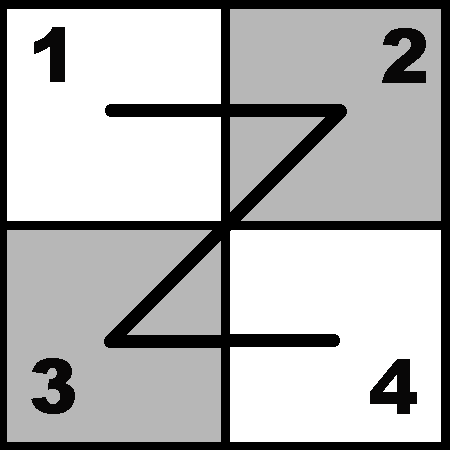
- Understanding
- Overall Story Signpost 1
Jake Barnes understands Robert Cohn: [He] “was married to the first girl who was nice to him. . . . [after his divorce] he had been taken in hand by a lady [Frances] . . . . She was very forceful” (5). Frances Clyne believes she understands Robert Cohn even better: “He’s decided to go back to New York alone, and be there when his book comes out so when a lot of little chickens like it . . . . You don’t know him like I do, Jake . . . . He wants to have a big triumph this fall all by himself” (48). Frances understands Robert’s reluctance to marry her: “Why, you see, Robert’s always wanted to have a mistress, and if he doesn’t marry me, why, then he’s had one” (51). After Cohn returns from a successful publishing mission in New York, Jake comments: “I think that was where Frances lost him, because several women were nice to him . . . he realized that he was an attractive quantity to women, and that the fact of a woman caring for him and wanting to live with him was not simply a divine miracle. This changed him so that he was not so pleasant to have around” (8-9).
- Overall Story Journey 1 from Understanding to Doing
Frances Clyne, comprehending that Cohn has rejected her, accepts his money to leave Paris. Brett, understanding perfectly how Jake feels about her, tells Jake only that she is going out of town, but doesn’t let him know it is with Robert Cohn.
- Doing
- Overall Story Signpost 2
Jake goes to the races and dines with friends. When Bill Gorton arrives, they walk and taxi all over Paris, eating and drinking and attending the fights. Mike Campbell comes into town and does a lot of talking and drinking.
- Overall Story Journey 2 from Doing to Obtaining
Robert Cohn goes to San Sebastian with Brett. He refuses to believe “. . . it didn’t mean anything” (181). Later, in a jealous rage, he punches out Jake and Mike and beats up Romero. Finally, he realizes he can never have Brett so he leaves for good, taking with him the memory that “he had been away with her . . . . They could not take that away from him” (146). Mike Campbell generally gets drunk, and enjoys taunting Cohn: “Why did you follow Brett around like a poor bloody steer?” (142) Mike knows that she’ll eventually come back to him, like she always has. When Pedro Romero firsts meets Brett, he feels that there is something between them. When Cohn hits him after finding out Brett had been in his hotel room, Romero retaliates. In the bull ring, he performs beautifully. “It was only perfect bull-fighting” (217). After the performance he leaves on the train with Brett.
- Obtaining
- Overall Story Signpost 3
Brett, Bill, Mike, and Cohn all acquire firsthand knowledge of bullfighting. Romero achieves mastery over the bull. Brett wants to possess Romero: “Oh, isn’t he lovely, and those green trousers . . . how old do you suppose he is?” (165, 167) Mike Campbell remarks on Brett losing her usual composure: “I believe, you know, that she’s falling in love with this bullfighter chap” (168).
- Overall Story Journey 3 from Obtaining to Learning
Robert Cohn leaves Pamplona with the knowledge that he will never be able to possess Brett or anyone else like her. “What do you suppose he’ll do?” (222) Mike Campbell hasn’t any more money, but he has long ago learned that his allowance will always come through and that there are always “easy touches” wherever he goes. Although he does feel badly that Brett has gone off yet again, he has learned through experience that most likely she will be back. Pedro Romero, having possessed Brett and taken her away, realizes that she is not good for his career. At first he tries to make her over, then agrees to let her go after she herself sees that she is no good for him.
- Learning
- Overall Story Signpost 4
Mike Campbell chooses not to learn about finances: “One never gets anywhere by discussing finances” (230). Pedro Romero has learned that Brett’s type is not good for his bullfighting career and that her sort could never be controlled.
Main Character
- Present
- Main Character Signpost 1
Jake Barnes is an American journalist living and working in Paris. He is hopelessly in love with Lady Brett Ashley, but because of his impotence, it appears that he can’t have her.
- Main Character Journey 1 from Present to Past
Jake’s current situation is that of a relaxed gentleman journalist-about-town. He has affable (for the most part) interactions with all of his friends and enjoys tennis, dinner parties, dancing, and gossiping with them. But when Brett Ashley comes to town he loses his hard won composure, and emotionally regresses: “Probably I never would have had any trouble if I hadn’t run into Brett when they shipped me to England. I suppose she only wanted what she couldn’t have” (31).
- Past
- Main Character Signpost 2
Jake has been coming to the Hotel Montoya in Pamplona for several years and enjoys renewing his friendship with all of the locals. It is important to note that when Jake goes fishing in Burguete before the fiesta, he forgets his agitated past and simply enjoys living in the moment, relaxing and enjoying simple, healthy pleasures. This also holds true after the fiesta when he goes to San Sebastian for much needed rest and relaxation. Complicated emotional issues are left behind, and he seems to let nature take over and heal his body and spirit.
- Main Character Journey 2 from Past to Progress
Just as the fiesta moves forward quickly, Jake and Brett’s situation escalates. Jake has had to absorb the twin blows of Brett’s brief fling with Cohn and her departure with Romero. By the time he sees her again in Madrid he has started to progress to the realization that, like it or not, he will always only be friend to her, albeit a very close and loyal one.
- Progress
- Main Character Signpost 3
Jake comments on the acceleration of the fiesta’s mood. After a calm and relaxing day around town he finishes by saying: “That was the last day before the fiesta” (151). The next morning: . . .“the fiesta exploded” (152). Rockets are set off and pipes and drums keep up a steady beat. Peasants flock into town along with high ranking officials and tourists by the car load. “The Cafe was like a battleship stripped for action” (153). Everything escalates to excess: singing, dancing and drinking. People stay up most of the night, things cost a great deal more and personalities start to get edgy and combative. The pace progresses considerably when the bulls are let loose in the street. A strong element of danger permeates every aspect of fiesta life. Jake begins to get involved in others’ volatile personal business. Nothing lets up: “. . . but all day and night the fiesta kept on” (169).
- Main Character Journey 3 from Progress to Future
After some badly needed rest and relaxation, Jake answers Brett’s summons in Madrid. This is the first time he does not plead his case. Although he drinks too much at lunch and Brett knows perfectly well why, he keeps his own counsel, knowing finally that there is no future (such as he would like it to be), with her.
- Future
- Main Character Signpost 4
Jake begins to finally understand that he will have no future with Brett.
Influence Character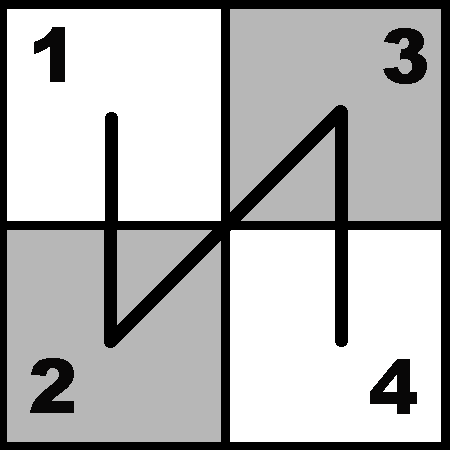
- Memory
- Influence Character Signpost 1
Brett Ashley recalls the way she has been treating men: “When I think of the hell I’ve put chaps through” (26). Referring to Jake’s war wound, she comments: “I laughed about it too, myself, once . . . It seemed like a hell of a joke” (26-7). Commenting on their previous frustrating attempt at a physical relationship, she tells Jake: “I don’t want to go through that hell again” (26). Brett says of the count: “He remembers everything that happened,” and adds: “Who’d want to?” (54)
- influence Character Journey 1 from Memory to Subconscious
Although Brett recalls with distaste the way she has been treating men, she continues to behave in the same manner towards them, following her basic overwhelming sexual drive.
- Subconscious
- Influence Character Signpost 2
Brett keeps dropping hints to Jake about San Sebastian. She wants him to ask with whom she went. She tells him that she was a fool to go away and that she didn’t have a “frightfully amusing” time. She says that she hardly saw anybody. “I never went out” (75).
- Influence Character Journey 2 from Subconscious to Preconscious
Brett’s strong drives keep her impulsive nature going. Her immediate response to Pedro Romero is one of overwhelming desire over which she has no control. “I’m mad about the Romero boy. I can’t help it. I’ve never been able to help anything . . . I can’t stop things” (183).
- Preconscious
- Influence Character Signpost 3
Brett’s impulsive and instinctive response to Pedro Romero is: “Oh, isn’t he lovely, and those green trousers. . . . And God, what looks” (165,168). Her immediate response to the horses being gored by the bull is: “I couldn’t help looking at them . . .I couldn’t look away, though . . .I didn’t feel badly at all” (165).
- Influence Character Journey 3 from Preconscious to Conscious
Brett makes a conscious decision to change her impulsive, thoughtless ways. She demonstrates her newfound sensibility by physically leaving Romero, and emotionally leaving Jake: “I made him [Romero] go. He shouldn’t be living with anyone” (241). She always has treated Jake with consideration; her parting gift of “We could have had such a damned good time together” (241) is clearly meant to try and make him feel better.
- Conscious
- Influence Character Signpost 4
Brett is fully aware of how she has treated men in the past. She is conscious of the fact that she might have ruined Romero, had she stayed. She knows she was really too old for him and that his compatriots heartily disapproved of her. Brett is aware that she would be less destructive by staying with Mike, since they are two of a kind. She also knows that Jake is drinking too much because of her, and assures him that he will be all right and survive.
Relationship Story
- Conceiving
- Relationship Story Signpost 1
Jake can’t conceive of living without Brett: “You don’t have to go” (34). “Couldn’t we live together, Brett? Couldn’t we just live together?” (55) Brett can’t conceive of living with Jake. “I don’t think so. I’d just tromper you with everybody. You couldn’t stand it” (55).
- Relationship Story Journey 1 from Conceiving to ConceptualizingBrett and Jake are operating at cross purposes. She has long ago arrived at the idea that she and Jake can't live together, while he feels that he can't live without her. When Brett comes back from San Sebastian, she is hopeful that Jake will ask with whom she had been. Having Jake find out, as painful as it might be, would, in her eyes, eliminate the problem of his continued hope. Jake, on his part, can still envision a future with Brett, so at this stage it is beneficial to him to remain ignorant of the facts.
- Conceptualizing
- Relationship Story Signpost 2
Jake still does not have any idea that Brett had gone to San Sebastian with Cohn. Brett seems to be hinting at it; it’s as if she were asking him to visualize it.
- Relationship Story Journey 2 from Conceptualizing to Becoming
Brett tells Jake that she had been away with Robert Cohn: “Didn’t you really know?” “No, I guess I didn’t think about it” (84). Later, Jake admits he had become: “. . . blind, unforgivingly jealous of what had happened to him” (99).
- Becoming
- Relationship Story Signpost 3
Jake observes Brett—seated on a wine cask with a wreath of garlic around her neck—as the personification of a pagan goddess: “They (the peasants) wanted her as an image to dance around” (155). Jake is about to become a pimp for Brett.
- Relationship Story Journey 3 from Becoming to Being
Jake stops identifying with Brett’s lover, Romero, reverting back to his role of easy going confidant. He has finally realized that he has no future with Brett other than that of a close friend, and reluctantly accepts this role as permanent. Brett realizes she is bad for Romero and decides to go back to Mike and to marry him. She is beginning to tire of her exhausting role of temptress.
- Being
- Relationship Story Signpost 4
Jake once again takes on his old familiar role of non-judgmental confidant to Brett, pretending that it’s fine that she is going to go back to Mike. But his heavy drinking gives him away, causing Brett to comment: “Don’t get drunk, Jake . . . You don’t have to” (246).
Plot Progression Visualizations
Dynamic Act Schematics
OS:  MC:
MC:  IC:
IC:  RS:
RS: