Rebel Without a Cause
Comprehensive Storyform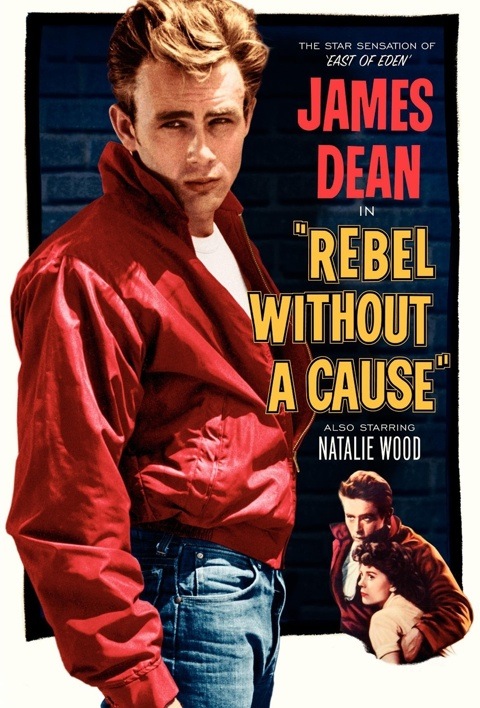
The following analysis reveals a comprehensive look at the Storyform for Rebel Without a Cause. Unlike most of the analysis found here—which simply lists the unique individual story appreciations—this in-depth study details the actual encoding for each structural item. This also means it has been incorporated into the Dramatica Story Expert application itself as an easily referenced contextual example.
Story Dynamics
8 of the 12 essential questions
- Steadfast
- Main Character Resolve
Jim is steadfast in his desire to be part of a functional family.
- Start
- Main Character Growth
Jim wants Frank to start to act like a man so that he can respect him as a father; Jim’s family moves constantly, ostensibly to give their son a fresh start each time:
Ray: That why you moved from the last town? ‘Cause you were in trouble? You can talk about it if you want to—I know about it anyway. Routine check.
Jim: And they think they are protecting me by moving.
Ray: You were getting a good start in the wrong direction back there. Why did you do it? (Stern 15) - Do-er
- Main Character Approach
Jim tries to solve his problems by first taking action. For example, when he’s called a chicken, he puts his fists up; his concern for Plato compels him to run into the planetarium at the risk of being shot (by the police or by Plato); interestingly, he tries to change his tendency to fight first and reflect later by stalling when he is challenged by the gang “I don’t want trouble” (Stern 41) but when backed against the wall he fights “All right—you want it, you got it” (Stern 43).
- Male
- Main Character Mental Sex
Jim tends to use the technique of binary reasoning to problem solve. As an example, he demands yes or no answers from his parents. He also looks at problems in terms of cause and effect. For example, he believes his mother runs the family because his father won’t stand up to her.
- Action
- Story Driver
Jim’s drunkenness lands him jail; Buzz cannot get out of his car in time to prevent his driving over the cliff which results in his death; Plato’s death brings the Stark family together; and so forth.
- Optionlock
- Story Limit
Plato, concerned that Buzz’s friends will do harm to Jim, believes he has no other option but to brandish a gun to protect his friend; Jim’s angst has turned to utter devastation when Plato is killed, which at this point leaves him one of two options, continue to spiral downward in his depression, or look to his father to resurrect his spirits; once Frank recognizes he may lose his son, he takes the option to grow up to be a real man and father; and so forth.
- Success
- Story Outcome
Judy falls in love with Jim and is happy, something she never thought she could be; the Stark family is united with the indication that they will be a happy family:
Jim: Mom—Dad—this is my friend. Her name is Judy.
The parents nod warmly and smile at her. She smiles shyly in response, happy at being accepted. There is a warmth emanating from the tight little group. Changes have happened to them. Things have been shed and a new start has been made. (Stern 117) - Good
- Story Judgment
Jim’s father stands up as a man and turns to help his son stand up, assuring Jim he can trust him; Jim introduces Judy to his parents as his friend; and so forth.
Overall Story Throughline
""The Kids""
- Psychology
- Overall Story Throughline
An example of how the objective story explores a certain way of thinking is when Buzz indicates to Jim that he likes him, just before the chickie race. Jim questions him about why, then, must they engage in a dangerous contest:
Buzz: I like you, you know?
Jim: Buzz? What are we doing this for?
Buzz: (still quiet) We got to do something. Don’t we? (Stern 59-60); to Plato’s way of thinking, Jim is his father figure although they have only known each other briefly; Judy explains to Jim that she must treat him one way in front of the kids and another way when they are alone; Jim explains to the juvenile officer how his parents handle his transgressions:
Jim: They think I’ll make friends if we move. Just move and everything’ll be roses and sunshine.
Ray: But you don’t think that’s a solution. (Stern 16) - Being
- Overall Story Concern
The teen characters are concerned with what it means to be a teenager. One way this is illustrated is in their “uniform” attitude: “Their clothing is not uniform—it is the air they assume . . . swaggering, self-conscious, piratical” (Stern 22); Buzz and Judy are big wheels on campus; Jim and Judy pretend to be married and Plato pretends to be their real estate broker; Plato wants Jim and Judy to be his family; Judy’s father ponders the complexity of being a father to a sixteen year-old girl, when it appears so easy to be a father to a little boy; Jim and Frank act buddy buddy; Jim’s grandmother puts on an act at the police station that everything is all right with Jim: “He’s always been a lovely boy” (Stern 17); Jim confronts his mother when she acts as if their family is not involved with the tragedy of Buzz’s death: “A boy was killed! I don’t see how we can get out of that by pretending it didn’t happen” (Stern 72); Judy sobs to the juvenile officer:
Judy: He calls me a dirty tramp—my own father!
Ray: Do you think your father means that?
Judy: Yes! I don’t know! I mean maybe he doesn’t mean it but he acts like he does. (Stern 5) - Desire
- Overall Story Issue
By moving from town to town, the Stark family indicates their wish to change their situation; Plato wishes he, Jim, and Judy were a family; Judy desires her father’s love; Jim covets Buzz’s girlfriend, Judy; and so forth.
- Ability
- Overall Story Counterpoint
Judy is surprised to find that she is able to love; Judy’s father is unable to return her affection; Ray is the adult in the story best suited to relate to the troubled teens; Plato feels Jim is the best suited to take the place of his father; and so forth.
- Overall Story Thematic Conflict
Desire vs.AbilityAn example of how the conflict between desire and ability is explored in the objective story can be found in how the kids interact with each other and their parents. That they are unable to articulate their desires leaves them to resort to their physicality—such as fighting—which only undermines their aspirations to be taken seriously.
- Test
- Overall Story Problem
In the opening scene, three teenagers are held for questioning at the police station as a result of testing their respective parents’ or guardians’ boundaries. One of the teens, Judy, is picked up aimlessly walking around at 1:00 AM. After explaining she had a fight with her father, the juvenile officer asks: “Do you think you can get back at your dad that way?” (Stern 6); Buzz tests Judy’s loyalty after observing her walking with Jim; Buzz challenges Jim at the planetarium, “This is the test, man. It’s a crazy game” (Stern 30) by waving a knife in his face; the chickie run is a test of the boys’ courage; and so forth.
- Trust
- Overall Story Solution
The juvenile officer suggests to Plato’s maid that his mother had better start trusting in what a psychiatrist could do for her deeply disturbed son; if Jim can meet the gang’s challenge his trustworthiness will be unquestioned, “Cut off a button and you get to join the club” (Stern 42); Jim and Judy discuss their lack of trust in others:
Jim: I don’t think you trust anybody, do you?
Judy: Why?
Jim: I’m getting that way too . . . Would you go with me? You can trust me, Judy. (Stern 83-84) - Expectation
- Overall Story Symptom
As an example of how attention is focused on expectation in the objective story, Jim expects the same kind of amused reaction from the kids when he “moos” at the planetarium lecturer’s discussion of the Taurus bull that Buzz received when he imitated the Cancer crab; Judy anticipates the same kind of affection from her father as a teen that she had always received as a little girl; Jim’s family expects he will make friends if he can stay out of trouble; and so forth.
- Determination
- Overall Story Response
Buzz figures out that by calling Jim a “chicken” he can get a rise out of him; Jim discerns the real cause of why his family cannot stay in one place is predominantly because of his mother; and so forth.
- Thought
- Overall Story Catalyst
Buzz considers Jim a worthy enough opponent to challenge him to a “chickie race” which accelerates the process he must go through to be accepted into the gang; after Buzz’s death, Plato goes berserk when thinks his “father and mother” have abandoned him; Buzz’s rebel friends’ thinking Jim has ratted to the police is the catalyst that brings the objective story to its climactic moment. While tracking Jim down, they shake down Plato for information, causing him to snatch up his mother’s gun for Jim’s protection and to go off in search of his friend. The delinquents also terrorize the Stark household, alerting Jim’s parents to the possibility that their son is in trouble; and so forth.
- Worry
- Overall Story Inhibitor
Progress in the objective story slows down when the adults don’t worry enough about their teens. For example, Jim’s parents are not concerned enough to realize he is not in his bed; Judy’s parents let her flounce out the door without knowing where she is going, when she had been picked up wandering aimlessly around only the night before; the police officer isn’t concerned enough to bother with Jim when he comes in to relay his part in Buzz’s death; and so forth.
- Becoming
- Overall Story Benchmark
How the teens adjust to the psychological trauma of becoming adults—and how the adults in their lives contend with these changes, is the standard by which progress is measured in the objective story.
- Overall Story Throughline Synopsis
The opening of Rebel Without a Cause introduces three upper middle class rebellious teens, Jim, Judy, and Plato, and their respective troubled family relationships. The scenes that follow depict these teens as they try to fit in with their peers and find the love they so desperately need from their families.
Jim is the new kid in town; he is intrigued with Judy, the girlfriend of the big wheel on campus, Buzz. Upon meeting Jim, Plato—a friendless misfit—immediately looks up to him as a father figure. The three teens band together because they share in the same feeling of alienation from their families, and in the tragedy that strikes during Jim’s initiation into the gang.
Jim expresses his need to come clean to the police. His parents, not wishing to stick their necks out, try to talk him out of it. Jim quarrels with his father for not standing up for him and leaves his home. Buzz’s friends, thinking Jim has squealed to the police about what had happened up on the cliffs, set out to avenge their dead friend. Jim and Judy hide out in the deserted mansion that Plato had told Jim about. After a warning from the gang, Plato takes his mother’s gun and rushes to the mansion to protect Jim. The three act as a family and find a few moments of peace.
Crunch, Goon, and Moose find the mansion. One of the boys is wounded by Plato. Plato, who momentarily cannot find his “mother” and “father” (Jim and Judy) feels abandoned once again and fires at Jim in anger. Jim chases after Plato as he runs into the planetarium. The police, Jim’s parents, and Plato’s housekeeper have converged outside the planetarium. Jim talks Plato into coming outside. Once he does, he sees the police and starts to run in a panic. The police officer shoots him, thinking his gun is loaded. The tragedy of Plato’s death brings the Stark family, that (for now) includes Judy, closer together. - Overall Story Backstory
Peary describes the conditions that led up to the overall troubles in Rebel Without a Cause:
In the police station at the beginning of Rebel we see a March of Dimes poster on a pole. This is a film about juvenile delinquency, but from this poster we see immediately that director Ray is on the side of all kids—who have all sorts of problems to contend with (including diseases that usually strike the young). More that any other film, in fact, Rebel sympathizes with youth. Getting money isn’t the problem of teen-agers in Rebel. . . . These middle-class teen-agers have more complex problems. As the title states, their causes are impossible to define. But at the heart of the matter is their need to win acceptance from their peers, which too often requires they take part in dangerous, illegal rituals, and their need to get their parents’ attention and understanding. (285)
Additional Overall Story Information →
Main Character Throughline
Jim Stark — New kid in town
- Universe
- Main Character Throughline
Jim considers his family environment a “zoo”; Jim is the new kid in town trying to fit in; and so forth.
- Progress
- Main Character Concern
Jim underscores his concern with the progress of his own maturation when he observes his family through a peephole in Ray’s office door and comments: “How can anyone grow up in this circus” (Stern 16); Jim is concerned with how his relationship with Judy is going; he is concerned with the progress he is making in finding new friends; he is concerned with (in his eyes) the change in Plato, who has advanced in an extremely short span of time from a needy, immature boy to a psychotic with a gun; and so forth.
- Threat
- Main Character Issue
Jim’s response to Ray’s warning against striking a juvenile officer is to hurl himself at the man; Jim attempts not to fall into the trap of striking back at the gang’s threats; Jim doesn’t perceive Plato waving a loaded gun as too much of a threat, and, even though Plato has shot at him, Jim pursues the boy anyway.
- Security
- Main Character Counterpoint
Jim does not have the sense of security that a child in a functional family would have. As an example of his family not addressing serious issues, they move from town to town leaving at the first hint of difficulty and not allowing for healthy problem solving.
- Main Character Thematic Conflict
Threat vs.SecurityThe thematic conflict that Jim must grapple with is the absence of a secure family home life that he so desperately needs to counteract the outside world in which he is vulnerable.
- Hunch
- Main Character Problem
As an example of how Jim is driven by “hunch,” in the police station he is in danger of acting on his intuition that he may cause violence: “I swear you better lock me up. I’m going to smash somebody-I know it” (Stern 15); it is a problem for Jim that he and his family never have stayed in one place long enough for him to make friends. But after seeing Judy, he informs his family “I have a feeling we’re going to stay here” (Stern 19); Jim’s problem lies within his family’s structural dynamics. Though it is his fighting that his parents use as an excuse to move around, he recognizes their inability to settle comfortably in one town is a part of a dysfunctional pattern that they are all guilty of:
Mother: Well, it doesn’t matter anyhow—because we’re moving.
Jim: No! You’re not tearing me loose anymore.
Father: This is news to me! Why are we moving?
Mother: Do I have to spell it out?
Jim: You’re not going to use me as an excuse again, Mom. Every time you can’t face yourself you want to move and you say it’s because of me or the neighborhood or some other phony excuse. Now I want to do one thing right and I’m not letting you run away. (Stern 73) - Theory
- Main Character Solution
Once Jim can articulate his own theory on why his family is dysfunctional to his parents, he has done all he can do to try to reach them. Peary comments, that for all Jim’s inarticulateness, he does finally manage to send a message to his parents:
. . . Jim’s inability to communicate with his parents and other adults . . . he mumbled when he thought no one was listening and started his sentences over, louder and clearer, when he discovered with surprise that he was being heard. (284) - Expectation
- Main Character Symptom
Jim presumes that if he does not accept the challenge Buzz and the other kids have given him, he will never be accepted as part of their group: “They called me a chicken—you know a chicken! I had to go or I would never have been able to face any of those kids again” (Stern 71).
- Determination
- Main Character Response
Because Jim has determined his castrating mother and grandmother are why his father is a “chicken,” he makes every effort not to turn out the same way.
- Fantasy
- Main Character Unique Ability
Jim’s ability to create a fantasy family for himself, Judy, and Plato evinces his belief that an imaginary happy family life can be turned into a reality.
- Experience
- Main Character Critical Flaw
Jim lacks the experience necessary to deal with the problems facing him. As an example, he is not equipped to deal with Plato’s instability when he fails to fulfill the boy’s desire to be his father figure:
Plato: (with hate) I don’t want you for my father.
Jim: Your father!
Plato fires at Jim. Jim leaps at Plato with a cry and knocks him down.
Jim: (continuing; in rage) You crazy nut! You crazy, crazy nut! (Stern 102) - Future
- Main Character Benchmark
As an example of how Jim uses the future as the standard to judge the degree of his concern, at the start of the story Jim has no friends, however, as he falls in love with Judy he assures her that they will never be lonely again.
- Main Character Description
Jim is a sensitive, vulnerable, and rebellious youth. Plato describes Jim to Judy:
Judy: What’s he like?
Plato: Oh, I don’t know. You have to get to know him. He doesn’t say much but when he does you know he means it. He’s sincere.
Judy: Well, that’s the main thing—don’t you think so? (Stern 58) - Main Character Throughline Synopsis
Jim Stark is a “vulnerable, sensitive, self-destructive loner” (Peary 283) who is trying to make friends in a new town and find peace and parental guidance within his own home. He is attracted to Judy, the girl next door and girlfriend of Buzz, the leader of the pack. To gain acceptance within the gang, he must engage in dangerous pursuits. He is intelligent enough to question potential trouble, and looks to his father for advice. Frank Stark is too ineffectual a man to be of use to his son, leaving Jim feeling alone and disassociated from his family.
When tragedy occurs at the chickie race between Jim and Buzz, Jim, Judy, and Plato—a misfit Jim has befriended—band together. Jim is protective and fatherly toward Plato and sensitive toward Judy. Jim wants to do the right thing and report his involvement in Buzz’s untimely end to the police, much to his parent’s dismay. Buzz’s friends come after Jim, thinking he has ratted on all of them. Plato, in his unbalanced state, shoots Jim with the gun he has carried around to protect him when he thinks Jim has failed him as a parental figure. This action calls attention to the police and to Jim’s parents. Plato is inadvertently shot, and as Frank comforts Jim, the teen-ager is finally able to depend on his father for support. - Main Character Backstory
In the past, Jim has been in trouble for fighting. This is the ostensible reason why his family must move from place to place. Peary remarks:
Jim Stark is a lonely kid who supposedly hasn’t a friend in the world when we first see him lying drunk in an L.A. gutter, but his personality is such that within a twenty-four-hour period he makes friends with Plato, Buzz, and Judy, three teen-agers completely different from each other and himself. (283)
Additional Main Character Information →
Influence Character Throughline
Frank Stark — Jim's father
- Mind
- Influence Character Throughline
Frank is entrenched in a fixed way of thinking. He takes the position that what works for him in one situation holds true for another in the same situation. For example, as an attempt to smooth over Jim’s run-in with the local juvenile authorities, he offers cigars to Ray, a ploy that has obviously worked in the past. When the juvenile officer refuses the gift, Frank continues to press him until his wife drags him away in embarrassment. His fixed point of view defines the “generation gap” type of thinking when it comes to his son.
- Preconscious
- Influence Character Concern
Jim demands immediate responses from his father, which Frank is unable to give.
- Worry
- Influence Character Issue
Frank’s constant worrying emasculates him in his son’s eyes. For example, Jim comes home to find his father wearing a frilly apron while cleaning up a tray of dinner he has dropped en route to serving his wife:
Father: I better clean this up before she sees it.
Jim: Let her see. What could happen. Dad—Dad—don’t. Don’t.
Jim touches his father’s elbow, bringing him to his feet. They look at each other a moment then Jim goes to his bedroom. The father goes back to mopping up the mess. (Stern 46) - Confidence
- Influence Character Counterpoint
Franks’ lack of confidence keeps him from being the kind of man his family can respect. It is not until he is filled with concern for his son’s life that he can stand up and be a real man.
- Influence Character Thematic Conflict
Worry vs.ConfidenceFrank’s anxieties concerning his family undermine what little confidence he has in himself. An example of this conflict occurs when Jim informs his parents of the fatal car accident:
Jim: Dad?
Father: Son—this is all happening so fast—
Jim: You better give me something, Dad. You better give me something fast. (He stops as he sees the emptiness in them.)
Mother: Jimmy, you’re very young—and a foolish decision now could wreck your whole life.
Jim: Dad—answer her—aren’t you going to stand up for me? (the father is mute, helpless . . . (Stern 73) - Test
- Influence Character Problem
Frank fails to set meaningful boundaries for Jim every time his son tests him. An example can be found when he picks up his drunk son from the police station:
Father: Why’d you get drunk? You must have had a reason. Was it because we went to that party? You know what kind of drunken brawls those parties turn into—it’s no place for kids.
Mother: A minute ago you said you didn’t care if he drinks. (Stern 13)
Another example is when Jim asks if he is going to stop him from heading into trouble. Frank, not fully comprehending the danger his son is about to put himself in answers: “You know I never stop you from anything” (Stern 54). - Trust
- Influence Character Solution
Once Frank can assure Jim that his son can trust him, he has resolved his personal drive: “And you can depend on me, son. Trust me. Whatever comes we’ll face it together, I swear” (Stern 116).
- Theory
- Influence Character Symptom
Frank’s structured explanations make problems for Jim. Jim demands immediate and straight forward answers to his problems, and his father’s theorizing gets him nowhere.
- Hunch
- Influence Character Response
Frank does not act on his intuition that his son needs his immediate help. For example, the blood on Jim’s shirt is evidence enough to create the suspicion that he is in some kind of trouble, and his hints that more trouble lies ahead should be enough for Frank to take direct action to find out what kind of problem Jim is struggling with. Yet he skirts the issue, and his waffling sends Jim right out the door.
- Worth
- Influence Character Unique Ability
Once Frank is able to realize his own worth, especially as a parent to Jim, he can stand up for himself and his son. This realization occurs at the planetarium when he witnesses his son’s emotional and physical vulnerabilities:
Jim is at Plato’s side. A couple of officers rush forward to take Jim. The father comes and pushes them aside.
Father: Let him alone! He’s mine! I’ll take care of him! . . . The father stares down at Jim for a moment. Then he kneels beside his son, puts his coat over Jim’s shoulders. He speaks very gently.
Father: For a minute . . . that jacket . . . I thought . . . (breaks off, then) You couldn’t help it son. (reaches out, gently, but firmly) You did everything a man could do. (Stern 115-116) - Desire
- Influence Character Critical Flaw
Frank’s lack of desire to change the circumstances of his family life undermines his efforts to be a strong parent to his son.
- Subconscious
- Influence Character Benchmark
The more Frank taps into his basic desire to protect his son, the faster he is able to respond to Jim’s problems.
- Influence Character Description
Henpecked husband; tries to be a buddy to his son; well meaning but ineffectual.
- Influence Character Throughline Synopsis
Frank Stark is a well-meaning but ineffectual parent. He is the classic hen-pecked son and husband of two dominant women. Frank thinks if he is a pal to Jim and relates to his son using his own adolescence as a guideline, that everything will be just peachy, which of course does not hold true. Frank’s good intentions also include buying gifts for his son, and buying his son’s way out of trouble. What he doesn’t do is stand up for Jim and face their problems in a straight forward manner. This absence of integrity results in a lack of respect from Jim. Until Frank can truly take on the role of a parent, there is conflict between father and son.
- Influence Character Backstory
The acerbic comment Frank’s mother makes after Jim explodes in anger in the police station “Well you know who he takes after” (Stern 14) is an indication of the kind of childhood Frank must have had. The cold and righteous attitude Frank’s mother exhibits has caused him to smother his own child with friendship and affection, but without the authority and discipline his son needs.
More Influence Character Information →
Relationship Story Throughline
""Generation Gap""
- Physics
- Relationship Story Throughline
Raising a teenager in a time of social upheaval is as problematic for Frank as the endeavor to respect an ineffectual father is for Jim. Conflict occurs between father and son when they cannot engage in the kinds of activities that will bring them emotionally closer. For example, Frank encourages activities that are “buddy buddy” in nature, but that are not necessarily meaningful for a father and son relationship:
Frank: Listen—I took a steak out of the freezer. I thought we could have a real old-fashioned stag party—just the two of us, what do you say?
Jim: I’m not hungry. (Stern 53) - Doing
- Relationship Story Concern
What his father is or is not doing causes problems; Jim’s fighting causes problems; Jim asks his father what action to take in a difficult situation. Frank’s inability to give advice causes problems between the two:
Jim: Suppose you knew that you had to do something very dangerous—where you have to prove something . . . a question of honor. Would you do it?
Father: Is there some kind of trick answer?
Jim: What would you do, Dad? . . . can you answer me now?
Father: Listen—nobody should make a snap decision . . . (Stern 53) - Experience
- Relationship Story Issue
As a teenager, Jim has no wealth of experiences to draw on when faced with a difficult decision, which is why he asks his (presumably experienced) father. Frank attempts to alleviate what he believes are Jim’s growing pains: “In ten years you’ll look back on this and wish you were a kid again” (Stern 54). Jim has no time to lose: “Ten years? Now, Dad—I need an answer now” (Stern 54).
- Skill
- Relationship Story Counterpoint
Frank is unskilled in helping his son understand what is to be a man, compelling Jim to ask Ray (father figure) how he is supposed to live through the experience; and so forth.
- Relationship Story Thematic Conflict
Experience vs.SkillFrank lacks the necessary parenting skills Jim needs in order to deal with the confusion of growing up. As an example of how he does not serve his son’s needs, he relies on his experiences that are inappropriate as guidelines, and instead of dealing directly with Jim’s requests for immediate answers, assures his son once he gains his own experiences his present problems will seem insignificant.
- Non-Accurate
- Relationship Story Problem
Frank’s inadequacy as a man and the mistakes he continues to make causes problems for Jim: “She eats him alive and he takes it. . . . He always wants to be my pal, you know? But how can I give him anything when he’s—I mean I love him and I don’t want to hurt him—but I don’t know what to do anymore except maybe die” (Stern 16); Frank does not give Jim sufficient support as delineated in the scene in which Jim wants to go to the police to report his involvement in Buzz’s death:
Jim: You better give me something, Dad. You better give me something fast. Mom?
Mother: Jimmy, you’re very young—and a foolish decision now could wreck your whole life.
Jim: Dad—answer her—aren’t you going to stand up for me? (the father is mute, helpless . . . suddenly Jim screams) Dad? (Stern 73-74) - Accurate
- Relationship Story Solution
An accurate assessment of Frank’s strengths and limitations and the acknowledgment of such will solve problems between the two: “Stand up, Jim. I’ll stand up with you. Let me try to be as strong as you want me to be” (Stern 116).
- Expectation
- Relationship Story Symptom
Jim does not anticipate turning out like his father: “One thing I know is I never want to be like him” (Stern 16).
- Determination
- Relationship Story Response
Jim ascertains that the twin forces that diminish his father’s manhood are his mother and paternal grandmother. “I mean if he had the guts to knock Mom cold once I bet she’d be happy and I bet she’d stop picking. They make mush out of him. Just mush. . .” (Stern 16) This determination of why his father is a “chicken” is what keeps Jim from holding his father totally responsible for his actions, thereby allowing him to have a superficial “buddy buddy” relationship with his father.
- Enlightenment
- Relationship Story Catalyst
Frank intuitively discerns his son is in a dangerous predicament, and rushes to his side; Plato’s death gives Jim and Frank an insight into the value of life, which serves to accelerate the closeness between father and son:
Jim feels, for the first time, the love and security he has always wanted. He clutches at his father, crying unashamedly. The father’s arms envelop him. Plato, through his death, has helped these two find each other. (Stern 116) - Threat
- Relationship Story Inhibitor
Jim’s threats to go to the police with the story of his involvement in Buzz’s death are met with great resistance from his parents. He explains the importance of taking this step, but instead of giving the guidance that Jim needs his father can only offer empty platitudes as to why he shouldn’t make himself vulnerable to the law and potential trouble.
- Obtaining
- Relationship Story Benchmark
The more Frank can gain control in the family, the more respect Jim is able to give him and the closer the two can be.
- Relationship Story Throughline Synopsis
At the beginning of Rebel Without a Cause, it is clear that father and son love each other, yet they cannot relate to one another. As they explore their relationship, it becomes evident to Frank that Jim does not respect him as a man or father, yet at the same time is desperate for his father to fulfill those roles. As Jim involves himself in dangerous and illegal activities, Frank must overcome his ineffectualness to be the man Jim needs to lean on. “At the end, tearful Jim is lifted to his feet by his father, who holds him and assures him he will stand by him as he has never done before” (Peary 285).
- Relationship Story Backstory
Frank’s interactions with his wife and mother have given Jim the impression that his father is weak and a “chicken.” This has developed into a problem in their relationship, as Jim cannot respect his father, and, in his effort not to turn out like him he finds himself constantly fist fighting.
Additional Relationship Story Information →
Additional Story Points
Key Structural Appreciations
- Being
- Overall Story Goal
The goal of common concern to all the objective characters is to be part of a happy, functional family, whether their own or as part of a peer group.
- Doing
- Overall Story Consequence
The consequence of failing to achieve the goal would be continuing on with the emotionally exhausting process of trying to be part of a functional family. The severity of this consequence is underscored by Jim when he says to Ray: “I don’t know what to do anymore except maybe die” (Stern 16).
- Preconscious
- Overall Story Cost
The police officer’s immediate reaction to seeing Plato raise his gun is to shoot him, resulting in the boy’s death; Judy’s father slaps her as she attempts to kiss him, further alienating father and daughter; Buzz drives off the cliff to his death when he is unable to immediately respond to a dangerous situation; and so forth.
- Progress
- Overall Story Dividend
A benefit accrued by Jim and Judy on the way to the goal of being part of a functional family is their developing romance; Jim feels confident enough in the way things are going, such as his interest in Judy, to remark to his parents: “You know something? I have a feeling we’re going to stay here” (Stern 19); and so forth.
- Becoming
- Overall Story Requirements
For the Stark family to be a happy, functional family, Frank must overcome his weaknesses and become a real father to Jim; to be part of a peer group family, one must first become friends with the gang; and so forth.
- Obtaining
- Overall Story Prerequisites
To meet the story requirement of “becoming,” parents must come to the realization that their children are growing up in a much different time than they did, and respect the difficulties these times engender.
- Subconscious
- Overall Story Preconditions
An example of an unessential restriction put on the requirement of “becoming” is illustrated by Plato’s desire to be part of a happy family with Jim as his father:
Maybe next summer he’s going to take me hunting with him—and fishing. I want him to teach me how and I bet he won’t get mad if I goof. His name’s Jim. It’s really James but he likes Jim more. People he really likes—he lets call him “Jamie.” (Stern 58) - Future
- Overall Story Forewarnings
As an example of the “future” as the forewarning for the consequence of “doing,” the chances Buzz takes and his disregard for authority forewarn the likelihood that he will always engage in actions that garner negative attention.
Plot Progression
Dynamic Act Appreciations
Overall Story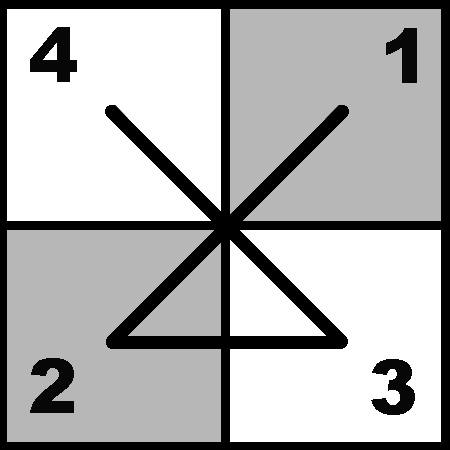
- Being
- Overall Story Signpost 1
What it means to be a teen is explored in the objective story. Judy appears as “a dirty tramp” (Stern 5) to her father because of her red lipstick, when she is just trying to act like a grown woman, using a woman’s props; Jim imitates a siren. When he is reprimanded by a police officer he asks: “Want me to imitate a stupid cop?” (Stern 7); Buzz and Judy act like they are in love, when there is no real affection between the popular couple; and so forth.
- Overall Story Journey 1 from Being to Becoming
After Judy and her father’s emotionally charged confrontation, Judy’s parents discuss the changes in their daughter, as she transforms from a teen into a woman:
Father: I don’t know what to do. All of the sudden she’s a problem.
Mother: She’ll outgrow it, dear. It’s just the age . . .It’s the age when nothing fits. (Stern 52) - Becoming
- Overall Story Signpost 2
Judy and her family explore the shifting relationships that occur as she transforms into a woman; Buzz and Jim become friends; Buzz dies; and so forth.
- Overall Story Journey 2 from Becoming to Conceiving
As Plato progresses from pretending to have a relationship with the new kid, to truly becoming a friend of Jim’s, he comes up with the idea of Jim as his father:
If you want to come we could talk and then in the morning we could have breakfast like my dad used to—(he pauses—then excitedly as though an idea had suddenly struck him) Gee . . . if you could only have been my father . . . we could . . .(Stern 68) - Conceiving
- Overall Story Signpost 3
Mr. and Mrs. Stark grill Jim to find out if anyone has any idea that he was involved in Buzz’s death; Crunch and the gang have the idea that Jim has squealed to the police; Jim comes up with the idea of hiding out at the old mansion with Judy; Plato comes up with the idea of taking his mother’s gun; Frank has no idea where his son has disappeared to; and so forth.
- Overall Story Journey 3 from Conceiving to Conceptualizing
Plato, Jim, and Judy invent an imaginary family life, relieving their angst for a few carefree moments.
- Conceptualizing
- Overall Story Signpost 4
Crunch and the gang implement their plan to confront Jim by hanging a dead chicken on his front porch and driving around until they find him; Jim implements his idea of removing the bullets from Plato’s gun to ensure everybody’s safety; and so forth.
Main Character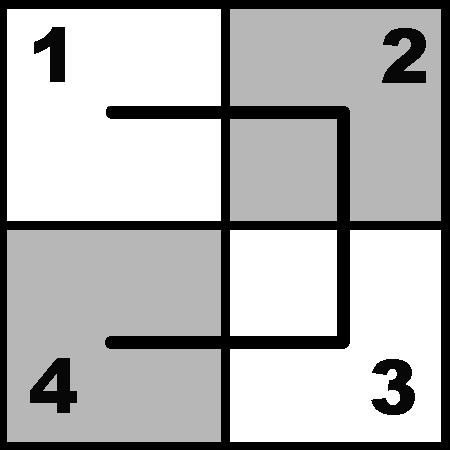
- Past
- Main Character Signpost 1
Jim discusses his history of violence with Ray, however, his family tries to hush it up.
- Main Character Journey 1 from Past to Progress
In the past, if called a chicken, Jim would fight. Jim begins to develop from a hothead to a cool “rebel” when he notes the potential for a fight and does his best to avoid the trouble, even after Buzz calls him a chicken.
- Progress
- Main Character Signpost 2
Jim’s friendship with Plato and Judy moves forward after Buzz’s death.
- Main Character Journey 2 from Progress to Present
Jim has successfully passed the required test to graduate into the gang when he takes part in the chickie race. The circumstances surrounding Buzz’s death force him to deal with how things stand—laws have been broken, a boy is dead, and he is neck deep in it:
Jim: I don’t want to drag you into this but I can’t help it. I don’t think I can prove anything by going around pretending I’m tough anymore, so maybe you look like one thing but you still feel like another. (Stern 71) - Present
- Main Character Signpost 3
Jim explains the current situation to his parents—Buzz’s death, the part he has played in it, and all of its ramifications: “But I am involved! We’re all involved, Mom!” (Stern 72)
- Main Character Journey 3 from Present to Future
The events that occur in the present 24 hour period of Jim’s life, although filled with tragedy, give him hope for the future.
- Future
- Main Character Signpost 4
Jim gives Plato his opinion on when the world will end, just moments before Plato’s life ends.
Influence Character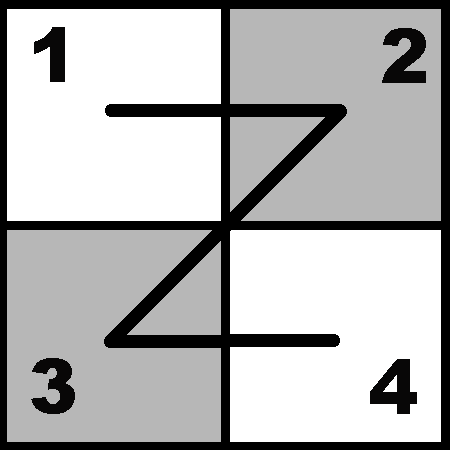
- Memory
- Influence Character Signpost 1
Frank recollects his own drunken antics as a teen, as a way to excuse his son’s: “I guess I cut pretty loose in my day too” (Stern 12).
- influence Character Journey 1 from Memory to Preconscious
Frank tries to relate to what Jim is going through, such as starting a new school, by regaling his son with memories of his own experiences. Unfortunately, this is not the kind of interaction Jim wants or needs. He has no time for reminiscences; he needs immediate responses to his difficult questions, however, Frank is not able to give him that.
- Preconscious
- Influence Character Signpost 2
Frank’s instinctive response to trouble is hesitation, which causes problems for his son who demands immediate answers, and his wife who would like to feel that Frank can protect her:
Mother: Are you going down there?
Father: Look—just relax, will you? (the pounding ceases) See? It stopped.
Mother: I still think you should go down. (Stern 86) - Influence Character Journey 2 from Preconscious to Subconscious
Frank fails to provide Jim with the parental instincts his son requires. Yet, as he begins to understand that Jim is in trouble, his basic drive to protect his son takes over.
- Subconscious
- Influence Character Signpost 3
Frank draws on his own experiences and his basic drive to protect his son when Jim pleads with him for advice, telling him “Nobody thanks you for sticking your neck out” (Stern 72).
- Influence Character Journey 3 from Subconscious to Conscious
Frank’s basic drive to protect his son is put into high gear when he considers the grave danger Jim is in. This is especially apparent when he is forced to contemplate that the police have just shot him. He pushes the officers aside shouting: “Let him alone! He’s mine! I’ll take care of him” (Stern 115).
- Conscious
- Influence Character Signpost 4
Frank contemplates that the boy with the gun in the planetarium may be his son.
Relationship Story
- Understanding
- Relationship Story Signpost 1
Frank tries to comprehend the meaning of Jim’s actions. He questions him in the police station: “I want to understand you. Why’d you get drunk? You must have had a reason” (Stern 13).
- Relationship Story Journey 1 from Understanding to DoingThough they do not comprehend the actions of each other, father and son, each in their own way, try to do something about it. They reach out to each other repeatedly, trying to overcome their misunderstandings: Jim: You can't protect me. Father: You mind if I try? You have to slam the door in my face? I can't even touch you anymore but you pull away. I want to understand you. (Stern 13)
- Doing
- Relationship Story Signpost 2
Jim does not know what to do. Should he face the kids down by entering into the “chickie fight?” Or should he stay at home, thus avoiding danger—Jim asks his father: “What can you do when you have to be a man?” (Stern 54). Frank’s suggestion is to make a list of pros and cons—an unacceptable answer to Jim.
- Relationship Story Journey 2 from Doing to Obtaining
Jim wants to “do one thing right” (Stern 73) by informing the police of his part in Buzz’s accident. He is desperate to obtain his father’s approval during this difficult decision making process, but fails to attain any kind of satisfaction.
- Obtaining
- Relationship Story Signpost 3
Jim looks to his father to support him in his decision to go to the police about chickie race tragedy. When Frank falters, Jim demands: “You better give me something, Dad. You better give me something fast” (Stern 73). Frank is unable at this point to help his son.
- Relationship Story Journey 3 from Obtaining to Learning
Jim and Frank attain the experience necessary to be a man. Frank learns what it really means to be a father and Jim learns from Frank he did everything he could have done to protect his friend Plato.
- Learning
- Relationship Story Signpost 4
Once Frank learns that Jim is one of a group of kids in trouble, he accompanies the police officer to the scene.
Plot Progression Visualizations
Dynamic Act Schematics
OS:  MC:
MC:  IC:
IC:  RS:
RS: