Rear Window
Comprehensive Storyform
The following analysis reveals a comprehensive look at the Storyform for Rear Window. Unlike most of the analysis found here—which simply lists the unique individual story appreciations—this in-depth study details the actual encoding for each structural item. This also means it has been incorporated into the Dramatica Story Expert application itself as an easily referenced contextual example.
Story Dynamics
8 of the 12 essential questions
- Change
- Main Character Resolve
We first see Jeff’s fiancée, Lisa, in a negative light, literally, as a negative image on a slide viewer. This symbolizes the negative feelings Jeff has about the state of matrimony. But as he watches the marriage and courtship rituals of his neighbors, and those who suffer the perils of loneliness, Jeff’s distaste for married life dissipates and he grows more amenable toward the issue of marriage.
- Start
- Main Character Growth
The firmly entrenched bachelor, Jeff, needs to start admitting what he likes about marriage—he obviously enjoys being pampered by his nurse—and commit to his relationship with Lisa, before he turns into a “lonesome and bitter old man.” He also needs to begin a personal involvement with Thorwald if he’s to entrap him.
- Do-er
- Main Character Approach
Though seemingly a passive observer (because of his physical predicament), Jeff will risk his neck (or rather leg) to get the best photo. Eager to go on a big assignment despite his injury, he asks:
JEFF: Okay. When do I leave? Half-hour? Hour?
GUNNISON: With that cast on - you don’t.
JEFF: Oh, stop sounding stuffy. I can take pictures from a jeep or a water buffalo if necessary.
To get the goods on Thorwald, he brings in Doyle, Lisa, and Stella to do his legwork. - Female
- Main Character Mental Sex
Jeff tries to hold together his theory of Thorwald as a murderer in the face of opposition from Stella, Lisa, and especially Doyle. He’s more interested in the why and when of the murder, leaving the how to Stella and Doyle to consider, and piecing his ideas together to form the big picture.
- Action
- Story Driver
Jeff’s running out onto the racetrack put his leg in a cast and made him house bound; Thorwald’s going out in the rain at 1:55 a.m. makes Jeff suspicious, as does almost everything he does; Thorwald’s packing makes Jeff intensify his efforts; Lisa’s waving of the wedding ring alerts Thorwald to the fact he’s being watched; etc.
- Optionlock
- Story Limit
When digging up the flower bed provides no evidence, (Jeff and) Lisa’s last chance to find incriminating evidence is to go inside Thorwald’s apartment in search of the wedding ring.
- Success
- Story Outcome
With the help of Lisa and Stella, Jeff’s able to lure Thorwald out into the open and expose him as a murderer. Even doubting Doyle has to concede that Jeff’s ideas were right when presented with the visual evidence of a head in a hatbox.
- Good
- Story Judgment
During Lisa’s tussle with Thorwald, Jeff realizes how much he really cares for her. The final scene has Lisa seemingly prepared to adapt to Jeff’s globetrotting lifestyle. Jeff’s growth towards marriage is alluded to in an earlier draft of the screenplay, where there is a final discussion of Mrs. Thorwald between Doyle and Jeff:
DOYLE: You were right. There was something in that garden. I just got a signal—it’s in Thorwald’s icebox now.
JEFF: That reminds me—two heads are better than one.
(Hayes, 12/2/53, p.164)
Overall Story Throughline
""Spying on the Neighbors""
- Psychology
- Overall Story Throughline
The source of the story’s troubles stem from attempts to conceptualize what is going on in various personal relationships. Though he lacks tangible evidence, Jeff’s convinced that Thorwald has done away with his wife. He spends a lot of time trying to bring Stella, Lisa, and Doyle around to his way of thinking. To manipulate Thorwald into leaving the apartment, Jeff plays mind games with a note and a phone call.
- Conceptualizing
- Overall Story Concern
After the final straw of criticism from his wife, Thorwald had to have imagined his elaborate scheme for disposing of her; Jeff, Lisa, and Stella spend their time trying to figure out just how he’s carrying that plan out; The jaded detective Doyle lacks the imagination to believe in the crime; Using his photo slides of the garden, Jeff shows how something appears to be buried there; Lisa can’t imagine a woman going on a trip without her handbag and jewelry, especially her wedding ring.
- Situation
- Overall Story Issue
Jeff’s stuck in a wheelchair nursing a broken leg; Thorwald’s stuck in a marriage to a nagging wife; As it’s her job, Stella has to keep visiting and caring for Jeff; etc.
- Circumstances
- Overall Story Counterpoint
Jeff’s inactivity and boredom is driving him crazy. Thorwald has come to the point where he can’t take his ungrateful wife’s nagging any more. As he watches Thorwald’s suspicious activities, the crusader in Jeff wants to get involved.
- Overall Story Thematic Conflict
Situation vs.CircumstancesThorwald reaches the breaking point and murders his wife, rather than continue to suffer. When Jeff watches the aftermath, he feels compelled to interfere and bring Thorwald to justice. Circumstances are a stronger influence than Situation.
- Perception
- Overall Story Problem
The murderer, Thorwald, takes care to keep things looking normal (a postcard from his wife, etc.) as he moves out. Jeff though, perceives something suspicious about his activities, and sticks to this point of view even when doubted by the other characters. Doyle’s perception of how murderers usually operate prevents him from seeing Thorwald as a killer.
- Actuality
- Overall Story Solution
Jeff seeks to bring the truth about Thorwald out into the open. Proving to Doyle that a murder actually took place and getting him to apprehend Thorwald will bring the story to an end.
- Order
- Overall Story Symptom
Lisa’s focused on getting into a formalized relationship with Jeff—marriage; Thorwald’s marriage is falling apart; As the voice of law and order, Doyle will only investigate according to his established pattern; etc.
- Chaos
- Overall Story Response
Thorwald’s response to the chaos of a bad marriage is society’s biggest taboo—murder. Jeff’s experiences at the center of chaos—as seen in his photos of the car crash, a labor strike, war action, and a nuclear bomb test—qualifies him to recognize and observe Thorwald’s chaotic activities.
- Sense of Self
- Overall Story Catalyst
The objective story moves forward when the self image of various characters is attacked. For example, Thorwald’s response to his wife’s criticism is to kill her, dispose of her body, and flee with a woman who appreciates him more; Jeff’s sense of self-righteousness makes him try to stop the murderer, Thorwald; Lisa’s feelings of inadequacy compels her to prove to Jeff that she can be adventurous by digging for clues; etc.
- Instinct
- Overall Story Inhibitor
Lisa’s strong sexual drive is a distraction to Jeff’s observations of Thorwald—at one point she holds Jeff’s chair, not allowing him to turn back to the window; Jeff’s male instincts allow Miss Torso’s cavortings to capture his attention instead of watching out for Thorwald’s return—at the same time, Stella’s protective instincts turns her attention towards the suicidal Miss Lonely Hearts—putting Lisa in danger and her evidence-gathering at risk.
- Being
- Overall Story Benchmark
The more Jeff et al act as if there was a murder, the sooner they can bring Thorwald to justice. For example, to bolster his murder theory, Jeff must act like a night owl to observe Thorwald’s nocturnal activities; Lisa and Stella play detective to gather evidence of Mrs. Thorwald’s demise; Jeff sets up a bogus meeting with Thorwald to get him out of the house; caught in the act, Lisa pretends to be a burglar in order to get arrested; etc.
- Overall Story Throughline Synopsis
“A news photographer, confined to a wheelchair by a broken leg, gazes idly at the behavior of the neighbors across the courtyard of his Greenwich Village apartment. His observations lead him to suspect that one of the neighbors has murdered his wife, but he is unable to convince his fiancée and his detective friend that he is right. Eventually, when the fiancée discovers incriminating evidence confirming his suspicions, the killer discovers he is being watched and tries to kill the photographer. The snooper is saved in the nick of time, though his second leg is broken in the course of the rescue operation.”
(Truffaut, p. 214.) - Overall Story Backstory
Jeff determines what kind of life the Thorwalds lead as he spies the salesman returning home on a sweltering day to tend to his invalid wife, who nags him for not meeting her expectations; Jeff’s background as an action photographer is revealed by the camera as it pans over his photos, particularly one of a car crash:
GUNNISON: I didn’t ask you to stand in the middle of that automobile race track.
JEFF: You asked for something dramatically different! You got it!
GUNNISON: So did you. Goodbye, Jeff.
JEFF: Wait a minute, Gunnison. You’ve got to get me out of here! Six weeks - sitting in a two-room apartment with nothing to do but look out the window at the neighbors!
Additional Overall Story Information →
Main Character Throughline
L.B. "Jeff" Jefferies — Impotent photographer
- Universe
- Main Character Throughline
Jeff is house bound because of his broken leg. He’s frustrated that he can’t get out and explore the world with his camera, so he turns his attention and his lens out of his rear window. His swollen limb seems to make him impotent in more ways than one, and all his activities must be carried out by proxy, using the friends and colleagues who visit him.
- Past
- Main Character Concern
Cooped up in his apartment, Jeff realizes how much he misses his exciting life before he broke his leg; he becomes concerned with Thorwald’s immediate past, specifically what he did with his wife.
- Prediction
- Main Character Issue
Jeff has a nose for predicting the next international trouble spots:
GUNNISON: Kashmir. Got a code tip from the bureau chief this morning. Place is about to go up in smoke.
JEFF: What’d I tell you? Didn’t I tell you that was the next place to watch?
GUNNISON: You did.
Both Gunnison and Stella predict marriage in Jeff’s future, and Stella figures Lisa is the perfect woman for him. Stella claims previous accuracy in her forecasting:
STELLA: You know, I shoulda been a Gypsy fortune teller, instead of an insurance company nurse. I got a nose for trouble - can smell it ten miles away. You heard of that market crash in ‘29? I predicted that.
The singles and couples he sees out his window predict the variety of future lifestyles Jeff has to choose from. - Interdiction
- Main Character Counterpoint
Jeff doesn’t see domestic bliss in his future:
JEFF: Yeah, can you just see me - rushing home to a hot apartment every night to listen to the automatic laundry and the electric dishwasher and the garbage disposal and a nagging wife.
He dodges Lisa’s every attempt at intimacy, and sees the pursuit of Thorwald as an interesting diversion. Jeff interferes with Thorwald’s plans for escape. - Main Character Thematic Conflict
Prediction vs.InterdictionWhile Jeff sees the Thorwald case as a return to his life of excitement and a way of avoiding the marriage question, it actually forces he and Lisa to work together and develop a closer relationship.
- Perception
- Main Character Problem
Jeff reads Thorwald’s activities as criminal, which makes him seem obsessed to everyone else. When he examines the couples outside his window, their troubles reinforce his negative perception of marriage.
- Actuality
- Main Character Solution
Revealing Thorwald’s true nature as a wife murderer will get him arrested and allow Jeff to get on with his life.
- Inertia
- Main Character Symptom
Jeff feels content in his current state as a bachelor, and focuses on the disadvantages that marriage would present:
LISA: You don’t think either one of us could ever change?
JEFF: Right now, it doesn’t seem so.
—and:
JEFF: Couldn’t we just, couldn’t we just sort of keep things status quo?
LISA: Without any future? - Change
- Main Character Response
Jeff has remained distant from Thorwald, expecting Doyle to apprehend the murderer. As Thorwald gets closer to escaping, Jeff changes his tactics and initiates the personal contact which leads to the final confrontation.
- Destiny
- Main Character Unique Ability
As the photographer with a nose for trouble and the man on the scene, Jeff seems destined to repeat his success investigating this latest strife-torn scenario—Thorwald’s marriage—and get another broken leg for his trouble.
- Truth
- Main Character Critical Flaw
Jeff’s resolve to keep after Thorwald is challenged by Doyle’s “truth” about what’s going on:
JEFF: You know, for a minute, that Tom Doyle almost had me convinced I was wrong.
LISA: But you’re not?
His inability to tell Lisa the truth keeps him in the relationship:
JEFF: The only honest thing for me to do is to call the whole thing off. Let her find somebody else. - Progress
- Main Character Benchmark
For each clue to the murder that Jeff comes up with, Doyle has a perfectly innocent, corroborated answer—making it look more and more likely that Thorwald will escape justice.
- Main Character Description
“A tall, lean, energetic thirty-five, his face long and serious-looking at rest, is in other circumstances capable of humor, passion, naive wonder and the kind of intensity that bespeaks inner convictions of moral strength and basic honesty. [...] THE CAMERA PANS along his right leg. It is encased in a plaster of Paris spica from his waistline to the base of his toes.”
(Hayes, p. 3) - Main Character Throughline Synopsis
Laid up and seeking respite from his fiancée, Jeff Jefferies is disturbed by seeing what he believes to be evidence of a murder. Unable to get any serious help from his detective friend, Jeff enlists his fiancée and nurse to entrap the killer. Jeff succeeds in flushing the killer out into the open, but at the expense of another broken leg, and his own probable entrapment into marriage.
- Main Character Backstory
“THE CAMERA PANS to a nearby table on which rests a shattered and twisted Speed Graphic Camera, the kind used by fast-action news photographers.
On the same table, the CAMERA PANS to an eight by ten glossy photo print. It shows a dirt track auto racing speedway, taken from a point dangerously near the center of the track. A racing car is skidding toward the camera, out of control, spewing a cloud of dust behind it. A rear wheel has come off the car, and the wheel is bounding at top speed directly into the camera lens.”
(Hayes, p. 3)
Additional Main Character Information →
Influence Character Throughline
Lisa Fremont — Amorous fiancée
- Mind
- Influence Character Throughline
Lisa is dogged in her position that love will find a way to overcome their differences in lifestyle. She seems determined to wear the trousers in her relationship with Jeff—not realizing that this may scare him off.
- Memory
- Influence Character Concern
Lisa’s determined to make an impact on Jeff:
LISA: Well, I’m going to make this a week you’ll never forget.
When Lisa finally believes Jeff’s murder theory, she asks him to recollect the details:
LISA: Let’s start from the beginning again, Jeff. Tell me everything you saw—and what you think it means. - Evidence
- Influence Character Issue
Lisa won’t believe Jeff’s murder theory unless she sees evidence herself. Then she actively collects evidence in partnership with Jeff.
- Suspicion
- Influence Character Counterpoint
Initially, Lisa’s wary of Jeff’s obsession with Thorwald and the possibility of a murder; later, she’s suspicious of Mrs. Thorwald’s leaving without her jewelry.
- Influence Character Thematic Conflict
Evidence vs.SuspicionOnce Lisa sees Thorwald struggling with the trunk first hand, she’s suspicious of him and no longer of Jeff’s motivations. She teams up with Jeff and Stella to gather the evidence needed to entrap Thorwald. Evidence serves the Obstacle Character better.
- Change
- Influence Character Problem
Lisa is driven to change Jeff’s mind about marriage to her, and to persuade him that they can adapt to each other:
LISA: You… I can’t fit in here—You can’t fit in there. According to you, people should be born, live, and die on the same spot—
JEFF: Shut up! - Inertia
- Influence Character Solution
If Lisa could learn to accept Jeff for who he is, instead of trying to change him into her ideal mate, he’d be more amenable to the ideal of marriage to her.
- Order
- Influence Character Symptom
Lisa wants to get Jeff into a more structured lifestyle, one that involves him being in one place with regular work—in short, marriage.
- Chaos
- Influence Character Response
Lisa tries to let a little of Jeff’s chaotic lifestyle into her life. When she comes to stay over, she brings only one suitcase, even if it is one made by Mark Cross. At story’s end, she dresses in uncharacteristic work clothes and reads a book on exploring the Himalayas.
- Falsehood
- Influence Character Unique Ability
Lisa’s actively investigating a murder case—delivering notes, digging for evidence, entering the apartment, struggling with the murderer Thorwald, etc.—proves Jeff wrong in his determination that she’s not cut out for an active, dangerous lifestyle such as his.
- Fate
- Influence Character Critical Flaw
Lisa feels she may never marry her quarry, Jeff:
LISA: And besides, you’re not up on your private eye literature. When they’re in trouble, it’s always their Girl Friday who gets them out of it.
JEFF: Is she the girl that saves him from the clutches of the seductive show girls, and the over-passionate daughters of the rich?
LISA: The same.
JEFF: That’s the one. Funny, he never ends up marrying her, does he?. That is strange.
LISA: Weird. - Preconscious
- Influence Character Benchmark
The more Lisa gives way to her impulses, particularly in solving the crime, the more she will impress Jeff and the less chance of her becoming just a faded memory to him. For example, finding nothing buried in the flower bed, Lisa remembers the wedding ring and unthinkingly rushes up the fire escape to look for it in Thorwald’s apartment.
- Influence Character Description
“We see her full facial beauty for the first time. It is a warm, intelligent face. [...] She is now in full figure, beautifully groomed and flawless. Her dress is high-style fashion and dramatic evening wear. [...] She does a professional model’s turn in the dress showing off its features.”
(Hayes, p. 24-25) - Influence Character Throughline Synopsis
Lisa wants to marry Jeff. When she realizes he won’t change to her style of living, she tries to adapt to his—and one way is by teaming up with him to go after Thorwald. She finds she has a flair for dangerous adventure, and risks her neck unthinkingly. In doing so, she proves to Jeff that she has an adventurous nature, even if she’s still interested in high fashion when he’s not looking.
- Influence Character Backstory
Lisa’s background is the diametric opposite of Jeff’s:
JEFF: It’s very simple. She belongs to that [rarefied] atmosphere of Park Avenue, expensive restaurants, and literary cocktail parties.
More Influence Character Information →
Relationship Story Throughline
""Changing Lisa to Jeff's Liking""
- Physics
- Relationship Story Throughline
Jeff and Lisa conflict over their differing activities: his globetrotting vs. her table-hopping in the fashion world. The amorous Lisa is in active pursuit of Jeff: bringing him dinner from “21,” smothering him in kisses, moving into his apartment for the night, offering to replace his “old” cigarette case with a new silver one, etc., all of which bother him to no end.
- Understanding
- Relationship Story Concern
Jeff can’t fathom how Lisa expects him to give up his active lifestyle to settle down with her. Lisa doesn’t understand how Jeff can turn away from her charms to discuss a neighbor’s activities instead.
- Senses
- Relationship Story Issue
Looking through his binoculars and whopping telephoto lens, Jeff’s excited by what he sees going on in Thorwald’s apartment. The sensual Lisa wishes he’d focus his attention more on her, and satisfy her immediate desires. She tries to entice him by appealing to his senses: the beautiful way she wears clothes and her silky negligée, she brings him fine wine and gourmet food, smothers him in lingering kisses, etc.
- Interpretation
- Relationship Story Counterpoint
When Jeff prefers to ogle Thorwald instead of her, Lisa interprets it as a failing of hers:
JEFF: Lisa - there’s something terribly wrong.
LISA: And I’m afraid it’s with me.
Then she’s afraid it means something’s not right with him:
JEFF: What do you think?
LISA: Something too frightful to utter. - Relationship Story Thematic Conflict
Senses vs.InterpretationDisagreement over the meaning of what Jeff’s seen out the rear window starts to drive a wedge between Jeff and Lisa:
LISA: Sitting around, looking out of the window to kill time, is one thing—but doing it the way you are, with binoculars, and with wild opinions about every little thing you see - is, is diseased!
But when she interprets the trunk evidence with her own eyes, it brings her and Jeff together as partners in solving the crime. Interpretation is better. - Inequity
- Relationship Story Problem
Lisa wants Jeff to marry her, and settle down to a stable life with a regular job—such as a fashion photographer on her newspaper. Jeff prefers the relative instability of his news magazine job, traveling all over the world on short notice, and with an irregular income. The disparity between their approaches creates tension in their relationship.
- Equity
- Relationship Story Solution
If Lisa can’t tame Jeff, she’ll prove to him she’s his equal—by putting herself at risk like he does, getting her hands dirty in the garden, and dressing down in Levis and a plaid shirt—to win him over.
- Order
- Relationship Story Symptom
Lisa keeps to an organized social and business calendar, and wants Jeff to be part of it:
LISA: What a day I’ve had!
JEFF: What, are you tired?
LISA: Not a bit. I was all morning in a sales meeting. Then I had to dash to the Waldorf for a quick drink with Madame Dufresne - she’s just over from Paris, with some spy reports. And then I had to go to “21” and have lunch with the Harper’s Bazaar people - that’s when I ordered dinner. Then I had two fall showings - twenty blocks apart. Then I had to have a cocktail with Leland and Slim Hayward - we’re trying to get his new show. And then I had to dash back and change. - Chaos
- Relationship Story Response
Jeff doesn’t believe Lisa is cut out for the disorganized, chaotic lifestyle his job entails:
JEFF: Lisa, in this job you carry one suitcase. Your home is the available transportation. You don’t sleep very much, bathe even less, and sometimes the food you eat is made from things that you couldn’t even look at when they were alive! - Conditioning
- Relationship Story Catalyst
Based on her previous experience with men, Lisa moves the subjective story forward when she pulls out all the stops to lure Jeff—fine wining and dining, sexy negligée, physical affection—in order to convince him she’s a perfect marriage partner.
- State of Being
- Relationship Story Inhibitor
When Jeff doesn’t respond to her advances the way she wishes, Lisa turns that inward into self-criticism. She thinks she’s just not good enough for him, when in fact Jeff thinks she’s too perfect. He also thinks her essential nature can’t change, so he resists getting closer to her, slowing down the growth of their relationship.
- Doing
- Relationship Story Benchmark
The more Lisa can show Jeff that she’s a woman of action, the more they grow closer in their relationship. For example, she climbs through the window of Thorwald’s apartment, taking a dangerous risk to gather the evidence that she and Jeff need against the murderer. This serves to impress Jeff as well as to cause him to have more concern for her.
- Relationship Story Throughline Synopsis
Jeff’s having a problem with the too-perfect Lisa, who expects him to marry her:
STELLA: You never going to get married?
JEFF: Oh, probably get married one of these days. But with what I do, it’s going to be with someone who thinks of life not just as a new dress, as a lobster dinner, and the latest scandal. I need a woman who’s willing to go anywhere, do anything, and love it.
Lisa suggests he leave the news magazine and get a job near her, in fashion.
She comes onto him strong, romantically and sexually, but he rebuffs her by pointing to his neighbors’ problematic relationships. When Lisa takes an interest in his obsession with Thorwald, she’s excited by the danger she gets into. Helpless while she’s manipulated by another man—Thorwald—Jeff realizes how much he really does care for her:
JEFF: Lisa, sweetie, if anything had happened to you… [...] Gee, I’m proud of ya.
At story’s end, she makes concessions to his lifestyle, but only while he’s watching. - Relationship Story Backstory
Their problems stem from their differing lifestyles:
JEFF: Well, it’s very simple, Stella. She belongs in that rarefied atmosphere of Park Avenue, you know, expensive restaurants, and literary cocktail parties.
STELLA: People with sense can belong wherever they’re put.
JEFF: Can you imagine her tramping around the world with a camera bum who never has more than a week’s salary in the bank? If only she was ordinary.
Additional Relationship Story Information →
Additional Story Points
Key Structural Appreciations
- Conceptualizing
- Overall Story Goal
Thorwald has come up with a complicated plan to dispose of his wife’s body, and is busy implementing it. From the scant clues he sees from out his window, Jeff tries to imagine what that plan might be so he can interfere with it. Lisa, Stella, and Doyle give their input, and proceed to try and prove their scenario right.
- Understanding
- Overall Story Consequence
If Thorwald gets away with murder despite their efforts, Jeff and Lisa should realize that crime investigation is dangerous for amateur dabblers, and is best left to dedicated professionals—and that spying on your neighbors is not the best use of your time.
- Memory
- Overall Story Cost
Based on his recollections of other interviews with women, Doyle won’t listen to Lisa’s wedding ring theory, costing him precious time in the murder investigation:
DOYLE: Look, Miss Fremont - that feminine intuition stuff sells magazines - but in real life, it’s still a fairy tale. I don’t know how many wasted years I’ve spent tracking down leads based on female intuitions.
When the dog—the mongrel who knew too much—is killed by Thorwald, Jeff remembers his slides of the flower bed. This convinces him there’s something buried there, and encourages Lisa and Stella to dig it up—to Thorwald’s detriment. - Past
- Overall Story Dividend
Jeff renews his long-term relationship with his crusty wartime buddy Doyle; Lisa effectively eradicates her image as that of a vapid fashion plate.
- Being
- Overall Story Requirements
To bolster his murder theory, Jeff must act like a night owl to observe Thorwald’s nocturnal activities. Lisa and Stella play detective to gather evidence of Mrs. Thorwald’s demise.
- Doing
- Overall Story Prerequisites
Jeff, Lisa, and Stella cannot acquire enough incriminating evidence on Thorwald merely by watching from the rear window. They must leave the apartment, dig in the garden, and enter his apartment.
- Preconscious
- Overall Story Preconditions
Lisa impulsively enters Thorwald’s apartment, not thinking of the danger she’s risking; Lisa signals with the wedding ring without thinking about how it could alert Thorwald that Jeff’s watching him; Jeff answers the phone assuming it’s Doyle calling him, not the murderer.
- Progress
- Overall Story Forewarnings
As Thorwald moves more and more of his wife’s belongings—and more and more of his wife—out of his apartment, he comes closer to getting away with murder.
Plot Progression
Dynamic Act Appreciations
Overall Story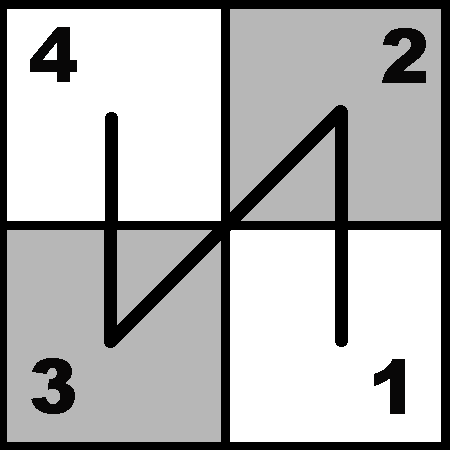
- Conceiving
- Overall Story Signpost 1
Jeff first gets the idea that Thorwald has evil in mind when he sees him venturing out into the rain with his suitcase at 1:55 a.m., putting his plans into action. Lisa and Stella don’t buy into Jeff’s theory.
- Overall Story Journey 1 from Conceiving to Being
Once they buy Jeff’s theory, Lisa and Stella’s initial worry over Jeff’s obsession turns into their volunteering to help him.
- Being
- Overall Story Signpost 2
Lisa and Stella start to act like detectives, leaving the apartment to check out Thorwald’s apartment and moving truck. Thorwald acts like his wife’s still alive.
- Overall Story Journey 2 from Being to Becoming
Thrilled by their role in the investigation, Lisa and Stella become more proactive and go further out on a limb for Jeff.
- Becoming
- Overall Story Signpost 3
Lisa and Stella become active investigators, digging for evidence and searching Thorwald’s apartment.
- Overall Story Journey 3 from Becoming to Conceptualizing
Exposed as a burglar, Lisa desperately alerts Jeff (and Thorwald) to each other’s presence, leading to the OS climax.
- Conceptualizing
- Overall Story Signpost 4
Off Lisa’s signal with the wedding ring, Thorwald scans the neighborhood, imagining somebody watching him. Cornered, Jeff comes up with flashbulbs as a visual warning device, and as a means of defense against Thorwald.
Main Character
- Progress
- Main Character Signpost 1
Jeff’s stuck in his apartment, not going anywhere. His career’s on hold, while assignments pass him by.
- Main Character Journey 1 from Progress to Future
Frustrated by his stagnation, Jeff looks forward to what Thorwald will do next.
- Future
- Main Character Signpost 2
Jeff looks like he’s going to be suckered into marriage unless he diverts attention elsewhere—such as toward Thorwald, who looks like he will get away with murder scot-free unless Jeff can stop him.
- Main Character Journey 2 from Future to Present
Avoiding the prospect of marriage in his own future, Jeff spends all his hours looking out the rear window at Thorwald and the other neighbors.
- Present
- Main Character Signpost 3
Jeff stays up all night watching, trying to catch Thorwald in the one act that will prove his guilt.
- Main Character Journey 3 from Present to Past
Wrapped up in the moment and concerned with Lisa’s current predicament in jail, Jeff’s lack of caution allows Thorwald to enter through his unlocked door opening up the possibility of Thorwald committing yet another murder.
- Past
- Main Character Signpost 4
In his life-and-death struggle with Thorwald, Jeff repeats his own past—endangering himself while using his camera equipment—by breaking the other leg.
Influence Character
- Memory
- Influence Character Signpost 1
Lisa’s determined to have an impact on Jeff’s life:
LISA: Well, I’m going to make this a week you’ll never forget.
She wants to replace Jeff’s cigarette box, along with its treasured memories, and bores him with her society calendar:
LISA: What a day I’ve had! - influence Character Journey 1 from Memory to Preconscious
Lisa moves on from trying to replace Jeff’s memories of work with memories of her, to impulsively taking the step of believing in his wild murder theory.
- Preconscious
- Influence Character Signpost 2
Lisa tries to talk Jeff out of his “insane” theory about Thorwald, until she reacts to seeing him with the trunk herself:
“Lisa has looked up and out the window. She opens her mouth to answer, but a new look overtakes her face. It is concern, surprise, and a little shock.” [...]
LISA: Let’s start from the beginning again, Jeff. Tell me everything you saw—and what you think it means.
(Hayes, p.66) - Influence Character Journey 2 from Preconscious to Subconscious
Once she’s switched to Jeff’s point of view, Lisa is ecstatic over her new adventures.
- Subconscious
- Influence Character Signpost 3
After putting on a negligée fails to entice Jeff into romance, Lisa channels her energies into helping Jeff by delivering the note:
“Lisa comes in, panting and flushed. She stands a second at the door, catching her breath, but smiling with the pleasure of sampling danger and escaping unharmed.”
(Hayes, p. 130) - Influence Character Journey 3 from Subconscious to Conscious
Turned on by danger, Lisa contemplates more excitement at Jeff’s side.
- Conscious
- Influence Character Signpost 4
Lisa sits watching over Jeff as he nods off. She considers what becoming part of his lifestyle would be like by reading a book on the Himalayas.
Relationship Story
- Understanding
- Relationship Story Signpost 1
While Lisa can relate to how terrible it must be for Jeff to be cooped up for so long—
LISA: I couldn’t think of anything more boring and tiresome than what you’ve been through. And the last week must be the hardest.
—she can’t understand how their differing lifestyles can come between them:
LISA: It doesn’t make sense. What’s so different about it here from over there, or any place you go, that one person couldn’t live in both places just as easily? - Relationship Story Journey 1 from Understanding to DoingAnxious to better understand the lifestyle Jeff inhabits, and appreciating his ideas about Thorwald, Lisa joins in his cause to uncover the truth.
- Doing
- Relationship Story Signpost 2
Once Lisa believes Jeff’s story, she partners up with him to watch Thorwald’s activities.
- Relationship Story Journey 2 from Doing to Obtaining
Excited by her new abilities, Lisa tries to gain Jeff’s respect by taking risks.
- Obtaining
- Relationship Story Signpost 3
As Jeff can’t get his leg over to Thorwald’s apartment, he lets his fiancée do the walking. When she’s in danger collecting evidence, Jeff realizes how much he cares for (and needs) Lisa.
- Relationship Story Journey 3 from Obtaining to Learning
After she experiences the thrill of the chase that Jeff so loves, Lisa seeks to know more.
- Learning
- Relationship Story Signpost 4
Lisa now knows that taking an interest in Jeff’s activities will bring them closer together. She tries to learn about exotic foreign lands from a book.
Plot Progression Visualizations
Dynamic Act Schematics
OS:  MC:
MC:  IC:
IC:  RS:
RS: