Pride and Prejudice
Comprehensive Storyform
The following analysis reveals a comprehensive look at the Storyform for Pride and Prejudice. Unlike most of the analysis found here—which simply lists the unique individual story appreciations—this in-depth study details the actual encoding for each structural item. This also means it has been incorporated into the Dramatica Story Expert application itself as an easily referenced contextual example.
Story Dynamics
8 of the 12 essential questions
- Change
- Main Character Resolve
Elizabeth firmly believes Mr. Darcy is the last man in the world she would ever marry. Her change of heart is illustrated when he proposes for the second time:
“If your feelings are still what they were last April, tell me so at once. My affections and wishes are unchanged, but one word from you will silence me on this subject forever.” Elizabeth . . . gave him to understand that her sentiments had undergone so material a change, since the period to which he alluded, as to make her receive with gratitude and pleasure his present assurances. (Austen 305) - Stop
- Main Character Growth
Elizabeth must discard her prejudice of Mr. Darcy.
- Do-er
- Main Character Approach
Elizabeth’s tendency to solve a problem is to handle it through activity. For example, after learning that Jane has taken ill at the neighbor estate of Netherfield Park, Elizabeth is not content to stay at home until she is assured of her recovery. Instead, she braves a rainstorm and lengthy journey on foot to personally tend to her sister’s health.
- Female
- Main Character Mental Sex
An example of Elizabeth using a female problem solving technique is illustrated when she cannot fathom why Mr. Darcy would interfere with the romance between Mr. Bingley and her sister, Jane. She looks at the issue holistically, reviewing all the possible objections he could have against her sister and her family, as well as taking into account the possibility that Mr. Darcy may wish to have his friend marry Darcy’s younger sister, Georgiana. Elizabeth also determines that the fine points Jane has to offer Mr. Bingley more than make up for any deficiency Mr. Darcy may have perceived. Elizabeth is left to conclude Mr. Darcy’s objections to the match “had been partly governed by this worst kind of pride, and partly by the wish of retaining Mr. Bingley for his sister” (Austen 159).
- Decision
- Story Driver
Mr. Darcy’s decision not to ask Elizabeth to dance at their first meeting is why she and her family and friends take an instant dislike to the man; Elizabeth’s refusal of Mr. Collins’ proposal gives leave for her best friend, Charlotte, to encourage his attentions; Elizabeth’s decision not to reveal Wickham’s true nature leads to her youngest sister committing folly; and so forth.
- Optionlock
- Story Limit
The objective characters move within a limited society, in which there are only so many possible marital connections one can make. As people are paired off, choices of a spouse are narrowed. In the case of Elizabeth and Mr. Darcy, the story is forced to a climax when Elizabeth gathers all the information necessary to exonerate his character and realizes there is no other man for her but him, and he learns she cares for him, making it possible for him to propose for a second time without fear of rejection.
- Success
- Story Outcome
All the principal characters’ future security and happiness are assured.
- Good
- Story Judgment
Elizabeth has overcome her prejudice of Mr. Darcy and looks forward to a happy marriage.
Overall Story Throughline
""First Impressions""
- Universe
- Overall Story Throughline
The objective story explores the particular social customs and manners of England’s upper class in the early nineteenth century. An example of a social custom is voiced by Lady Catherine: “Young women should always be properly guarded and attended, according to their situation in life” (Austen 179). The situation the Bennet family finds themselves in is, with five daughters and no male heir, their estate is entailed to their priggish cousin Collins. To secure their future, it is necessary for the Bennet girls to marry well.
- Future
- Overall Story Concern
The objective characters are concerned with their marriage prospects. This concern is illustrated by the Lucas family, after Mr. Collins asks for Charlotte’s hand:
Mr. Collins’ present circumstances [as heir to the Bennet estate] made it a most eligible match for their daughter . . . his prospects of future wealth were exceedingly fair. Lady Lucas began directly to calculate with more interest than the matter had ever excited before how many years longer Mr. Bennet was likely to live . . . .The younger girls formed hopes of coming out a year or two sooner than they might otherwise have done; and the boys were relieved from their apprehension of Charlotte’s dying an old maid. (Austen 105-106) - Choice
- Overall Story Issue
Elizabeth is certain Wickham would have chosen her for a wife if she were wealthy; Lady Catherine, Mr. Collins’ patroness, commands him to marry a particular type of woman: “Choose properly, choose a gentlewoman for my sake; and for your own, let her be an active, useful sort of person . . .” (Austen 92); Once Collins introduces himself into the Bennet household, Jane becomes his “settled choice” (Austen 61), however, a hint from Mrs. Bennet that Jane may soon be engaged to another man determines Elizabeth as an alternative. Colonel Fitzwilliam and Elizabeth discuss the financial and social position that allows Darcy the freedom of choice in his business dealings:
“He arranges business just as he pleases.” “And if not able to please himself in the arrangement, he has at least great pleasure in the power of choice. I do not know anybody who seems more to enjoy the power of doing what he likes than Mr. Darcy.” (Austen 155) - Delay
- Overall Story Counterpoint
Although Jane is stricken ill during her visit with the Bingley sisters, Mrs. Bennet encourages her to put off returning home from Netherfield Park, in hopes she will spend more time in courtship with Mr. Bingley; Miss Bingley is annoyed that Jane’s and Elizabeth’s journey home is deferred: “[she] was then sorry that she had proposed the delay, for her jealousy and dislike of one sister much exceeded her affection for the other” (Austen 52); It is the Bennet family’s concern that Wickham and Lydia must be found without delay, before the young girl’s reputation is ruined forever; and so forth.
- Overall Story Thematic Conflict
Choice vs.DelayAn example of the thematic conflict as it relates to choice vs. delay is illustrated in a conversation between Jane and her sister as she expresses concern over the possibility Mr. Bingley’s sisters and friends may be against their match. Elizabeth advises that she must decide what is more important, other people’s opinions or her love for Mr. Bingley. Jane determines the latter, but points out “. . . if he returns no more this winter, my choice will never be required. A thousand things may arise in six months!” (Austen 104)
- Temptation
- Overall Story Problem
The Bennet girls’ aunt, Mrs. Gardiner, entreats Elizabeth to guard against an attachment to Wickham, to which her niece replies:
“. . . how can I promise to be wiser than so many of my fellow creatures if I am tempted, or how am I even to know that it would be wisdom to resist?” (Austen 125); Elizabeth explains to Mr. Darcy the family crisis her youngest sister, Lydia, has put them in:
My youngest sister has left all her friends—has eloped—has thrown herself into the power of—Mr. Wickham. They are gone off together from Brighton. You know him too well to doubt the rest. She has no money, no connections, nothing that can tempt him to—she is lost forever. (Austen 230); Mr. Collins is concerned with “how little there is to tempt any one to our humble abode” (Austen 181) as he wishes Elizabeth farewell; Mr. Bennet embraces marriage with the pretty yet featherbrained Mrs. Bennet, and soon realizes they have little in common: “Her father, captivated by youth and beauty, and that appearance of good humour which youth and beauty generally give, had married a woman whose weak understanding and illiberal mind had very early in their marriage put an end to all real affection for her” (Austen 198); In the belief he will have a male heir, Mr. Bennet indulges in spending money without a care for the future; and so forth. - Conscience
- Overall Story Solution
After a sensible conversation with her aunt, Elizabeth assures her she will guard against involving Wickham in “an affection” (Austen 124); Mr. Darcy coerces Wickham into marring Lydia thereby saving her and the Bennet family’s good name; Elizabeth assures Mr. Collins that she had “spent six weeks with great enjoyment; and the pleasure of being with Charlotte, and the kind attentions she had received, must make her feel the obliged” (Austen 181); Mr. Bennet reconciles himself to the fact he has married a foolish woman and uses as much forbearance as he possibly can with her silliness; Mr. Bennet’s conscience is pricked when he thinks his brother-in-law has paid for Lydia’s imprudence. His conscience is cleared, however, when he learns from Elizabeth that Darcy was responsible for paying off Lydia and Wickham’s debts:
“And so, Darcy did everything; made up the match, gave the money, paid the fellow’s debts, and got him his commission! So much the better. It will save me a world of trouble and economy. Had it been your uncle’s doing, I must and would have paid him; but these violent young lovers carry everything their own way. I shall offer to pay him tomorrow; he will rant and storm about his love for you and there will be an end of the matter.” (Austen 315) - Feeling
- Overall Story Symptom
An example of how attention is focused on feeling in the objective story is depicted by Mrs. Bennet, a foolish woman who uses only her emotions to assess how things are going, and in doing so almost ruins her daughters’ chances for a promising future: “She was a woman of mean understanding, little information, and uncertain temper. When she was discontented she fancied herself nervous” (Austen 7). Caroline Bingley’s emotional assessment of her chances with Mr. Darcy render her quite desperate; Lydia does not stop to consider that her sister may feel left out when she is not included in the invitation to Brighton: “Wholly inattentive to her sister’s feelings, Lydia flew about the house in restless ecstasy . . . laughing and talking with more violence that ever, whilst luckless Kitty continued in the parlour repining at her fate in terms as unreasonable as her accent was peevish” (Austen 193); Jane and Elizabeth implore their father to receive his errant daughter Lydia and her new husband: “for the sake of their sister’s feelings and consequence” (Austen 261); and so forth
- Logic
- Overall Story Response
Charlotte is sensible to the fact that she is not an attractive girl and her prospects for a husband are limited. When Elizabeth refuses Collins’ proposal, Charlotte makes the most of the opportunity and sets about in a logical manner to secure Collins for herself; Caroline Bingley attempts to win Mr. Darcy for herself by disparaging Elizabeth and her family at every turn, and encouraging her brother to ask for Georgiana Darcy’s hand reasoning “from the notion that when there has been one intermarriage, she may have less trouble in achieving a second; in which there is certainly some ingenuity. . .” (Austen 103); Kitty uses her own line of (weak) reasoning as she rails against her exclusion of the Brighton invitation: “I cannot see why Mrs. Forster should not ask me as well as Lydia . . . though I am not her particular friend. I have just as much right to be asked as she has, and more too, for I am two years older” (Austen 193); Jane and Elizabeth convince their father to receive the Wickhams after the sisters had: “urged him so earnestly, yet so rationally and so mildly . . . that he was prevailed on to think as they thought, and act as they wished (Austen 261); and so forth.
- Openness
- Overall Story Catalyst
Bingley is open to the two youngest Bennet girls’ entreaties for a ball. The festivities serve to put the objective characters in close proximity with each other, moving all their relationships (for better or worse) forward; Lydia’s receptiveness to Wickham’s plan to run off without the benefit of marriage accelerates the objective story forward; Darcy willingly reevaluates Elizabeth’s family relations when he meets the Gardiners. He collaborates with them to return honor to the Bennet family which increases the pace toward the climax of the story; and so forth.
- Denial
- Overall Story Inhibitor
Mr. Bingley, under the impression Jane Bennet does not care for him, denies his own feelings of love for her thereby halting the progress of their relationship; Miss Bingley and Mr. Darcy, unwilling to let go of their plan to keep Bingley away from Jane, do not let on that she is in London and available to be called upon; Darcy’s denial of his part in bringing Lydia and Wickham together in marriage impedes any progress between him and the Bennet family; and so forth.
- Present
- Overall Story Benchmark
The current state of each Bennet daughters’ courtship (or lack thereof) is how progress toward the goal of marrying for financial security is measured in the objective story.
- Overall Story Throughline Synopsis
Barrons’ Booknotes synopsis:
In the neighborhood of the Bennet family’s estate of Longbourn, Mr. Bingley, an attractive young bachelor with a good income, has moved into the nearby manor. He falls in love with the oldest of the five Bennet daughters, Jane. But his friend, wealthy and aristocratic Mr. Darcy, disapproves of Bingley’s choice. Darcy considers the Bennet family to be socially inferior, and he plots with Bingley’s sisters to separate the lovers. Meanwhile, though, Darcy is finding it hard to resist his own increasing attraction to Jane’s next younger sister, the vivacious Elizabeth.
Because Mr. Bennet has no son, his estate will be inherited by his nearest male relative, Mr. Collins. This pompous clergyman comes to Longbourn seeking a wife. He proposes to Elizabeth, who rejects him—even though marrying him would be the one way to keep Longbourn in the family. But he wins her best friend, Charlotte Lucas, a plain young woman who marries Collins to escape from spinsterhood into a safe, if loveless, marriage.
The story continues with an interweaving of plot and subplots. During her travels with the Gardiners, Elizabeth receives bad news from Longbourn: The youngest Bennet girl, giddy sixteen-year-old Lydia, has run away with Wickham. Such a scandal must disgrace the whole family, and Elizabeth decides that now, just as her feelings toward Darcy have begun to change, any hope of his renewing his proposal is lost forever.
But not so. Darcy feels partially responsible for Lydia’s elopement; he feels he should have warned the Bennets that Wickham once tried the same thing with Darcy’s own sister. Besides, he is very much in love with Elizabeth. For her sake he searches out the fugitive couple, makes sure that they are legally married, pays Wickham’s debts, and buys him a commission in the army. All this he does secretly. But, though sworn to secrecy, Lydia reveals Darcy’s part in her rescue—and Elizabeth realizes at last how wrong she’s been about him all along.
Bingley, with Darcy’s encouragement, proposes to Jane and is accepted. Soon Darcy makes his proposal again to Elizabeth. By now she has abandoned her prejudice and he has subdued his pride, and so they are married and all ends happily. - Overall Story Backstory
In her critical evaluation of Pride and Prejudice, Catherine E. Moore gives an insight to how things have come to the state they are in as the objective story begins:
The original title, First Impressions, focuses upon the initial errors of judgment from which the story develops, whereas the title Pride and Prejudice . . . indicates the central conflict involving the kinds of pride and prejudice which bar the marriages of Elizabeth Bennet and Darcy and Jane Bennet and Bingley, but bring about the marriages of Charlotte Lucas and Collins and Lydia Bennet and Wickham. . . . individual conflicts are defined and resolved within a rigidly delimiting social context, in which human relationships are determined by wealth and rank (5310).
Additional Overall Story Information →
Main Character Throughline
Elizabeth Bennet — 2nd of five daughters; her father's favorite
- Physics
- Main Character Throughline
Elizabeth dashes headlong into any problem she feels requires her attention—which arise, for the most part, out of her sisters’ and friends’ love lives. Static is created in the Bennet household as Elizabeth endeavors to find the perfect match for herself in marriage. Her flirtation with Wickham causes concern for her aunt; Charlotte reproves her friend’s shortsightedness in disregarding Mr. Darcy and encouraging Wickham; her decision to refuse Collins’ proposal of marriage divides her parents and particularly incenses her mother:
“I have done with you from this very day. . . .I should never speak to you again, and you will find me as good as my word. I have no pleasure in talking to undutiful children.” (Austen 98) - Obtaining
- Main Character Concern
Elizabeth is concerned with attaining the kind of marriage that will allow her to retain her individuality.
- Morality
- Main Character Issue
Elizabeth puts far more energy into doing what is best for others rather than what is best for herself. She is deeply involved in helping Jane and Mr. Bingley unite; she halts her vacation to be at her family’s side when she hears of Lydia’s misconduct and the pain it is causing her family, when Wickham discards Elizabeth for a woman of financial means, she supports his desertion understanding he must look out for himself:
The sudden acquisition of ten thousand pounds was the most remarkable charm of the young lady, to whom he was now rendering himself agreeable; but Elizabeth . . . did not quarrel with him for his wish of independence. . . .she was ready to allow it a wise and desirable measure for both, and could very sincerely wish him happy. (Austen 129) - Self-Interest
- Main Character Counterpoint
In all her altruistic endeavors, Elizabeth is not without a touch of narcissism as evidenced in a conversation with Jane: “. . . that is the one great difference between us. Compliments always take you by surprise, and me never” (Austen 14).
- Main Character Thematic Conflict
Morality vs.Self-InterestAs one result of Elizabeth’s personal growth, she considers the conflict between morality and self interest in observing her father as a role model for a husband and parent:
Elizabeth . . . had never been blind to the impropriety of her father’s behaviour as a husband. She had always seen it with pain; but respecting his abilities, and grateful for his affectionate treatment of herself, she endeavored to forget what she could not overlook, and to banish from her thoughts that continual breach of conjugal obligation and decorum which . . .was so reprehensible. But she had never felt so strongly as now the disadvantages which must attend the children of so unsuitable a marriage, nor ever been so fully aware of the evils arising from so ill-judged a direction of talents . . . which rightly used might at least have preserved the respectability of his daughters, even if incapable of enlarging the mind of his wife. (Austen 198) - Temptation
- Main Character Problem
Elizabeth indulges in her first impressions, especially because she is so often right. As an example, she is so taken by the pleasant countenance of Mr. Wickham, that she believes everything he says (especially against Mr. Darcy) to be true.
- Conscience
- Main Character Solution
Once Elizabeth realizes she is somewhat mistaken in her understanding of people based on first impressions, she is able to forbear indulging in prejudice, as Weinsheimer points out in his essay: “Wickham’s knavery teaches Elizabeth to ‘draw no limits in the future to the impudence of an impudent man.’” (24)
- Disbelief
- Main Character Symptom
As an example of how Elizabeth’s attention is focused on disbelief, she refuses to accept Miss Bingley’s, Mr. Bingley’s, and Mr. Darcy’s unanimous opinion that Wickham is a shady character.
- Faith
- Main Character Response
An example of how Elizabeth’s faith in herself intensifies in reaction to unsolicited and unwelcome opinions is illustrated when she refuses to accept Lady Catherine’s admonishment to give up Darcy:
“I am only resolved to act in that manner which will, in my own opinion, constitute my happiness, without reference to you, or to any person so wholly unconnected to me” (Austen 298). - Approach
- Main Character Unique Ability
Elizabeth defies putting on the demure manners imposed upon young ladies of her day. Instead she uses her wit and intelligence to say and do what she thinks. This approach attracts her to the right man that will make her happy in marriage.
- Obligation
- Main Character Critical Flaw
Elizabeth’s endeavor to help herself and her sisters attain the goal of a future secured by celebrated and happy marriages is severely undermined by her tacit agreement not to reveal Wickham’s true nature to her family and community. This pledge opens Lydia up to the temptation of running off with the bounder (which she does) and results in Elizabeth’s imagined loss of influence over Darcy:
“When I consider . . . that I might have prevented it!—I who knew what he was. Had I but explained some part of it only—some part of what I learned to my own family! Had his character been known, this could not have happened”. . . .Darcy made no answer. . .Elizabeth soon observed, and instantly understood it. Her power was sinking; everything must sink under such a proof of family weakness, such an assurance of the deepest disgrace. (Austen 230) - Learning
- Main Character Benchmark
As Elizabeth experiences more of the outside world, she is able to gain more knowledge of herself: A significant learning experience is described in Act 3:
“How humiliating is this discovery . . . had I been in love, I could not have been more wretchedly blind. But vanity, not love, has been my folly. Pleased with the preference of one, and offended by the neglect of the other, on the very beginning of our acquaintance I have courted prepossession and ignorance, and driven reason away, where either were concerned. Till this moment I never knew myself.” (Austen 176) - Main Character Description
Intelligent and spirited with exceptionally “fine eyes” (Austen 25). “Elizabeth’s celebrated liveliness is vigorously physical as well, verging sometimes on unladylike athleticism. . . .she also runs, jumps, springs, and rambles” (Johnson 1988).
- Main Character Throughline Synopsis
As stated by Moore:
Elizabeth begins by rejecting the values and restraints of society, as represented by such people as her mother, the Lucases, Miss Bingley, and Lady Catherine, upholding instead the claims of the individual, represented only by her whimsical father. By the end of the novel, the heart of her conflict appears in the contrast between her father and Darcy. Loving her father, she has tried to overlook his lack of decorum in conjugal matters. The implicit comparison between Mr. Bennet’s and Darcy’s approach to matrimony points up their different methods of dealing with society’s restraints. . . .Her marriage to Darcy is in a sense a triumph of the individual over society; but, paradoxically, Elizabeth achieves her most genuine conquest of pride and prejudice only after she has accepted the full social value of her judgment that “to be the mistress of Pemberley [Darcy’s estate] might be something!” . . . without evading Elizabeth’s capitulation to society, it [the novel] affirms the vitality, the independent life which is possible at least to an Elizabeth Bennet. (5311-5313) - Main Character Backstory
In her critical evaluation of Pride and Prejudice, Catherine E. Moore gives an insight to how things have come to the state they are in as the main character story begins:
As the central character, Elizabeth, her father’s favorite child and her mother’s least favorite, must come to terms with the conflicting values implicit in her parents’ antithetical characters. She is like her father in her scorn of society’s conventional judgments, but she champions the concept of individual merit independent of money and rank. (5311)
Additional Main Character Information →
Influence Character Throughline
Mr. Darcy — Proud and wealthy aristocrat
- Psychology
- Influence Character Throughline
Mr. Darcy makes an impact on those around him by the way he thinks and what is thought about him. He explains himself to Elizabeth and the others in a conversation at Netherfield Park:
“But it has been the study of my life to avoid those weaknesses which often expose a strong understanding to ridicule. . . .vanity is a weakness indeed. But pride-where there is a real superiority of mind, pride will be always under good regulation. . . .I have faults enough, but they are not, I hope, of understanding. My temper I dare not vouch for. It is . . . a too little yielding—certainly too little for the convenience of the world. I cannot forget the follies and vices of others as soon as I ought, nor their offenses against myself. My feelings are not puffed about with every attempt to move them. My temper would perhaps be called resentful. My good opinion once lost is lost for ever.” (Austen 50-51)
Elizabeth remarks on his disagreeable nature to Wickham:
“‘He is not at all liked in Hertfordshire. Everybody is disgusted with his pride. You will not find him more favourably spoken of by any one’” (Austen 67). - Becoming
- Influence Character Concern
For Elizabeth’s sake, Mr. Darcy is concerned with transforming his proud nature to one that is kind and considerate, and capable of making her happy.
- Responsibility
- Influence Character Issue
Darcy takes his responsibilities seriously: “Darcy’s pride is real, but is regulated by responsibility” (Moore 5312).
- Commitment
- Influence Character Counterpoint
Once Darcy makes a commitment, he sticks with it regardless of his personal feelings. An example of this is how he treats Wickham after marrying into the Bennet family: “Though Darcy could never receive him at Pemberley, yet, for Elizabeth’s sake he assisted him farther in his profession” (Austen 323).
- Influence Character Thematic Conflict
Responsibility vs.CommitmentMr. Darcy is an extremely responsible individual. That he prides himself on this trait is off-putting to those who do not know him well. It is when he evidences his commitment that he garners admiration and respect.
- Hinder
- Influence Character Problem
Based on his assumption that Jane’s feelings for Mr. Bingley are superficial and insincere, Mr. Darcy obstructs the relationship between the two by convincing his friend to quit Netherfield Park; Wickham’s reports that Darcy has impeded all his efforts to make something of himself strengthens the already negative impression Hertfordshire has of the proud aristocrat.
- Help
- Influence Character Solution
Mr. Darcy makes amends to Jane and Mr. Bingley by admitting to his friend the part he played in undermining their relationship:
“I made a confession to him, which I believe I ought to have made long ago. I told him of all that had occurred to make my former interference in his affairs absurd and impertinent . . . I told him, moreover, that I believed myself mistaken in supposing . . . that your sister was indifferent to him; and as I could easily perceive that his attachment to her was unabated, I felt no doubt of their happiness together.” (Austen 309)
Mr. Darcy assists in the saving of Lydia Bennet’s, and therefore the Bennet family’s, reputation by ensuring that Wickham marries the girl; and so forth. - Feeling
- Influence Character Symptom
The sentiments Mr. Darcy expresses in his marriage proposal to Elizabeth puts her into a tailspin of emotions.
- Logic
- Influence Character Response
In answer to Elizabeth’s accusations against his character, Mr. Darcy writes a letter that provides a reasonable account of all his actions, thus forcing her to realize she had severely misjudged him.
- Rationalization
- Influence Character Unique Ability
Mr. Darcy fabricates many excuses to see Elizabeth, but maddeningly does not repeat his declaration of love. This circumstance compels her to thank him for his part in saving her sister’s reputation, which also serves as an apology for her past prejudice of him:
Now was the moment for her resolution to be executed, and while her courage was high, she immediately said, “I can no longer help thanking you for your unexampled kindness . . . I have been most anxious to acknowledge to you how gratefully I feel it” (Austen 304). - Attitude
- Influence Character Critical Flaw
The first impression people receive from Mr. Darcy’s proud demeanor is a negative one, so much so that certain acquaintances are unwilling to reevaluate this impression and make an effort to understand the man.
- Conceiving
- Influence Character Benchmark
As, over time, the original ideas Mr. Darcy entertains on social position change, he is able to transform his proud nature.
- Influence Character Description
Tall, dark, and handsome—with an income over 10,000 pounds per year
- Influence Character Throughline Synopsis
Barrons’ Booknotes:
Darcy’s character gradually unfolds in the course of the story. He takes Elizabeth’s criticism of him to heart—makes an effort to curb his pride and judge people according to what they really are, not merely by their rank in society. He demonstrates this change by his politeness and then his growing friendship with Elizabeth’s aunt and uncle, the Gardiners, even though Mr. Gardiner is “in trade.” The gradual revelation and development of Darcy’s character—from pride to generosity and gentleness—is one of the strengths of the novel. - Influence Character Backstory
Mr. Darcy’s ancient family name, magnificent estate, and sizable fortune all contribute to his pride. But there’s another side to his character. He is a generous master to his servants and tenants and a loving brother to his young sister Georgiana (Barrons’ Booknotes). He grew up with Wickham, the son of Mr. Darcy’s father’s steward and a great favorite of the late Mr. Darcy. Although he tried to do right by his father’s wishes for Wickham, the steward’s son proved to be a wastrel. Mr. Darcy is the best friend of Mr. Bingley. As Bingley is apt to be too pleasant and easily falls in love, Mr. Darcy feels it is his responsibility to guard over his friend’s heart. Mr. Darcy places tremendous importance on being a gentleman.
More Influence Character Information →
Relationship Story Throughline
""Pride Goeth Before Fall""
- Mind
- Relationship Story Throughline
Because of his wealth and social standing, Mr. Darcy is predisposed to disdain Elizabeth and her family; though in his same legal class, they are certainly not as well-to-do. His aristocratic position has created an arrogance that is immediately felt by Elizabeth at their first meeting when he refuses to ask her to dance. Elizabeth is insulted by his snub, and this first bad impression provides the impetus for her fixed attitude against him: “‘. . . I could easily forgive his pride, if he had not mortified mine’” (Austen 19).
- Subconscious
- Relationship Story Concern
Elizabeth and Mr. Darcy each present a subconscious challenge to the other to explore their basic drives and desires. As Margaret Drabble comments:
We have little doubt, from their first meeting, that they will finally be brought together, for the convention of violent antipathy that turns to love is almost as strong as the convention of love at first sight. . . (vii) - Dream
- Relationship Story Issue
Mr. Darcy aspires to become Elizabeth’s husband, even though she has flatly rejected his marriage proposal; Elizabeth desires to marry Darcy, but fears he would never ask for her hand again after her rejection of him: “. . . never had she so honestly felt that she could have loved him as now, when all love must be in vain” (Austen 230).
- Hope
- Relationship Story Counterpoint
Mr. Darcy is confident his desire to marry Elizabeth will be reciprocated:
He concluded with representing to her the strength of that attachment which, in spite of all his endeavors, he had found impossible to conquer; and with expressing his hope that it would now be rewarded by her acceptance of his hand. (Austen 162) - Relationship Story Thematic Conflict
Dream vs.HopeDream is given much more play than hope in the subjective story. Although not of the same social status, Elizabeth and Mr. Darcy move in the same social milieu, creating a reasonable hope that the two might come together. However, their hostile beginning quashes all hope, and a happy relationship for the two is an unlikely event.
- Uncontrolled
- Relationship Story Problem
Mr. Darcy’s careless response to Mr. Bingley’s suggestion that he ask Elizabeth to dance is the beginning of his and Elizabeth’s volatile relationship; Darcy is further heedless in what he says in his marriage proposal to Elizabeth, creating an (almost) irrevocable breach between them.
- Control
- Relationship Story Solution
Once Elizabeth and Mr. Darcy conduct themselves and their relationship with open minds and hearts, they accept each other and embrace their future happiness as a married couple.
- Feeling
- Relationship Story Symptom
Elizabeth’s feeling run high on the subject of Mr. Darcy—she despises him. Darcy, despite himself, is quite attracted to the young lady. This point is illustrated when Darcy first proposes to Elizabeth:
“My feelings will not be repressed. You must allow me to tell you how ardently I admire and love you.” Elizabeth’s astonishment was beyond expression. She stared, coloured, doubted, and was silent. This he considered sufficient encouragement, and the avowal of all that he felt and had long felt for her immediately followed. He spoke well, but there were feelings besides those of the heart to be detailed, and he was not more eloquent on the subject of tenderness than of pride. (Austen 160) - Logic
- Relationship Story Response
Elizabeth reasons her first impression of Darcy and the infamous stories she hears about him draw a true picture of his character; Darcy reasons he should not fall in love with a young lady that is socially beneath him.
- Closure
- Relationship Story Catalyst
Darcy’s letter to Elizabeth answers the accusations she has made against him compelling her to see him in a new light; Mrs. Gardiner’s explanation of how Darcy resolved the scandal of Lydia and Wickham furthers the relationship between Darcy and Elizabeth.
- Preconception
- Relationship Story Inhibitor
Mr. Darcy’s initial closed minded attitude toward marriage to a woman whose status is beneath his own, impedes the relationship between Elizabeth and himself. When, in spite of himself, Mr. Darcy falls in love and first proposes to Elizabeth, she makes clear that the prejudices she holds against him halt any happy future relationship they might have:
“From the very beginning, from the first moment, I may almost say, of my acquaintance with you, your manners impressing me with the fullest belief of your arrogance, your conceit, and your selfish disdain of the feelings of others, were such as to form that groundwork of disapprobation on which succeeding events have built so immovable dislike; and I had not known you a month before I felt that you were the last man in the world whom I could ever be prevailed on to marry.” (Austen 164) - Conscious
- Relationship Story Benchmark
As time passes, the gap between Elizabeth and Mr. Darcy narrows as, in spite of her family, Mr. Darcy contemplates marriage to Elizabeth and she considers new information on Darcy that puts him in a favorable light.
- Relationship Story Throughline Synopsis
Barrons’ Booknotes synopsis:
Elizabeth is prejudiced against Darcy because he seems so proud and conceited. She also suspects that he has interfered between Jane and Bingley. She is even more put off when she hears that Darcy has treated a young man, George Wickham, cruelly and unjustly. Wickham tells her that Darcy has denied him the inheritance that his godfather, Darcy’s father, left him. Wickham courts Elizabeth, and his good looks, charming manners, and story of injustice at Darcy’s hands win her sympathy and deepens her prejudice against Darcy.
Elizabeth visits Charlotte, now Mrs. Collins. Darcy visits his aunt, Lady Catherine, who is Mr. Collins’s patron. Darcy and Elizabeth meet constantly, and at last he proposes to her, saying with more honesty than tact that he does this against his better judgment. She angrily rejects him, accusing him of destroying Jane’s happiness and Wickham’s legitimate prospects. Later, in an earnest letter, he tells her the truth on both counts: he did interfere between Jane and Bingley, but he did not treat Wickham unjustly. In fact, he says, Wickham is a thoroughly bad character. Elizabeth believes Darcy for once, and her prejudice against him begins to weaken.
Elizabeth travels with her aunt and uncle, the Gardiners. They come to Darcy’s magnificent estate in his absence and are shown through the house. His housekeeper praises him for his goodness and generosity, painting a very different picture of him from the one Elizabeth has had. Suddenly and unexpectedly, Darcy himself arrives. Elizabeth is mortified to be found there, but he is full of courtesy to the Gardiners and very attentive to Elizabeth.
Once Elizabeth is aware of the part Darcy has played in Lydia and Wickham’s marriage, she realizes how wrong she has been about him. Soon Darcy makes his proposal again to Elizabeth. By now she has abandoned her prejudice and he has subdued his pride, and so they are married and all ends happily. - Relationship Story Backstory
In her critical evaluation of Pride and Prejudice, Catherine E. Moore gives an insight to how things have come to the state they are in as the subjective story begins:
She [Elizabeth] is like her father in her scorn of society’s conventional judgments, but she champions the concept of individual merit independent of money and rank. She is, indeed, prejudiced against the prejudices of society. From this premise she attacks Darcy’s pride, assuming that it derives from the causes that Charlotte Lucas identifies: ” . . . with family, fortune, every thing in his favor . . . .he has a right to be proud.”
. . . Significantly, it is Darcy who warns her against prejudicial conclusions, reminding her that her experience is quite limited. . . . it is only when she begins to move into Darcy’s world that she can judge with true discrimination both the individual merit and the dictates of society which she has rejected. Fundamentally honest, she revises her conclusions as new experiences warrant. . . (5311)
Additional Relationship Story Information →
Additional Story Points
Key Structural Appreciations
- Future
- Overall Story Goal
A future assured with marital success for the Bennet daughters, in particular Jane, Elizabeth, and Lydia, is the goal of common concern for the primary characters.
- Subconscious
- Overall Story Consequence
In a practical sense, the consequence of the Bennet daughters not marrying well will result in a struggle for survival, as upon their father’s demise they will be destitute. Emotionally, if the young ladies live their future out as spinsters, their hearts will be broken. Mrs. Bennet constantly reminds the reader of the consequences of failing to achieve the goal, as underscored by Evans in Drabble’s introduction of the novel:
If Mrs. Bennet is slightly crazy, then perhaps she is so because she perceives, more clearly than her husband, the possible fate of her daughters if they do not marry . . . Given that she has five daughters, it is little wonder that at times Mrs. Bennet is less than rational. (xi) - Becoming
- Overall Story Cost
For the sake of the Bennet family, Mr. Darcy overcomes his dislike of Wickham and forces the scoundrel to marry Lydia. The price Mr. Darcy pays (literally and figuratively) to aid the Bennet family is steep, for once the detested Wickham marries Lydia, he becomes a brother-in-law to Elizabeth and (after their marriage) Mr. Darcy.
- Obtaining
- Overall Story Dividend
While attempting to make good marriages that will secure their future, certain dividends are achieved, particularly in the form of invitations. Jane is invited to stay in London to ease her broken heart; Lydia obtains an invitation from a colonel’s wife to summer at Brighton beach, making herself available to the unattached members of the militia regiment; Elizabeth is invited to stay at Charlotte and Mr. Collins’ home, as well as to travel with the Gardiners; and so forth.
- Present
- Overall Story Requirements
The present state of affairs requires the Bennet daughters to marry well:
Mr. Bennet’s property consisted almost entirely in an estate of two thousand a year, which unfortunately for his daughters, was entailed in default of heirs male, on a distant relation; and their mother’s fortune, although ample for her situation in life, could but ill supply the deficiency of his. (Austen 25) - Conscious
- Overall Story Prerequisites
The circumstances that cause an entailment on the Bennet estate are such that Mr. Bennet’s father must consider only males worthy of an inheritance.
- Conceiving
- Overall Story Preconditions
To keep the Longbourn estate in the care of males, Mr. Bennet’s father comes up with the idea to entail his son’s estate to Mr. Collins if he does not produce any male heirs.
- Learning
- Overall Story Forewarnings
The Bennet family learns that Wickham has no intention of marrying Lydia; he will bed her thus ruining her reputation forever and eliminating any chance of her acquiring a decent husband; Jane learns Mr. Bingley has no intention of returning to Netherfield, drastically reducing opportunities for their romance to flourish; When Mrs. Bennet learns Elizabeth has turned down Mr. Collins’ offer of marriage she cries:
But I tell you what, Miss Lizzy, if you take it into your head to go on refusing every offer of marriage in this way, you will never get a husband at all—and I am sure I do not know who is to maintain you when your father is dead. I shall not be able to keep you—and so I warn you. (Austen 98)
Plot Progression
Dynamic Act Appreciations
Overall Story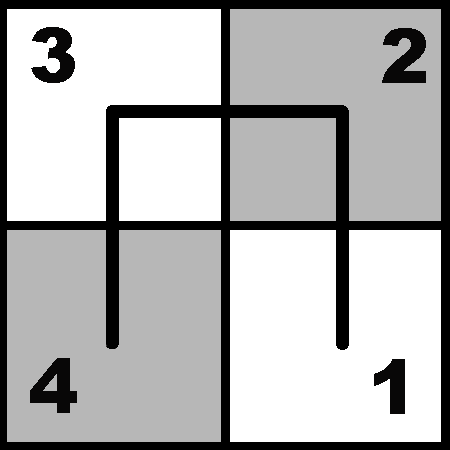
- Present
- Overall Story Signpost 1
It is established that after Mr. Bennet’s death, his estate will be passed on to a distant male relative, leaving his daughters destitute if they do not marry. Other young ladies in the neighborhood are in want of a “good catch” in particular, Elizabeth’s best friend Charlotte Lucas. It is with great excitement then, when the rich and unattached Mr. Bingley moves into the tiny community because, “It is a truth universally acknowledged that a single man in possession of a good fortune must be in want of a wife” (Austen 5).
- Overall Story Journey 1 from Present to Progress
The mutual attraction that develops between Jane Bennet and Mr. Bingley indicates he soon may ask for her hand in marriage. The progress of their relationship, however, is halted when Mr. Bingley and his party move on to London.
- Progress
- Overall Story Signpost 2
The way the Bennet daughters’ and Charlotte Lucas’ romances are proceeding is explored in Act 2.
- Overall Story Journey 2 from Progress to Past
Charlotte discusses how a romance should proceed, using Jane and Mr. Bingley as an example:
“. . .though Bingley and Jane meet tolerably often, it is never for many hours together; and as they always see each other in large mixed parties, it is impossible that every moment should be employed in conversing together. Jane should therefore make the most of every half hour in which she can command his attention. When she is secure of him, there will be leisure for falling in love as much as she chooses.” (Austen 20); The minor advancement toward achieving the goal of a future secured through the Bennet daughters’ marrying well is put firmly in the past with Elizabeth’s refusal of Collins’ proposal, and the Bingley party’s evacuation from Netherfield Park. - Past
- Overall Story Signpost 3
Mr. Collins is not content to leave Elizabeth’s rejection of his marriage proposal in the past. When she visits the curate and Charlotte, he takes every opportunity to show her what he believes she is missing; Mrs. Gardiner wants to tour Pemberley, the Darcy estate she knew in her youth with Mr. Gardiner and Elizabeth; Elizabeth pores over the lot of Jane’s letters to see if there is “any revival of past occurrences” (Austen 159).
- Overall Story Journey 3 from Past to Future
Jane’s and Mr. Bingley’s past is revived as they once more come into contact with each other, leaving no doubt as to their future together:
His behavior to her sister was such during dinnertime, as showed an admiration of her, which . . . persuaded Elizabeth that if left wholly to himself, Jane’s happiness, and his own, would speedily be secured (Austen 283). - Future
- Overall Story Signpost 4
The future is settled for the Bennet girls. Jane and Mr. Bingley are married as are Elizabeth and Mr. Darcy and Lydia and Mr. Wickham. Kitty’s social graces improve with her many visits to her two elder sister’s homes, making her more eligible for a decent marriage. Mary is also obliged into society as her mother’s companion, making it possible for her to meet potential suitors.
Main Character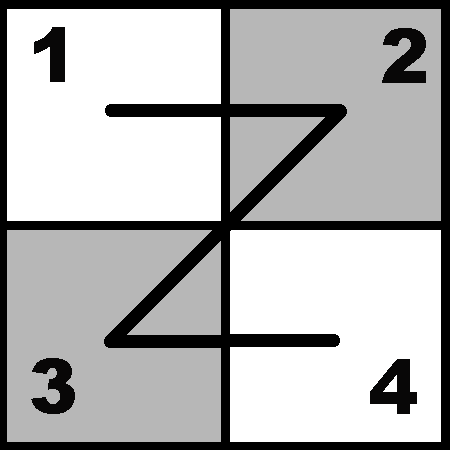
- Understanding
- Main Character Signpost 1
Elizabeth believes herself to have a great understanding of character.
- Main Character Journey 1 from Understanding to Doing
As Elizabeth becomes more personally involved in the courtship process, her ability to fully comprehend the words and actions of those around her lessens. Peterson notes the approval Elizabeth bestows upon Wickham’s action of voluntarily absenting himself from the ball, without realizing he had said earlier he would not avoid Darcy on any occasion, shows her prejudice has prevented her from reaching some very obvious conclusions (22).
- Doing
- Main Character Signpost 2
In Act 2, Elizabeth engages in matters of the heart. She counsels Jane and Charlotte on romance; she endeavors to convince Mr. Collins that she does not wish to become his wife; she surprises herself into dancing with Darcy at the ball; she flirts with Wickham; and so forth.
- Main Character Journey 2 from Doing to Obtaining
Elizabeth’s travels and participation in various societal entertainments makes it possible for her to glean pertinent information regarding Wickham, Darcy, and even her family.
- Obtaining
- Main Character Signpost 3
Without too much regret, Elizabeth loses Wickham to another young lady of greater financial means:
“His apparent partiality had subsided, his attentions were over, he was the admirer of someone else. Elizabeth was watchful enough to see it all . . . .Her heart had been but slightly touched . . . ” (Austen 129). - Main Character Journey 3 from Obtaining to Learning
After possessing all the facts concerning Wickham and Darcy, and attaining a clear picture of her family, Elizabeth has gathered the necessary information to review her own pride and prejudices.
- Learning
- Main Character Signpost 4
Elizabeth learns what the Pemberley estate is like:
Elizabeth was delighted. She had never seen a place for which nature had done more, or where natural beauty had been so little counteracted by an awkward taste (Austen 203).
Influence Character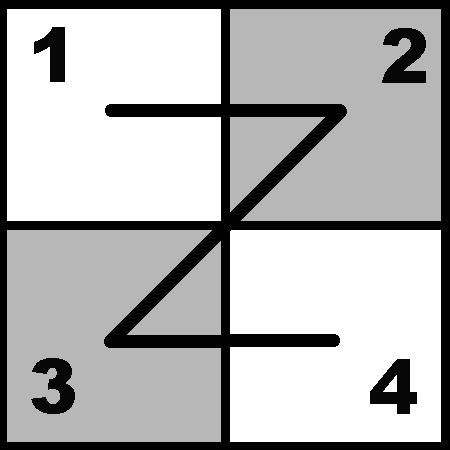
- Conceptualizing
- Influence Character Signpost 1
Mr. Darcy cannot imagine dancing with any of the young ladies at the ball that are new to his acquaintance, giving rise to his reputation as a proud, cold man; to conform to his idea of what an accomplished young lady is, the woman must:
“. . . have a thorough knowledge of music, singing, drawing, dancing, all the modern languages, to deserve the word; and besides all this, she must possess a certain something in her air and manner of walking, the tone of her voice, her address and expressions . . . and to all this she must yet add something more substantial, in the improvement of her mind by extensive reading.” (Austen 35) - influence Character Journey 1 from Conceptualizing to Being
Mr. Darcy’s refusal to ask any of the young ladies to dance at the ball determines to the Hertfordshire society what kind of man he is. His reputation to be proud and cold exacerbates with subsequent interactions with the locals, Mrs. Bennet in particular.
- Being
- Influence Character Signpost 2
Wickham begins his account of Darcy’s malicious and inhumane treatment of him by bitterly remarking:
“The world is blinded by his fortune and consequence, or frightened by his high and imposing manners, and sees him only as he chooses to be seen” (Austen 67). - Influence Character Journey 2 from Being to Becoming
Mr. Darcy assiduously works on overcoming his role as a proud aristocrat to a most amiable gentleman.
- Becoming
- Influence Character Signpost 3
Mr. Darcy must give up his pride in order to propose marriage to a young lady that is not of his same social standing; after Miss Bennet’s rejection of his marriage proposal, he writes a letter explaining his past actions, which begins his transformation from an arrogant aristocrat to a true gentleman.
- Influence Character Journey 3 from Becoming to Conceiving
As Mr. Darcy becomes a true gentleman, he conceives of how he can help the Bennet family and win Elizabeth’s heart.
- Conceiving
- Influence Character Signpost 4
The woman who had raised Darcy from the time he was four, gives her account of Darcy’s nature, providing Elizabeth and the Gardiners with a much different notion of him than they had surmised from their own original impressions and others’ reports:
“The commendation bestowed on him by Mrs. Reynolds was of no trifling nature. . . .Every idea that had been brought forward by the housekeeper was favorable to his character” (Austen 208).
Relationship Story
- Memory
- Relationship Story Signpost 1
Elizabeth commits to memory how, at their first meeting, Mr. Darcy snubbed her. Their subsequent interactions are filled with misunderstandings based upon this recollection.
- Relationship Story Journey 1 from Memory to PreconsciousThe impact of Elizabeth's and Darcy's first encounter differs. Elizabeth commits to memory the disparaging comments he makes and his refusal to dance with her. When her mother advises her not to dance with him in the future, Elizabeth replies, "'I believe, Ma'am, I may safely promise you never to dance with him'" (Austen 18). Darcy revises his first impression of Elizabeth and sets about acquainting himself with her. When he asks her to dance, she is so surprised she unthinkingly accepts.
- Preconscious
- Relationship Story Signpost 2
While at the ball, Elizabeth reflexively accepts Mr. Darcy’s invitation to dance with her:
When those dances were over she returned to Charlotte Lucas, and was in conversation with her when she found herself suddenly addressed by Mr. Darcy, who took her so much by surprise in his application for her hand that, without knowing what she did, she accepted him. He walked away again immediately, and she was left to fret over her own want of presence of mind. . . (Austen 78). - Relationship Story Journey 2 from Preconscious to Subconscious
As Elizabeth and Darcy’s relationship develops, they are able to relax more around each other and take each other’s measure. For Darcy, this means falling in love. Elizabeth still resents him and holds onto her desire for his comeuppance.
- Subconscious
- Relationship Story Signpost 3
During her visit with Charlotte and Collins, Darcy often seeks out Elizabeth prompting Mrs. Collins to exclaim: “‘My dear Eliza he must be in love with you, or he would never have called on us in this familiar way’” (Austen 153). Elizabeth attributes his strange behavior to having nothing better to do (Peterson 28) and thus is quite surprised when he proposes marriage.
- Relationship Story Journey 3 from Subconscious to Conscious
Although Elizabeth and Mr. Darcy love each other, there are still obstacles to take into consideration before resolving their problem.
- Conscious
- Relationship Story Signpost 4
Elizabeth contemplates how she might have been mistress of Pemberley if she hadn’t rejected Darcy; after her confrontation with Lady Catherine, Elizabeth is sensible to the fact Darcy may take into consideration his aunt’s vehement feelings against marriage to one that is beneath him in social position:
If he had been wavering before as to what he should do, which had often seemed likely, the advice and entreaty of so near a relation might settle every doubt. . .(Austen 300)
Plot Progression Visualizations
Dynamic Act Schematics
OS:  MC:
MC:  IC:
IC:  RS:
RS: