The Godfather
Comprehensive Storyform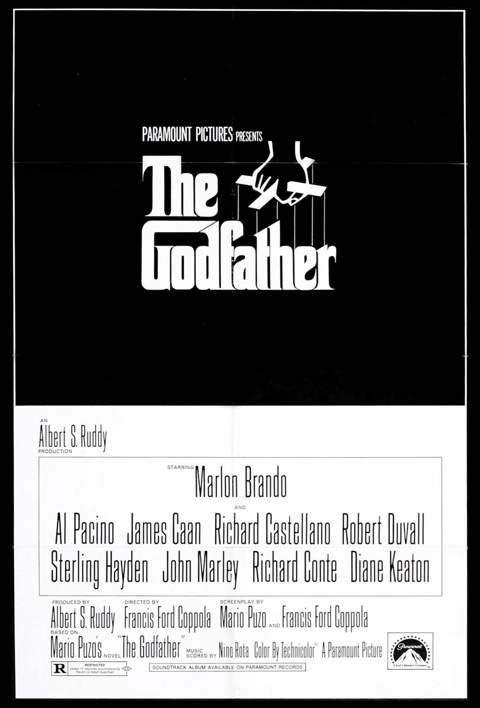
The following analysis reveals a comprehensive look at the Storyform for The Godfather. Unlike most of the analysis found here—which simply lists the unique individual story appreciations—this in-depth study details the actual encoding for each structural item. This also means it has been incorporated into the Dramatica Story Expert application itself as an easily referenced contextual example.
Story Dynamics
8 of the 12 essential questions
- Change
- Main Character Resolve
Michael changes from believing what his family does is wrong to believing that his family’s crimes are a necessary evil. He begins by insisting that his family’s crimes belong to his family, not to him. In the end, he is organizing the execution of these crimes as the family’s new Don, having reasoned they are necessary.
- Stop
- Main Character Growth
Michael resists association with his family at first, indicating that he plans to be with Kaye and not get involved in the family business. He stops this resistance, however, when all of his family’s power is threatened and he becomes the only one capable of preserving it.
- Do-er
- Main Character Approach
Michael prefers to problem solve externally. He has just come back from WW II as a veteran hero, then he insists that he can solve the “Turk”(Sollozzo) problem by killing Sollozzo and the police captain. When he falls in love with Appollonia from afar, he proposes marriage before even meeting her. He is virtually unable to cope with problems internally, always finding a way to solve them externally. This leads to many murders such as the “baptism of blood” when Michael secures his family’s seat of power by having all other threats eliminated during his godson’s baptism.
- Male
- Main Character Mental Sex
Michael uses a linear, cause and effect manner of looking at problems. He sees the relations of all the families as different links in one hierarchy of power, completely ignoring the holistic effects the families’ methods have on the women and children who are, in his eyes, “not involved.” His keen sense of logic is what allows him to see that he is the perfect candidate to kill the “Turk.” He sees a very binary relationship between people who are “in” the family vs. people who aren’t, warning Fredo never to take sides against the family. He is also able to ultimately convince himself that his “business” has nothing to do with his wife and that because she is “not involved” she should not ask him about it.
- Decision
- Story Driver
If it were not for decisions made in the Objective Story, the characters would not be forced to take the actions that they do. The “Turk,” Sollozzo’s move to hit Don Corleone is an action which is forced by the Don’s decision to not support his drug running scheme. The deliberations about how to deal with the “Turk” lead to Michael having to murder him. Sonny’s considerations about how the gang war should be fought leads to a prolonged conflict and his own death. The Don’s decision to end the war leads to Michael’s return to the States. Tessio’s decision to betray Michael leads to his own assassination. Michael’s decision to become the new “Godfather” leads to the “Baptism of blood” massacre. There are always a variety of ways for everyone to proceed towards their goals, and the characters constantly deliberate over them, forcing actions to follow.
- Optionlock
- Story Limit
There are only a limited number of Corleone’s who have the ability to maintain the family’s powerful stature (a limited number of candidates for the new “Godfather”). There are only a limited number of ways to keep the other families loyal and submissive to the Corleones.
- Success
- Story Outcome
A new “Godfather,” who will keep the Corleone family and the power structure of New York’s underground soundly preserved, is found in Michael.
- Bad
- Story Judgment
For Michael to have been left the only one capable of preserving his family’s power is bad for him personally. He continues to be in love with Kaye, maintaining the lie he is not a murderer. Kaye represents his original desire to remain outside of his family’s dirty business. When he changes by becoming willingly committed and involved as the new Don, his need to prevent Kaye from discovering this indicates he is still plagued by his personal problems.
Overall Story Throughline
""An Offer He Couldn't Refuse . . .""
- Physics
- Overall Story Throughline
The problem which involves all of the objective characters has to do with the activities of the feuding New York families. The Objective Story involves the disruption of the power structure among these families, and the search to establish a new “Godfather” who can sort it all out.
- Obtaining
- Overall Story Concern
The central Objective Story Concern of Obtaining is to obtain a new head of the families, a new “Godfather.” People also come to the Godfather to obtain favors, and it is his concern to obtain ways to grant these favors. Sollozzo, Sonny, the Don, Barzini, and all the other Mafioso are trying to obtain more power during this time of disruption. Kaye is trying to obtain Michael as a husband; Fredo and Connie’s husband, Carlos, want to obtain more respect from their family, etc.
- Approach
- Overall Story Issue
The issues raised in the Objective Story revolve around how to go about doing or obtaining—often in regards to culturally “wrong” things, such as murder. One’s approach vs. one’s attitude is at the heart of these issues. It is all right for the undertaker to ask the Godfather to murder someone, but the way in which he makes this request is taken to issue. The story explores a well defined chain of steps for any move these characters make. Whether their attitude makes their moves “business” moves or “personal” moves determines if their approach is correct or not. These issues occur in the dilemma of whether or not Michael can kill a police captain. Until Michael demonstrates that there is a business reason which makes this killing part of a method that other families would agree with, it is out of the question. The mob bosses’ discussion of how it may be acceptable to deal drugs is also a discussion of approach. Similar is the problem when Tessio betrays Michael for Barzini. Michael understands because “it is the smart move on Tessio’s part.” But even when Tessio admits the betrayal was purely for business, Michael still has to have him killed because that is the methodology among the families.
- Attitude
- Overall Story Counterpoint
- Overall Story Thematic Conflict
Approach vs.Attitude - Feeling
- Overall Story Problem
Feelings that occur in the Objective Story are problematic. The Don’s feelings about how drugs will affect his political connections cause him to refuse to get involved in the inevitable (and therefore logical) venture proposed by Sollozzo (the “Turk”). Sonny’s feelings cause him to run into trouble without thinking, which eventually gets him killed and strips the Corleone family of their acting Don. The movie producer’s feelings lead him to dedicate himself to preventing Johnny Fontaine from getting the movie part he needs; etc.
- Logic
- Overall Story Solution
Whenever logic is introduced in the Objective Story, it solves problems. Tom Hagan’s constant advice to Sonny is always logical and would make things easier if Sonny would only follow it. The logic that drugs are the inevitable future in organized crime ends up resolving the gang war which killed Sonny and wounded Don Corleone. Logic demanded that Michael kill the “Turk” when there was no other solution, and logical choices of victims in Michael’s climactic massacre secure power and stability for him and place his family over all of the families in New York.
- Reconsider
- Overall Story Symptom
The Objective characters believe the story’s problem lies in other people’s reconsidering (or non-considering). For example, Sonny thinks that the problem is that the other families are reconsidering their loyalty to the Corleones and that he should teach them a lesson; Tom thinks Sonny’s reconsidering all of Tom’s advice is making things worse; the other families think Don Corleone is reconsidering his commitment to them by refusing to cooperate in setting up organized drug dealing; Michael waits for one of his friends to reconsider his loyalty and turn to the Barzini family.
- Consider
- Overall Story Response
The characters believe that considerations will solve their problems. Sonny and Tom think the family should consider getting into the drug business. The Don finally considers it as well. Tom continually reins Sonny in, guiding him in the direction of considering rather than acting impulsively. They consider the forbidden act of killing a police captain, which will force the other families to consider the Corleones to be dangerous once again; Michael considers becoming much more involved in the family business.
- Attitude
- Overall Story Catalyst
Characters’ attitudes affect the progress of the Objective Story. When the undertaker adopts the proper attitude towards the Godfather, he is granted his request; Sonny’s attitude toward the “Turk”‘s proposal leads to the “Turk”‘s attempt to kill the Don in order to deal with Sonny; Michael’s attitude toward killing the “Turk” convinces his brothers to take advantage of their only opportunity to solve the “Turk” problem; when the Godfather adjusts his attitude toward negotiations about drugs the families are able to once again do business; when Michael insults Appollonia’s father, the proper attitude from Michael persuades the father to arrange for them to meet; Michael’s controlled attitude toward the betrayals and deceptions carried out by the other families allows him to efficiently wipe them all out unsuspectingly.
- Rationalization
- Overall Story Inhibitor
When characters rationalize, the Objective Story is slowed down. For example, when Tom and Sonny rationalize that no one can kill a police captain, it looks as though there is no solution to the “Turk” problem; Sonny’s rationalization that hitting the other families is a proper move begins a costly and unproductive gang war; etc.
- Doing
- Overall Story Benchmark
The Corleone family’s activities in relation to the Barzini’s plans and how the Corleones respond to the apparent loss of their power is the measuring stick of progress in the Objective Story. The more Michael does to lead the Corleone’s through this tough time the more the Objective Characters note the Corleone’s progress toward the goal of obtaining a new “Godfather.”
- Overall Story Throughline Synopsis
The Corleone family is the most powerful Mafia family in New York when a man named Sollozzo (the “Turk”) decides to try to bring narcotics dealing under the control of organized crime. The Don of the Corleone family decides not to get involved, which means Sollozzo cannot proceed because he needs the Don’s political connections. This refusal begins a power struggle that gets the Don shot and leads the Don’s “civilian” son, Michael (previously not involved in crime) to kill Sollozzo and flee the country. While Michael is away, the only other child who could successfully maintain the Corleone family business is murdered. The disheartened and recovering Don arranges a truce, temporarily ending the Mafia war and allowing Michael to return to New York. Michael returns to take over the family and makes plans to move their business to Las Vegas. The other families are slow to accept Michael as the new Don and begin to view the Barzini family as the new big power. When the old Don Corleone dies, Michael has been warned to expect a friend to betray him in an attempt to secure the shift of power to the Barzinis. When that betrayer reveals himself, Michael arranges a massive collection of murders to occur while he attends his godson’s christening. The victims include the heads of the families opposing him and the motel owner holding up the Corleone’s move to Vegas. This act of violence secures the Corleones continued reign as the top family in New York and confirms Michael as the new “Godfather,” Don Corleone.
Additional Overall Story Information →
Main Character Throughline
Michael Corleone — The Godfather's favorite son
- Universe
- Main Character Throughline
Michael is a young war hero who is uninterested in the life of crime offered him by his family. He operates primarily in terms of this situation—tied to a possible future as a the next Don, but desiring of something else which he can perhaps have with Kaye.
- Future
- Main Character Concern
Michael’s concern of the Future is that, from the beginning of the story, he does not know what to do with the rest of his life. He has competing visions of his own future which must be sorted out: one is a future with his girlfriend Kaye who will not tolerate a life of crime, and the other is a future as the head of his family’s criminal empire. Michael’s concern is to see which Michael wins out.
- Choice
- Main Character Issue
Michael is constantly faced with decisions relating to his future, yet he believes he can delay the decision of determining what that future will be (either a future of crime or a “civilian” future with Kaye). When the “Turk” needs to be killed, Mike chooses to be the assassin, when order needs to be restored to the New York crime scene, Mike chooses to eliminate the people threatening that order. Michael is the logical choice to become the new “Godfather.” However, he is not aware that these choices have taken away his power to put off determining whether or not to be the next “Godfather.”
- Delay
- Main Character Counterpoint
- Main Character Thematic Conflict
Choice vs.Delay - Feeling
- Main Character Problem
Michael’s feelings are the source of his problems. His mixed feelings about his family allow him to become involved in their criminal activity even as he promises Kaye he will never do so. Michael’s feelings are what make him vulnerable, as demonstrated in Sicily when his love for Appollonia leads to her death by a bomb meant for him. Feelings are what stand between Michael and his destiny as the next “Godfather.”
- Logic
- Main Character Solution
Michael finds that he is the logical successor to keeping the Corleone family on top among the families. Rather than being driven by his feelings of distaste for the Mafia, he becomes driven by the logic which will protect what his father’s Mafia activity has created.
- Temptation
- Main Character Symptom
Michael’s attention is focused on temptation, believing it to be his problem. For example, the temptation to join in the family business.
- Conscience
- Main Character Response
Michael’s efforts toward conscience begin when he protests to Kaye that the Mafia business belongs to his family, not to him. Michael also forgoes his status as a “civilian” to be the one to murder the “Turk” for his family. He is the voice of conscience for Fredo, for Carlos, and for anyone who would take sides “against the family.”
- Preconception
- Main Character Unique Ability
Other people’s preconceptions about Michael allow him to be effective. His preconceived status as a “civilian” allows him to surprise and murder the “Turk.” Preconceptions about his abilities as a new Don lead Tessio and Barzini to underestimate him and tip their hand making it possible to eliminate them during his godson’s christening. Kaye’s preconceptions about Michael’s morality allow him to lie to her effectively and convince her he is not a killer.
- Closure
- Main Character Critical Flaw
Ending his life as a “civilian” by becoming the new Godfather aids in the effort to achieve the Objective Story goal, however, it undermines Michael’s efforts to resolve his personal angst.
- Progress
- Main Character Benchmark
The more Michael adopts the manners of the heir apparent to his father’s power, the more difficult it will be for him to refuse his inheritance. By the end of the story, he has made too much progress as the new Don to go back to his civilian ways, having finally become a true “Godfather.”
- Main Character Description
Michael begins the story as a young man who has just returned from the war to an uncertain future. He does not want to follow in his family’s footsteps, yet he cannot ignore his feelings of commitment to them or his natural ability to take up the family mantle.
- Main Character Throughline Synopsis
Michael is the idealistic son of a Mafia Don. He begins the story without a set future because he insists he will not follow in his father’s footsteps and is thus uncertain about what he may do. As time goes by, however, he finds himself naturally inclined to getting involved in solving his family’s “business” related problems. Soon he is a murderer. He continues to deny that he has truly become a murderer until it almost becomes a joke. When he has his brother-in-law murdered, his sister accuses him of arranging it so that his whole family hears. This forces him to lie to his wife’s face that he is innocent and then pronounce her forbidden from ever asking about his business again. In doing so, he as much as proclaims that his business is murder.
Additional Main Character Information →
Influence Character Throughline
Kaye Corleone — Michael's girlfriend and wife
- Mind
- Influence Character Throughline
Kaye has the fixed attitude that organized crime is evil and that Michael must not be involved in it. Her attitude almost prevents her from marrying Michael and constantly threatens to destroy their relationship.
- Subconscious
- Influence Character Concern
Kaye’s concern and her area of greatest impact is with the drives that are at work in Michael. She needs to know that Michael’s drives are pure and that he wants to avoid the ways of organized crime. She is concerned also with maintaining a genuine love for him, which she demonstrates while Michael is in Sicily by constantly writing and trying to reach him. Finally, even when Michael is obviously mixed up in the Mafia, she only needs to hear that he isn’t and she remains satisfied about his drives and their love.
- Dream
- Influence Character Issue
Kaye’s dream is that she can keep Michael from becoming just like his father, even after it is obviously too late. She also has the hope of being Michael’s wife and of their having a family together. This hope is realized, but achieving her dream is impossible.
- Hope
- Influence Character Counterpoint
- Influence Character Thematic Conflict
Dream vs.Hope - Avoid
- Influence Character Problem
Kaye is driven to avoid the Mafia and the darker side of the Corleone family. She pressures Michael, her husband, to promise not to become too involved in the family business. She is so strongly driven to avoid this side of Michael that she turns a blind eye to his inexplicable rise to the role of “Godfather.”
- Pursuit
- Influence Character Solution
Kaye occasionally pursues the clues which indicate that Michael has become involved in organized crime. If she were to pursue them to the correct conclusion she would end her marriage to Michael, and thus her anxiety over his criminal activity. Another way of envisioning her solution of pursue would be if she decided to pursue the benefits of being married to a Mafia kingpin.
- Reconsider
- Influence Character Symptom
Kaye’s focus of reconsider is seen when Michael proposes to her and she doesn’t know immediately how to react because enough has happened that she doesn’t know if she still loves him. She is always finding out more about Michael and his family which causes her to constantly reconfigure her understanding of them and reconsider her relationship with them. Connie’s accusation that Michael had her husband killed causes her last reconsideration of the story
- Consider
- Influence Character Response
The nature of Kaye’s impact is always to make Michael consider. Her presence at his sister’s wedding forces him to explain his family’s violent history; her desire to marry him forces Michael to consider never becoming involved in his family’s business; Kaye’s ignorance of Michael’s increased involvement in crime forces Michael to always consider the immorality of what he’s doing.
- Denial
- Influence Character Unique Ability
It is Kaye’s denial of organized crime which makes her so uniquely able to affect Michael. She will not give up on Michael and pushes him to reconsider his involvement with the Mafia.
- Openness
- Influence Character Critical Flaw
Kaye’s openness to Michael’s excuses undermine her effectiveness at forcing him to divest himself of his involvement in his family’s criminal activities. She is willing to accept virtually any his explanations that clear him of responsibility for the crimes which seem to occur around him.
- Preconscious
- Influence Character Benchmark
Kaye’s immediate responses to Michael always illustrates how deep either she believes her concerns to be, or how deep her concerns really are, as when she responds positively to Michael’s lies at the end of the story. Since Michael promised not to get mixed up in all the crime his family perpetrates, she judges his allegiance to this promise by his immediate responses to her probing questions. Kaye’s immediate response to seeing Michael for the first time since he’s become the new Don Corleone shows that she is concerned that Michael may have changed. But her critical flaw of openness to Michael’s explanations allows him to convince her to marry him.
- Influence Character Description
Kaye is a socially committed woman.
- Influence Character Throughline Synopsis
Kaye is a young woman with strong social values. She is shocked when she discovers her boyfriend’s father is a Mafia kingpin. She only allows herself to become involved with him because he has promised not to become like his father. When Michael has to leave the country to escape the threat of revenge for murders he has committed, she continues to love him, ignorant of his deeds. She gets a job working with children and waits for him to return. When he does, she represents to him his youthful ideals and he marries her. She continues to pressure him to “legitimize” his family business. For the rest of the story, she represents the way her husband used to think and how he has always intended to be. Her impact always makes her husband deny what he truly does as a Mafioso.
More Influence Character Information →
Relationship Story Throughline
""Trust me--That's All I Can Tell You About My Business""
- Psychology
- Relationship Story Throughline
The relationship between Michael and Kaye is one of manipulations. Michael keeps his Mafia involvement a secret in order to receive Kaye’s love and support. Kaye is concerned with keeping Michael from becoming like his father. Act by act, we see them relate through their ways of thinking about their future together.
- Becoming
- Relationship Story Concern
Kaye and Michael’s conflict is over whether or not Michael will become like his murderous father.
- Rationalization
- Relationship Story Issue
Michael and Kaye rationalize their relationship to be together. Michael is obliged to his family, and he rationalizes these obligations are what keep him involved in the family business—and that he is still the man Kaye loves. Kaye rationalizes that Michael’s obligations demand that he do things which she should not know about. Rationalization keeps their relationship going past the point where, if Kaye were aware of all the facts involved, their relationship would have ended.
- Obligation
- Relationship Story Counterpoint
- Relationship Story Thematic Conflict
Rationalization vs.Obligation - Oppose
- Relationship Story Problem
At the heart of their conflict with one another is Kaye’s opposition to the traditions of violence to which Michael is heir. Both Michael and Kaye understand this opposition consciously, which is what drives Michael to hide his growing involvement in the family business.
- Support
- Relationship Story Solution
When Michael attains Kaye’s support, their relationship improves. But because he never truly avoids the crimes that his position forces onto him, Michael never truly has Kaye’s support.
- Reconsider
- Relationship Story Symptom
Kaye and Michael believe the trouble between them has to do with reconsiderations. Michael originally stated he would not be involved in his family’s business, but then seems to reconsider and has to mysteriously go to Sicily (because he’s wanted for murder). Michael realizes that his actions, which support of his family, are forcing Kaye to reconsider her love for him.
- Consider
- Relationship Story Response
To try and end their apparent problems of reconsidering their past commitments to one another, they force each other to consider. Kaye tries to force Michael to consider himself obliged to the women and children of the family by becoming a godfather, Michael returns from Sicily forcing her to consider marrying him; Kaye forces Michael to consider telling her of his involvement in Carlos’ murder; Michael forces Kaye to consider Michael’s business affairs as off limits.
- Obligation
- Relationship Story Catalyst
Whenever Michael or Kaye become obliged to someone, their relationship moves forward. Kaye is obliged to consider marrying Michael when he returns to meet her after several years apart; Michael is obliged to consider becoming his nephew’s godfather when Kaye asks him to; Michael is obliged to give Kaye some explanation after his sister implicates him in Carlos’ murder.
- Approach
- Relationship Story Inhibitor
Michael’s logical approach to solving his family’s problems forces him to run to Sicily and leave Kaye. Kaye’s open method of telling Michael she disapproves of his family’s violent ways forces Michael to hide from her what he does as a Don.
- Being
- Relationship Story Benchmark
The more Michael is able to get his marriage with Kaye to appear to be happy and normal, the more in danger it really is of snapping under the weight of his crimes. Since Kaye would clearly not remain with Michael if she knew what his position as the Don really meant, they are only “being” a family, having never truly “become” what they set out to be.
- Relationship Story Throughline Synopsis
Michael and Kaye are lovers as the story begins. Michael explains to Kaye what his family does, but also that he will never be a part of it. Michael pulls her into the family portrait taken at his sister’s wedding, implying that they intend to be married. However, Michael commits a murder for his family and leaves the country, telling Kaye that he can’t say when they’ll meet again. He does not tell her why he has to go, just that he won’t be back for a long time. While he’s gone, Kaye tries to reach Michael but never gets a response. Michael returns to the U.S., having become a widower in Sicily. He eventually meets Kaye again and proposes to her. Kaye continues to pressure Mike to avoid the Mafia, and he still keeps his Mafia involvement a secret. Michael promises that he will make his family “legitimate” and they get married. Michael eventually cements his place as New York’s new “Godfather,” through a blood bath that includes his own brother-in-law. Kaye forces Mike to tell her whether or not he was involved in these murders. Michael lies to her face, telling her he had nothing to do with them and that he will never discuss business with her again. Kaye is relieved and believes Michael, continuing to insist that he have no Mafia ties, though she now sees everyone calling Michael “Godfather,” and is obviously beginning to suspect that something is wrong.
Additional Relationship Story Information →
Additional Story Points
Key Structural Appreciations
- Obtaining
- Overall Story Goal
The Objective Story goal of “The Godfather” is for the Corleone family to reclaim their place of power and find a new “Godfather” to maintain this status.
- Becoming
- Overall Story Consequence
If the Corleone family fails to reclaim their power they will be forced to become one of the secondary families in the New York crime scene—which is unacceptable.
- Subconscious
- Overall Story Cost
As the struggle for power in New York’s underground continues, all of the people involved suffer emotional damage striking them in their subconscious. For example, Don Corleone loses one son and is unwillingly forced to make another son become a criminal like himself; Tom is forced to face the fact that he is not really the Don’s son; Sonny is forced to live with his brother-in-law who beats Sonny’s sister; Michael is forced into criminal acts which conflict with his sense of decency; the “Turk” is forced into an anxious position when the Don is only wounded during a murder attempt; Kaye is forced to wonder if her husband is or is not involved in organized crime.
- Future
- Overall Story Dividend
The struggle in the world of organized crime over how drugs will be distributed is costly, but it lays the groundwork for what will one day be their biggest money making industry. Michael’s choice of assassinations that make him New York’s new “Godfather” also ensures his family a safe move to Las Vegas in the future.
- Doing
- Overall Story Requirements
For a new Don Corleone to regain his family’s former stature and power, he must perform acts which demonstrate his superiority in the rivalry among the New York families. This is accomplished with the hits on Barzini, Tessio, and Moe Green on the day Michael “settles all family business.”
- Being
- Overall Story Prerequisites
Because Michael, the new candidate for the title of Don Corleone, had intended to avoid being in his family’s business, others are forced to temporarily fill in the vacancy left by his wounded father. Michael himself believes he is only temporarily involved with the Mafia up until the point when he has truly become the new “Godfather.”
- Preconscious
- Overall Story Preconditions
In order for someone to be a good Don, they have to have the correct kinds of immediate responses. Sonny was “not a good Don,” because he was too hot-headed. A precondition, which Michael fulfills, is that he have the instincts that will allow him to guide the family well. He demonstrates these when he is unflappable while protecting his father at the hospital, when he insists on killing the “Turk” himself, when he accepts the news of Tessio’s betrayal without blinking an eye; etc. It became apparent after Sonny tried muscling the Corleone’s back to the top that there were preconditions set as to who could be the next “Godfather.”
- Progress
- Overall Story Forewarnings
When Don Corleone realizes that it was the Barzini family who had been orchestrating his downfall all along, the Barzinis have already made quite a lot of progress towards becoming the new top family in New York. The progress of the loyalty of other families falling in line with Barzini threatens to cut off Michael’s chance to re-establish his family’s stature.
Plot Progression
Dynamic Act Appreciations
Overall Story
- Understanding
- Overall Story Signpost 1
Act 1 of the Objective Story deals with the presentation of Sollozzo, the “Turk”‘s proposal to Don Corleone. It becomes understood, when Sollozzo tries to have Don Corleone hit, that there is a major shift occurring among the families. It is also understood that drugs mean power in the future, and that although Don Corleone is against them, his children understand the importance of drug trafficking. It becomes understood that the only way to deal with Sollozzo is to bring Michael into the family business that he has, so far, been protected from. Act 1 shifts into Act 2 with the murder of Sollozzo and Captain McClusky.
- Obtaining
- Overall Story Signpost 2
Act 2 begins with the murder of Sollozzo and Captain McClusky which sends Michael to Sicily to hide. Objectively, all the families are fighting over who will obtain the most power and territory during this gang-land war. Sonny feels their family has lost some power and should fight to get it back. The enemies of the Corleone’s strive to catch Michael and scheme to get Sonny out into the open where he can be killed. The death of Sonny brings about the truce which signals the shift from Objective Act 2 to Act 3.
- Learning
- Overall Story Signpost 3
Act 3 begins with Michael taking over the job as the new Don Corleone. He learns from his father, who acts as the new consigliari, and sees others learning to give him respect. The other families also learn that Michael’s appearance means something new is underway for the Corleone family and that they are planning to move to Vegas. These plans are a surprise to everyone except for Michael and his father. The act is over when Michael has learned everything he can from his father to prepare for the inevitable betrayal of someone close to him in favor of Barzini. Finally the old Don Corleone dies signaling the beginning of a new Objective Story act.
- Doing
- Overall Story Signpost 4
This act concentrates on the Corleone family, especially its new Don, doing all of the things which will cement the establishment of a new Godfather Corleone in New York. Tessio does finally betray Michael; Michael takes the vows to become his nephew’s godfather; the Corleone’s hitmen make the key hits to shift power to Michael; other dons pledge their allegiance to Michael. These actions bring the Objective Story to a close.
Main Character
- Present
- Main Character Signpost 1
Michael’s concerns in the first act revolve around his present condition of having become recently unemployed and available for any kind of work he may choose. This concern is especially poignant because he is naturally expected to consider joining the family Mafia business, which he is against. The family’s problems make this current state of affairs difficult for Michael to cope with. These concerns come to the fore when he decides to kill Sollozzo to help his family, and thus signal a Main Character act break by taking this irreversible action.
- Future
- Main Character Signpost 2
Act 2 for Michael finds him in love with a Sicilian woman and marrying her. This is a commitment to the future, one which is interrupted by his ties to organized crime when his enemies accidentally kill Michael’s new wife while aiming to kill Michael. Michael is also continually wondering when he will be able to return to the States.
- Past
- Main Character Signpost 3
Michael is busy in this act, establishing his connection with things from the past. He reunites with Kaye and has to face his past commitments to being a legitimate businessman; he begins to deal with the mess which has been left by the gang land war his brother started; he has to deal with how other Don’s have always looked at him in the past, which is as though he were a civilian and not a future Don. These concerns of the Past make up the Main Character act 3.
- Progress
- Main Character Signpost 4
Michael is forced to see events in terms of how they have changed during this fourth act. He is struck by the irony of seeing Tessio betray him, he demands to hear his brother-in-law admit that he has become a pawn to Barzini; he is also forced to see that he is no longer doing business just for business when Kaye asks if he really had Carlos killed. Michael is also seen to make progress as the new Don by receiving pledges from other dons.
Influence Character
- Conscious
- Influence Character Signpost 1
Kaye becomes conscious that her boyfriend is involved with the Mafia, a fact she must take into account when considering continuing her relationship with him. She also represents considerations by forcing Michael to explain why Johnny Fontaine is at his sister’s wedding and just who is that big killer over there talking to himself?
- Memory
- Influence Character Signpost 2
Kaye and Vito Corleone carry the Obstacle Character throughline through this act, carrying the memory of what Michael had once promised to become—an upstanding citizen who would remain out of the family business. Kaye keeps the memory alive by writing letters to Michael in Sicily; Vito keeps it alive by becoming distressed when he is told that Michael committed the murders which took care of the Sollozzo problem. Vito “didn’t want this for Michael.”
- Preconscious
- Influence Character Signpost 3
Kaye’s immediate response to seeing Michael after he has become the new Don Corleone is to not get involved with him. Michael recognizes her instinct to veer away, and this compels him to insist he will try to legitimize the family business.
- Subconscious
- Influence Character Signpost 4
Kaye wants to know that she is still married to the man she was attracted to so long ago and who motivated her to become married. She affects Michael in his Subconscious by representing these old desires to avoid ever having to kill family members and commit crimes.
Relationship Story
- Conceptualizing
- Relationship Story Signpost 1
In Act 1, Michael and Kaye discuss the idea of staying together and keeping Michael from being involved in his family’s business. Michael pulls Kaye into the Corleone family portrait at his sister’s wedding, implying their intentions. Then, when Michael has to commit a murder and explains only that he may not see Kaye for a long time, the unspoken issue is how, in that case, will they continue to maintain their relationship.
- Being
- Relationship Story Signpost 2
In Act 2, Michael is living in hiding for having committed a murder while Kaye stays in New York and tries to wait for him. Both are temporarily adopting different ways of being in order to handle the situation which came about as a result of Michael’s killing Sollozzo. Their relationship at this time is thinly illustrated in the story, however, it is clear that Kaye is still in love with the Michael she remembers, and Michael is still not a hardened Mafioso. Kaye maintains the hope that Michael and she will be married and that Michael will remain uncommitted to a life of crime.
- Becoming
- Relationship Story Signpost 3
Michael, in act 3, has become the new Don Corleone. It is clear that this obvious change makes Kaye think twice about becoming Michael’s wife, however, once he promises to legitimize the family business they do get married and become a family.
- Conceiving
- Relationship Story Signpost 4
Conceiving in this Subjective Story act takes the form of Kaye’s finally conceiving of the possibility that Michael is really a killer. Michael, in return, conceives of ways to hide what he is from Kaye; agreeing to become their nephew’s godfather and allowing her to believe he will give her one chance to hear the truth about what he does in his family business. These new ideas dominate their relationship in this act and prevent it from being resolved in a fulfilling way for both of them.
Plot Progression Visualizations
Dynamic Act Schematics
OS:  MC:
MC:  IC:
IC:  RS:
RS: