The Glass Menagerie
Comprehensive Storyform
The following analysis reveals a comprehensive look at the Storyform for The Glass Menagerie. Unlike most of the analysis found here—which simply lists the unique individual story appreciations—this in-depth study details the actual encoding for each structural item. This also means it has been incorporated into the Dramatica Story Expert application itself as an easily referenced contextual example.
Story Dynamics
8 of the 12 essential questions
- Steadfast
- Main Character Resolve
Laura exists in a fantasy world where her very own “gentleman caller” awaits her. Even after Jim informs her of his impending marriage and permanent departure, Laura maintains her fantasy more securely than before.
- Start
- Main Character Growth
Laura is holding out for something good to come into her life—for her “Prince Charming” to arrive and take her away to live happily ever after.
- Be-er
- Main Character Approach
Laura approaches problems by internalizing them. This often paralyzes her—keeping her from being able to do ANYTHING.
- Female
- Main Character Mental Sex
- Decision
- Story Driver
Decisions drive actions in the story: Amanda’s decision to marry “father” has led to her abandonment; Laura’s decision to never return to Rubicam’s Business School drives Amanda to skip the D.A.R. meeting; Amanda’s decision to look for alternative means of supporting Laura drives her to telemarket subscriptions and Tom to bring home the gentleman caller; Tom’s decision to join the Merchant Marines leads to the power being turned off; Jim’s decision to keep his engagement a secret leads to the fiasco at the Wingfield’s; Tom’s decision to leave for good forces Amanda and Laura to support themselves; etc.
- Optionlock
- Story Limit
Though becoming an “old maid” has an implied time limit, it is actually the number of possible ways that the family can be kept together that ultimately brings the story to a point of crisis. Once the various avenues are explored, the story conflict must be addressed.
- Failure
- Story Outcome
Jim, the gentleman caller, is engaged to someone else and will never be calling again; Tom follows in his father’s footsteps and abandons his mother and sister, leaving them “a mother deserted, [and] an unmarried sister who’s crippled and has no job!”
- Bad
- Story Judgment
Laura retreats into her fantasy world—a glass menagerie that is like “bits of a shattered rainbow.” And though is seen being comforted by Amanda at the end, it is the memory of his sister that haunts Tom for the rest of his life.
Overall Story Throughline
""Plans and Provisions""
- Universe
- Overall Story Throughline
The Wingfields are tied to their tiny abode in St. Louis because of their struggle against poverty and the burden of Laura Wingfield’s status as a not-yet-but-soon-to-be “old maid.”
- Future
- Overall Story Concern
The security of Laura’s future seems to be directly tied to the future well being of the family. SCENE ONE: Amanda is preoccupied with Laura’s future and Laura’s inability to take of herself — (Amanda to Laura) “Stay fresh and pretty!—It’s almost time for our gentlemen caller to start arriving.” Followed closely by AMANDA: “...Mother’s afraid I’m going to be an old maid.” When Amanda finds out Laura has stopped going to business school, she says to Laura, “So what are we going to do the rest of our lives? Stay home and watch the parades go by?....Is that the future that we’ve mapped out for ourselves?” SCENE TWO: AMANDA: “What are we going to do, what is going to become of us, what is the future?” Scene Four has Amanda asking Tom to look for a gentleman caller for Laura at his work; Scene Five has Tom inviting Jim to dinner; and Scenes Six and Seven the gentleman caller comes to dinner and makes a “call” on Laura.
- Delay
- Overall Story Issue
Delay and Choice are the thematic teeter-totter used to explore the objective story’s search for meaning. We see the characters attempting to delay making choices contrasted by the impact that choices made have upon them. The impact of the father’s choice to abandon his family plays throughout the story—not so much his absence, but the fact that he CHOSE to leave them; Tom is trying to delay leaving (and the awareness of it) contrasted by his decision to follow in his father’s footsteps; Laura is trying to delay her entry into the “real” world, contrasted against Amanda’s compulsion to make her children’s life choices for them; and, of course, that Tom (as narrator) describes the gentleman caller as the symbol of “the long-delayed but always expected something that we live for.”
- Choice
- Overall Story Counterpoint
- Overall Story Thematic Conflict
Delay vs.Choice - Pursuit
- Overall Story Problem
Pursuit is at the root of the problems in this story. The father’s pursuit of the open road strands his family; Amanda’s pursuit of a better life for her daughter causes friction with both her son and daughter; Laura’s pursuit of a life without conflict causes undue stress on the rest of the family; Jim’s pursuit of women based on their looks or popularity causes him to end up with women he doesn’t care for; etc. However, the problems that Tom encounters are both due to him pursuing and being pursued. As Tom puts it in his soliloquy at the end of the play, “...I left Saint Louis. I descended the steps of this fire escape for a last time and followed, from then on, in my father’s footsteps, attempting to find in motion what was lost in space. I traveled around a great deal. The cities swept about me like dead leaves, leaves that were brightly colored but torn away from branches. I would have stopped, but I was pursued by something. It always came upon me unawares, taking me altogether by surprise. Perhaps it was a familiar bit of music. Perhaps it was only a piece of transparent glass. Perhaps I am walking along a street at night, in some strange city, before I have found companions. I pass the lighted window of a shop where pieces of colored glass, tiny transparent bottles in delicate colors, like bits of a shattered rainbow. Then all at once my sister touches my shoulder. I turn around and look into her eyes. Oh, Laura, Laura, I tried to leave you behind me, but I am more faithful than I intended to be!...”
- Avoid
- Overall Story Solution
- Oppose
- Overall Story Symptom
- Support
- Overall Story Response
- Preconception
- Overall Story Catalyst
- Morality
- Overall Story Inhibitor
- Present
- Overall Story Benchmark
Additional Overall Story Information →
Main Character Throughline
Laura Wingfield — Daughter
- Psychology
- Main Character Throughline
- Becoming
- Main Character Concern
- Rationalization
- Main Character Issue
- Obligation
- Main Character Counterpoint
- Main Character Thematic Conflict
Rationalization vs.Obligation - Consider
- Main Character Problem
- Reconsider
- Main Character Solution
- Oppose
- Main Character Symptom
- Support
- Main Character Response
- Obligation
- Main Character Unique Ability
- Dream
- Main Character Critical Flaw
- Conceiving
- Main Character Benchmark
- Main Character Description
“A childhood illness has left [Laura] crippled, one leg slightly shorter than the other, and held in a brace . . . Stemming from this, Laura’s separation [from reality] increases till she is like a piece of her own glass collection, too exquisitely fragile to move from the shelf.”
Additional Main Character Information →
Influence Character Throughline
Jim O'Connor — Gentleman Caller
- Physics
- Influence Character Throughline
- Obtaining
- Influence Character Concern
- Approach
- Influence Character Issue
- Attitude
- Influence Character Counterpoint
- Influence Character Thematic Conflict
Approach vs.Attitude - Pursuit
- Influence Character Problem
- Avoid
- Influence Character Solution
- Uncontrolled
- Influence Character Symptom
- Control
- Influence Character Response
- Attitude
- Influence Character Unique Ability
- Choice
- Influence Character Critical Flaw
- Learning
- Influence Character Benchmark
- Influence Character Description
A nice, ordinary, young man.
More Influence Character Information →
Relationship Story Throughline
""Say, How Did I Ever Get To Call You Blue Roses?""
- Mind
- Relationship Story Throughline
- Subconscious
- Relationship Story Concern
- Hope
- Relationship Story Issue
- Dream
- Relationship Story Counterpoint
- Relationship Story Thematic Conflict
Hope vs.Dream - Pursuit
- Relationship Story Problem
- Avoid
- Relationship Story Solution
- Reconsider
- Relationship Story Symptom
- Consider
- Relationship Story Response
- Denial
- Relationship Story Catalyst
- Responsibility
- Relationship Story Inhibitor
- Conscious
- Relationship Story Benchmark
Additional Relationship Story Information →
Additional Story Points
Key Structural Appreciations
- Future
- Overall Story Goal
In his essay, “The Catastrophe of Success,” Tennessee Williams compares his own success (due to the success of his plays—particularly ‘The Glass Menagerie’) to the Cinderella story which he calls “our favorite national myth.” The goal of the story echoes that desire to establish a future where they will be successful and live “happily ever after.” Amanda expresses this most clearly in Scene Five when she wishes for “success and happiness for my precious children! I wish for that whenever there’s a moon, and when there isn’t a moon, I wish for it, too.” The goal is, specifically, to get Laura married off to a suitable gentleman in order to secure her future and the future of the family.
- Subconscious
- Overall Story Consequence
The attempt to set Laura up with Jim ends in disaster. Jim is able to bring closure to his desire for women other than his fiancee; Amanda is humiliated; she loses all hope of providing for Laura’s future (to TOM—end of Scene Seven) AMANDA: “That’s right, now that you’ve had us make such fools of ourselves. The effort, the preparations, all the expense! The new floor lamp, the rug, the clothes for Laura! All for what? To entertain some other girl’s fiance! Go to the movies, go! Don’t think about us, a mother deserted, an unmarried sister who’s crippled and has no job! Don’t let anything interfere with your selfish pleasure”; Laura retreats into her dream world; and Jim abandons his mother and sister and enters a guilt ridden world of denial….“Oh, Laura, Laura, I tried to leave you behind me, but I am more faithful than I intended to be! I reach for a cigarette, I cross the street, I run into the movies of a bar, I buy a drink, I speak to the nearest stranger—anything that can blow your candles out! . . . For nowadays the world is lit by lightening! Blow out your candles, Laura…”
- Obtaining
- Overall Story Cost
For Amanda: the sixty dollars for Laura to attend Business School; End of Scene Seven: AMANDA: “The effort, the preparations, all the expense! The new floor lamp, the rug, the clothes for Laura! All for what?” For Tom: the low paying job (when he could be traveling the world); for Laura: the cold she caught, the loss of the unicorn, her favorite glass figurine; etc.
- Becoming
- Overall Story Dividend
- Present
- Overall Story Requirements
In order to secure Laura’s future, they need a gentleman caller NOW. She is not getting any younger and if too much time elapses she’ll end up an old maid.
- Conscious
- Overall Story Prerequisites
- Learning
- Overall Story Preconditions
- Conceiving
- Overall Story Forewarnings
Plot Progression
Dynamic Act Appreciations
Overall Story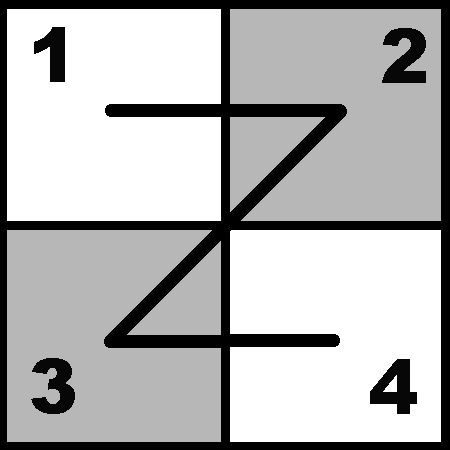
- Past
- Overall Story Signpost 1
In Act One, “what has already happened” (the Past) is explored in terms of Fate, Prediction, Interdiction, and Destiny. Scene One is dominated by Amanda’s retelling of the “...Sunday afternoon in Blue Mountain” story where she “received—-seventeen!—gentlemen callers!”. Her speech is a nice illustration of the Past in relation to Fate, Prediction, Interdiction, and Destiny (as well as allusions to the goal of the Future)...
AMANDA: There was young Champ Laughlin who later became vice-president of the Delta Planters Bank. Hadley Stevenson who was drowned in Moon Lake and left his widow one hundred and fifty thousand in Government bonds. There were the Cuttere brothers, Wesley and Bates. Bates was one of my bright particular beaux! He got in a quarrel with that wild Wainwright boy. They shot it out on the floor of Moon Lake Casino. Bates was shot through the stomach. Died in the ambulance on his way to Memphis. His widow was also well provided-for, came into eight or ten thousand acres, that’s all. She married him on the rebound—never loved her—carried my picture on him the night he died! And there was that boy that every girl in the Delta had set her cap for! That beautiful, brilliant young Fitzhugh boy from Greene County!
TOM: What did he leave his widow? . . . .
AMANDA: That Fitzhugh boy went North and made a fortune—came to be known as the Wolf of Wall Street! He had the Midas touch, whatever he touched turned to gold! And I could have been Mrs. Duncan J. Fitzhugh, mind you! But—I picked your father!
The first part of Scene Two is dominated by what Laura had been doing the previous six weeks (while NOT attending Rubicam’s Business College). The later part of Scene Two focuses on how Laura and Jim met in high school. - Progress
- Overall Story Signpost 2
Act Two explores Progress in terms of Fact, Security, Threat, and Fantasy. In Scene Three, Amanda goes into action toward securing Laura’s future.
TOM (in narrator mode): Mother was a woman of action as well as words. She began to take logical steps in the planned direction. Late that winter and in the early spring—realizing that extra money would be needed to properly feather the nest and plume the bird—she conducted a vigorous campaign on the telephone, roping in subscribers to one of those magazines for matrons called ‘The Homemaker’s Companion’...
Later in the scene, when Tom and Amanda are having it out, Amanda challenges Tom… (Security vs. Threat as it impacts Progress.)
AMANDA: “What right have you got to jeopardize your job? Jeopardize the security of us all? How do you think we’d manage if you were—”
And when Amanda does not buy Tom’s real account of what he does at night (FACT: he goes to the movies), Tom creates a completely fantasized version where he is a hired assassin and his enemies “plan to dynamite this place. They’re going to blow us all sky-high some night!! I’ll be glad, very happy…” (FANTASY)
In Scene Four, the progress of the Wingfield family’s slow disintegration is addressed by Amanda’s concern that Tom is falling into the same path as his father before him. (Security vs. Threat as it impacts Progress.) AMANDA: “And you—when I see you taking after his ways! Staying out late—and—well, you had been drinking the night you were in that—terrifying condition! Laura says that you hate the apartment and that you go out nights to get away from it! Is that true, Tom?” Even though Tom answers “no,” we know he is lying. Later in the scene is the section with the screen legend (in the written play version) “Plans and Provisions,” Amanda tells Tom of her plans for Laura and her concerns about the way things are going.
AMANDA: “We have to be making some plans and provisions for [Laura]. She’s older than you, two years, and nothing has happened. She just drifts along doing nothing. It frightens me terribly how she just drifts along…...I can see the handwriting on the wall as plain as I see the nose in front of my face! It’s terrifying! More and more you remind me of your father! He was out all hours without explanation!—Then left! Goodbye! And me with the bag to hold. I saw that letter you got from the Merchant Marine. I know what you’re dreaming of. I’m not standing here blindfolded. [She pauses.] Very well, then. Then do it! But not till there’s somebody to take your place.”
The act ends with Amanda asking Tom to find a gentleman caller for Laura and then Amanda returns to her subscription drive. - Future
- Overall Story Signpost 3
Act Three focuses on “what will happen or what will be” and is explored in terms of Openness, Delay, Choice, and Preconception. In Scene 5, Amanda harps on Tom’s smoking (issues of Choice) and comments on how he could make something of himself by going to night school with the money he’d save by not smoking (Delay vs. Choice as it impacts the Future). “AMANDA: You smoke too much. A pack a day at fifteen cents a pack. How much would that amount to in a month? . . . Figure it out and you will be astounded at what you could save. Enough to give you a night-school course in accounting at Washington U.! Just think what a wonderful thing that would be for you, son! TOM: I’d rather smoke. AMANDA: I know! That’s the tragedy of it. . .”
The largest development regarding the future in Act Three is the announcement that Tom has invited a gentleman caller (for Laura) who will arrive “Tomorrow.” Amanda immediately proceeds to think of Jim O’Connor as a “gentleman caller,” a potential husband for Laura, and starts making all kinds of assumptions about him (Preconception)—She assumes that he is Catholic, that she should serve fish, and that he might have a drinking problem because his last name is O’Connor (Irish). Before Jim has even arrived, Amanda is considering his marriage potential… (Openness vs. Preconception as it impacts the Future.) “The last thing I want for my daughter’s a boy who drinks!” Amanda’s preconceptions are balanced by Tom’s openness—Tom couldn’t care less about Jim’s background and habits. Amanda then tries to determine how well he might be able to support Laura and their future family… “AMANDA: ...But for a family man, eighty-five dollars a month is not much more than you can just get by on. . . . TOM: Yes, but Mr. O’Connor is not a family man. AMANDA: He might be, mightn’t he? Some time in the future? TOM: I see. Plans and Provisions. AMANDA: You are the only young man that I know of who ignores the fact that the future becomes the present, the present the past, and the past turns into everlasting regret if you don’t plan for it!”
Even then, his being Irish sends Amanda into a tizzy. A splendid discussion around preconception (Amanda) and openness (Tom) ensues: “AMANDA: Irish on both sides! Gracious! And doesn’t drink? TOM: Shall I call him up and ask him right this minute? AMANDA: The only way to find out about those things is to make discreet inquiries at the proper moment . . . That is the way such things are discreetly handled to keep a young woman from making a tragic mistake!”
Amanda warns against men of a “handsome appearance,” but also wants to make sure Jim is “not right-down homely” either. Tom then informs her that Jim is into self-improvement. “AMANDA: Then he has visions of being advanced in the world! Any young man who studies public speaking is aiming to have an executive job some day! And radio engineering? A thing for the future!...”
Scene Six sees the tug-of-war between Openness and Preconception continue with regard to Jim’s imminent arrival. Amanda continues her scheming for securing Laura’s future with the “gay deceivers” (falsies) for Laura and her other manipulations to get Laura interacting with Jim. Laura, meanwhile, is trying to delay (or altogether avoid) interactions with Jim—someone she has strong preconceptions about.
After Jim and Tom arrive, they have a discussion on the fire escape (Delay vs. Choice as it impacts the Future). Jim tries to convince Tom about securing his future through public speaking, and then about Tom’s potential lack of future at work—“JIM: [to Tom] You’re going to be out of a job if you don’t wake up.”, followed shortly by “TOM: I’m planning to change. I’m right at the point of committing myself to a future that doesn’t include the warehouse and Mr. Mendoza or even a night-school course in public speaking.” (DELAY vs. CHOICE) - Present
- Overall Story Signpost 4
Act Four illustrates “the current situation and circumstances” (the Present) and is explored in terms of Work, Attraction, Repulsion, and Attempt. Even though Jim and Laura briefly met in Act Three, it is not until Act Four do they come together and the “courtship” takes place.
Throughout the act (Scene Seven), Jim “works” at Laura to get her to open up (he is used to getting girls to do what he wants). JIM: “I guess being shy is something that you have to kind of work out gradually,” while Laura “attempts” to overcome her fears of interacting with people (something that is clearly NOT within her realm of experience) LAURA: “I—I—never have had much luck at—making friends.” Their discussion of Jim’s work after high school to better his situation compared to Laura’s failed attempt at business school and subsequent lack of trying; (Work vs. Attempt as it impacts the Present)
Jim’s efforts to have Laura try things that she may not have experience in but are easily within her abilities (like dancing and kissing). Attraction and Repulsion are also heavily illustrated in Act Four. The debilitating disease “pleurosis” suffered by Laura in her childhood and her resulting physical impairment (translated to ugly) contrasted to the misheard “Blue Roses” and the beautiful image they bring to mind; Jim’s beautiful singing voice and popularity contrasted by Laura’s quietness and solitude; the metaphor of the Unicorn and its beautiful singularity compared to the ordinariness of the other glass horses; etc.
Main Character
- Conceiving
- Main Character Signpost 1
- Being
- Main Character Signpost 2
- Conceptualizing
- Main Character Signpost 3
- Becoming
- Main Character Signpost 4
Influence Character
- Understanding
- Influence Character Signpost 1
- Doing
- Influence Character Signpost 2
- Obtaining
- Influence Character Signpost 3
- Learning
- Influence Character Signpost 4
Relationship Story
- Memory
- Relationship Story Signpost 1
- Preconscious
- Relationship Story Signpost 2
- Subconscious
- Relationship Story Signpost 3
- Conscious
- Relationship Story Signpost 4
Plot Progression Visualizations
Dynamic Act Schematics
OS:  MC:
MC:  IC:
IC:  RS:
RS: