The Great Gatsby
Comprehensive Storyform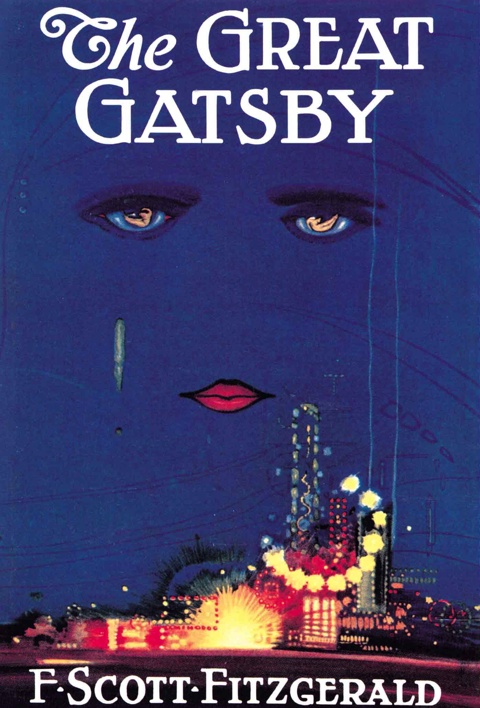
The following analysis reveals a comprehensive look at the Storyform for The Great Gatsby. Unlike most of the analysis found here—which simply lists the unique individual story appreciations—this in-depth study details the actual encoding for each structural item. This also means it has been incorporated into the Dramatica Story Expert application itself as an easily referenced contextual example.
Story Dynamics
8 of the 12 essential questions
- Change
- Main Character Resolve
Nick Carraway was raised to be tolerant of other’s moral shortcomings. The events that occurred in the summer of ‘22, however, gave him an aversion to the ways of the corrupt and dissolute, and his essential nature changed:
“In my younger and more vulnerable years my father gave me some advice that I’ve been turning over in mind ever since. ‘Whenever you feel like criticizing any one,’ he told me, ‘just remember that all the people in this world haven’t had the advantages that you’ve had.’ In consequence, I’m inclined to reserve all judgments… Reserving judgments is a matter of infinite hope. I am still a little afraid of missing something if I forget that, as my father snobbishly suggested, and I snobbishly repeat, a sense of the fundamental decencies is parceled out unequally at birth. And, after boasting this way of my tolerance, I come to the admission that it has a limit. Conduct may be founded on the hard rock or the wet marshes, but after a certain point I don’t care what it’s founded on.” - Stop
- Main Character Growth
Nick stop’s reserving judgment, as illustrated in his moral indictment of Tom and Daisy Buchanan:
“I couldn’t forgive him or like him, but I saw that what he had done was, to him, entirely justified. It was all very careless and confused. They were careless people, Tom and Daisy—they smashed up things and creatures and then retreated back into their money or their vast carelessness, or whatever it was that kept them together, and let other people clean up the mess they had made….” - Be-er
- Main Character Approach
Nick Carraway deals with personal issues internally—he prefers to adapt himself to his environment:
“I am slow-thinking and full of interior rules that act as brakes on my desires…” - Male
- Main Character Mental Sex
Nick uses the problem solving technique of cause and effect.
- Decision
- Story Driver
Although in love with the young soldier, Gatsby, in his absence Daisy decides to marry Tom:
“And all the time something within her was crying for a decision. She wanted her life shaped now, immediately-and the decision must be made by some force-of love, of money, of unquestionable practicality-that was close at hand.”
The Buchanans, Gatsby, Nick, and Jordan decide to go into town on the hottest day of the year, which results in confrontation and death:
“So we drove on toward death through the cooling twilight.”
Once he is disillusioned, Nick decides he can no longer live in the East:
“After Gatsby’s death the East was haunted for me like that, distorted beyond my eye’s power of correction. So when the blue smoke of brittle leaves was in the air and the wind blew the wet laundry stiff on the line I decided to come back home.” - Optionlock
- Story Limit
The objective characters have explored all possible avenues for fulfilling basic drives and desires.
- Failure
- Story Outcome
Nick and Jordan have a parting of the ways:
“There was one thing to be done before I left, an awkward, unpleasant thing that perhaps had better have been let alone. But I wanted to leave things in order and not just trust that obliging and indifferent sea to sweep my refuse away. I saw Jordan Baker and talked over and around what had happened to us together, and what had happened afterward to me, and she lay perfectly still, listening, in a big chair….
For just a minute I wondered if I wasn’t making a mistake then I thought it all over again quickly and got up to say good-by.
‘Nevertheless you did throw me over,’ said Jordan suddenly. ‘You threw me over on the telephone. I don’t give a damn about you now, but it was a new experience for me, and I felt a little dizzy for a while.’”
Nick reflects on Gatsby’s failure to realize his dream of obtaining Daisy:
“I went over and looked at that huge incoherent failure of a house once more…And as I sat there brooding on the old, unknown world, I thought of Gatsby’s wonder when he first picked out the green light at the end of Daisy’s dock. He had come a long way to this blue lawn, and his dream must have seemed so close that he could hardly fail to grasp it. He did not know that it was already behind him, somewhere back in that vast obscurity beyond the city, where the dark fields of the republic rolled on under the night.”
Once Wilson realizes Myrtle is having an affair, he attempts to hold onto her, which results in failure:
“He had discovered that Myrtle had some sort of life apart from him in another world…
‘I’ve got my wife locked in up there,’ explained Wilson calmly. ‘She’s going to stay there till the day after to-morrow, and then we’re going to move away.’
...A moment later she rushed out into the dusk, waving her hands and shouting—before he could move from his door the business was over.
...Myrtle Wilson, her life violently extinguished, knelt in the road and mingled her thick dark blood with the dust.” - Good
- Story Judgment
Nick realizes it’s important to have a certain amount of cynicism when interacting with human beings:
“When I came back from the East last autumn I felt that I wanted the world to be in uniform and at a sort of moral attention forever; I wanted no more riotous excursions with privileged glimpses into the human heart. Only Gatsby was exempt from my reaction—Gatsby, who represented everything for which I have an unaffected scorn.
No—Gatsby turned out all right at the end; it was what preyed on Gatsby, what foul dust floated in the wake of his dreams that temporarily closed out my interest in the abortive sorrows and short-winded elations of men.”
Overall Story Throughline
""Boats Against the Current""
- Mind
- Overall Story Throughline
The objective characters hold a fixed attitude about people and society. Tom’s prejudice about people with ethnic backgrounds other than Nordic, and his certainty of the part they will play in the downfall of western civilization, is illustrated as follows:
“‘Civilization’s going to pieces,’ broke out Tom violently. ‘I’ve gotten to be a terrible pessimist about things. Have you read ‘The Rise of the Colored Empires’ by this man Goddard?’
‘Why, no,’ I answered, rather surprised by his tone.
‘Well, it’s a fine book, and everybody ought to read it. The idea is if we don’t look out the white race will be-will be utterly submerged. It’s all scientific stuff; it’s been proved.’” - Subconscious
- Overall Story Concern
All the objective characters are concerned with their own and others’ romances. Gatsby’s concerns include Daisy leaving Tom and becoming his wife; Daisy’s concerns include a chance at reliving her girlhood through a romantic fling with Gatsby—yet retaining her secure marriage with Tom; Tom is concerned with retaining both his wife, Daisy, and his mistress, Myrtle. Myrtle would like to leave her husband, Wilson, and become the next Mrs. Tom Buchanan; Wilson is concerned with keeping his wife Myrtle; Nick and Jordan are halfway in love with each other.
- Dream
- Overall Story Issue
Gatsby’s dream of obtaining Daisy went far beyond mere hope:
“He had been full of the idea so long, dreamed it right through to the end, waited with his teeth set, so to speak, at an inconceivable pitch of intensity.” - Hope
- Overall Story Counterpoint
Wilson can only hope that Tom will sell him his auto:
“When he saw us a damp gleam of hope sprang into his light blue eyes.
‘Hello, Wilson old man,’ said Tom, slapping him jovially on the shoulder. ‘How’s business?’
‘I can’t complain,’ answered Wilson unconvincingly.
‘When are you going to sell me that car?’
‘Next week; I’ve got my man working on it now.’
‘Works pretty slow, don’t he?’
‘No he doesn’t,’ said Tom coldly. ‘And if you feel that way about it, maybe I’d better sell it somewhere else after all.’” - Overall Story Thematic Conflict
Dream vs.Hope - Faith
- Overall Story Problem
Gatsby believes he can become a myth of his own making—a myth that only causes him unhappiness and unfulfilled dreams:
“He invented just the sort of Jay Gatsby that a seventeen-year-old boy would be likely to invent, and to this conception he was faithful to the end.”
Tom’s unfaithfulness with Myrtle, and Daisy’s unfaithfulness with Gatsby, causes problems in their marriage, as well as problems in Myrtle and Wilson’s marriage.
Nick is appalled to find that Gatsby’s mentor, Meyer Wolfsheim, fixed the 1919 World’s Series, and played “with the faith of fifty million people…” - Disbelief
- Overall Story Solution
Gatsby had faith in his dream of obtaining Daisy when he should have had disbelief. Nick’s eventual distrust of Tom, Daisy, and Jordan allows him to become realistic in regard to human nature.
- Support
- Overall Story Symptom
Nick and Jordan support Gatsby’s efforts to attain Daisy:
“‘He wants to know,’ continued Jordan, ‘if you’ll invite Daisy to your house some afternoon and then let him come over.’...‘And Daisy ought to have something in her life,’ murmured Jordan to me.”
Catherine supports Myrtle’s dream of leaving Wilson and marrying Tom:
“‘She really ought to get away from him,’ remarked Catherine to me. ‘They’ve been living over that garage for eleven years. And Tom’s the first sweetie she ever had.’
‘When they do get married,’ continued Catherine, ‘they’re going West to live for a while until it blows over.’” - Oppose
- Overall Story Response
Gatsby opposes Daisy’s marriage to Tom:
“‘She never loved you, do you hear?’ he cried. ‘She only married you because I was poor and she was tired of waiting for me. It was a terrible mistake, but in her heart she never loved any one except me!’”
Tom opposes Daisy’s relationship with Gatsby:
“‘She’s not leaving me!’ Tom’s words suddenly leaned down over Gatsby. ‘Certainly not for a common swindler who’d have to steal the ring he put on her finger.’”
Daisy protests as the two men quarrel over her:
“‘I won’t stand this!’ cried Daisy. ‘Oh, please let’s get out.’” - Denial
- Overall Story Catalyst
Gatsby’s denial that Daisy ever loved Tom precipitates the harrowing events that followed:
“It passed, and he began to talk excitedly to Daisy, denying everything, defending his name against accusations that had not been made. But with every word she was drawing further and further into herself, so he gave that up, and only the dead dream fought on as the afternoon slipped away, trying to touch what was no longer tangible, struggling unhappily, undespairingly, toward that lost voice across the room.” - Openness
- Overall Story Inhibitor
Nick’s initial tolerance of Gatsby, Jordan, and the Buchanans’ prolongs his stay in the East.
- Memory
- Overall Story Benchmark
The more the primary characters recall their memories, the more progress is made in an effort to achieve the goal.
- Overall Story Throughline Synopsis
Nick Carraway happens to move next door to “the great Gatsby,” a self-made millionaire who had a long ago love affair with Nick’s cousin, Daisy. Nick becomes involved with the resumption of their affair, and the destruction and havoc it wreaked for all.
Additional Overall Story Information →
Main Character Throughline
Nick Carraway — Cousin of Daisy, old school-mate of Tom's.
- Psychology
- Main Character Throughline
Nick explores a new way of thinking about others’ moral shortcomings.
- Becoming
- Main Character Concern
Nick becomes realistic in the ways of the morally corrupt and changes his tolerant nature.
- Commitment
- Main Character Issue
Nick fulfills the commitment to his friendship with Gatsby by taking on the responsibilities associated with Gatsby’s death, e.g., making funeral arrangements:
“I found myself on Gatsby’s side, and alone. From the moment I telephoned news of the catastrophe to West Egg Village, every surmise about him, and every practical question, was referred to me. At first I was surprised and confused; then, as he lay in his house and didn’t move or breathe or speak, hour upon hour, it grew upon me that I was responsible, because no one else was interested—interested, I mean, with that intense personal interest to which every one has some vague right at the end.”
Before making any kind of romantic commitment to Jordan, Nick feels responsible to “get myself definitely out of that tangle back home.” - Responsibility
- Main Character Counterpoint
- Main Character Thematic Conflict
Commitment vs.Responsibility - Faith
- Main Character Problem
Nick has too much faith in his fellow men and women: “I’m inclined to reserve all judgments…”
- Disbelief
- Main Character Solution
Although Nick was raised to have faith in people, regardless of their moral shortcomings, he eventually comes to disbelieve this ideal.
- Pursuit
- Main Character Symptom
Nick pursues a better life in the East because he believes his home in the Middle West is provincial after his time at Yale and stint in the Great War:
“I graduated from New Haven in 1915, just a quarter of a century after my father, and a little later I participated in that delayed Teutonic migration known as the Great War. I enjoyed the counter-raid so thoroughly that I came back restless. Instead of being the warm center of the world, the Middle West now seemed like the ragged edge of the universe.” - Avoid
- Main Character Response
Nick reconsiders his decision to live in the East and prepares to return to his roots:
“I see now that this has been a story of the West, after all-Tom and Gatsby, Daisy and Jordan and I, were all Westerners, and perhaps we possessed some deficiency in common which made us subtly unadaptable to Eastern life.”
People seek Nick out because of his non-judgmental nature, oftentimes to his dismay:
“...I’m inclined to reserve all judgments, a habit that has opened up many curious natures to me and also made me the victim of not a few veteran bores. The abnormal mind is quick to detect and attach itself to this quality when it appears in a normal person, and so it came about that in college I was unjustly accuses of being a politician, because I was so privy to the secret griefs of wild, unknown men. Most of the confidences were unsought-frequently I have feigned sleep, preoccupation, or a hostile levity when I realized by some unmistakable sign that an intimate revelation was quivering on the horizon…” - Obligation
- Main Character Unique Ability
Nick is obligated to remain true to himself, therefore he refuses to settle for anything less than a true love who has the same kind of integrity as he:
“Every one suspects himself of at least one of the cardinal virtues, and this is mine: I am one of the few honest people that I have ever known.” - Approach
- Main Character Critical Flaw
Nick’s honesty keeps him from pursuing a relationship with Jordan:
“‘I’m thirty,’ I said. ‘I’m five years too old to lie to myself and call it honor.’
She didn’t answer. Angry, and half in love with her, and tremendously sorry, I turned away.” - Conceptualizing
- Main Character Benchmark
Over the course of the summer, Nick realizes he can no longer imagine a happy life on the East coast:
“After Gatsby’s death the East was haunted for me like that, distorted beyond my eye’s power of correction. So when the blue smoke of brittle leaves was in the air and the wind blew the wet laundry stiff on the line I decided to come back home.” - Main Character Description
“I never saw this great-uncle, but I’m supposed to look like him-with special reference to the rather hard-boiled painting that hangs in father’s office.”
- Main Character Throughline Synopsis
Nick is a man who all his life has tried to be fair and non-judgmental, until the occurrence of events in the summer of 1922.
Additional Main Character Information →
Influence Character Throughline
Jay Gatsby — Daisy's lover
- Physics
- Influence Character Throughline
To attain great wealth, Gatsby involves himself in shady financial dealings—to obtain Daisy, Gatsby buys a mansion across the water from her home, and throws parties in hopes she will attend.
- Obtaining
- Influence Character Concern
Gatsby is concerned with attaining vast wealth in order to obtain Daisy.
- Self-Interest
- Influence Character Issue
For Gatsby, self-interest is his own kind of morality:
“He might have despised himself, for he had certainly taken her under false pretenses. I don’t mean that he had traded on his phantom millions, but he had deliberately given Daisy a sense of security; he let her believe that he was a person from much the same stratum as herself-that he was fully able to take care of her. As a matter of fact, he had no such facilities…but he didn’t despise himself and it didn’t turn out as he had imagined. He had intended, probably, to take what he could and go-but he found that he had committed himself to the following of a grail.” - Morality
- Influence Character Counterpoint
- Influence Character Thematic Conflict
Self-Interest vs.Morality - Help
- Influence Character Problem
Jay Gatsby allows the wrong kind of people to help him further his ambitions:
“‘Did you start him in business?’ I inquired.
‘Start him! I made him.’
‘Oh.’
‘I raised him up out of nothing, right out of the gutter. I saw right away he was a fine-appearing, gentlemanly young man, and when he told me he was an Oggsford I knew I could use him good. I got him to join up in the American Legion and he used to stand high there. Right off he did some work for a client of mine up to Albany. We were so thick like that in everything”-he held up two bulbous fingers-“always together.’
I wondered if this partnership had included the World’s Series transaction in 1919.”
To keep his meeting with Daisy quiet, Gatsby must let go of his “help”:
“‘I hear you fired all your servants.’
‘I wanted somebody who wouldn’t gossip. Daisy comes over quite often-in the afternoons.’” - Hinder
- Influence Character Solution
If Gatsby’s “extravagant ambitions” for wealth and glamour had been hindered—his desire for Daisy-the woman who embodied this dream—may not have developed.
- Support
- Influence Character Symptom
Nick accepts Gatsby’s friendship unconditionally, that is why he finds Gatsby’s offer of “support,” for the favor of using his home as a meeting place for Gatsby and Daisy, repugnant:
“‘I thought if you don’t make very much-You’re selling bonds, aren’t you, old sport?’
‘Trying to.’
‘Well, this would interest you. It wouldn’t take up much of your time and you might pick up a nice bit of money. It happens to be a rather confidential sort of thing.’
I realize now that under different circumstances that conversation might have been one of the crises of my life. But, because the offer was obviously and tactlessly for a service to be rendered, I had no choice except to cut him off there.” - Oppose
- Influence Character Response
Gatsby vehemently opposes Nick’s suggestion that he cannot repeat the past.
- Attitude
- Influence Character Unique Ability
The impact Gatsby’s rationalization of Daisy’s behavior has on Nick is twofold, increased sympathy for Gatsby, a man fighting a “dead dream” and disenchantment for Daisy et al:
“‘They’re a rotten crowd,’ I shouted across the lawn. ‘You’re worth the whole damn bunch put together.’
Although Nick “disapproved of him from beginning to end,” his friendship with Gatsby transcended his ultimate intolerance of immoral people:
“Only Gatsby, the man who gives his name to this book, was exempt from my reaction-Gatsby, who represented everything for which I have an unaffected scorn. If personality is an unbroken series of successful gestures, then there was something gorgeous about him, some heightened sensitivity to the promises of life…” - Rationalization
- Influence Character Critical Flaw
To keep his dream alive, it is imperative that Gatsby rationalize Daisy’s fickle behavior to himself and Nick-a rationalization that Nick finds pathetic:
“‘I don’t think she ever loved him,’ Gatsby turned around from a window and looked at me challengingly. ‘You must remember, old sport, she was very excited this afternoon. He told her those things in a way that frightened her—that made it look as if I was some kind of cheap sharper. And the result was she hardly knew what she was saying.’
He sat down gloomily.
‘Of course she might have loved him just for a minute, when they were first married—and loved me more even then, do you see?’” - Understanding
- Influence Character Benchmark
The more Gatsby works on creating and convincing others of his phony persona-“the long secret extravaganza”-the better the audience can understand his desperation in obtaining Daisy.
- Influence Character Description
Jay Gatsby is Daisy Buchanan’s long lost love.
- Influence Character Throughline Synopsis
As a young man, James Gatz invented the persona of Jay Gatsby, and devoted his life to remaining true to this conception of himself which included living a life of wealth and glamour-and obtaining Daisy-a woman who embodied all that he desired.
More Influence Character Information →
Relationship Story Throughline
""The Dreamer and the Realist""
- Universe
- Relationship Story Throughline
As a set of external circumstances, Nick and Gatsby’s homes are situated next to each other; Nick is related to the object of Gatsby’s desire (he is Daisy’s distant cousin)—and is willing to help Gatsby in his endeavor to obtain Daisy.
- Future
- Relationship Story Concern
Gatsby dreams of the future; Nick understands we truly never have a future, only the past:
“Gatsby believed in the green light, the orgiastic future that year by year recedes before us. It eludes us then, but that’s no matter—tomorrow we will run faster, stretch out our arms farther…And one fine morning-
So we beat on, boats against the current, borne back ceaselessly into the past.” - Choice
- Relationship Story Issue
Gatsby chooses the times he spends with Nick, delaying their mutual trust and inevitable friendship:
“It was the first time he had called on me, though I had gone to two of his parties, mounted in his hydroplane, and, at his urgent invitation, made frequent use of his beach.”
Gatsby selects Nick’s cottage (and therefore Nick’s approval) for his first assignation after many years with Daisy:
“‘He wants to know,’ continued Jordan, ‘if you’ll invite Daisy to your house some afternoon and then let him come over.’
The modesty of the demand shook me. He had waited five years and bought a mansion where he dispensed starlight to casual moths—so that he could ‘Come over’ some afternoon to a stranger’s garden.
‘Did I have to know all this before he could ask such a little thing?’
‘He’s afraid, he’s waited so long. He thought you might be offended. You see, he’s a regular tough underneath it all.’” - Delay
- Relationship Story Counterpoint
- Relationship Story Thematic Conflict
Choice vs.Delay - Faith
- Relationship Story Problem
Nick is in the process of changing his tolerance of people’s moral shortcomings. Although he instinctively knows Gatsby is corrupt—it is Gatsby’s faith in his dream that endears him to Nick.
Nick continually loses and renews faith in Gatsby:
“I wanted to get up and slap him on the back. I had one of those renewals of complete faith in him that I’d experienced before.” - Disbelief
- Relationship Story Solution
His disbelief in Gatsby allows Nick to accept their relationship:
“‘They’re a rotten crowd,’ I shouted across the lawn. ‘You’re worth the whole damn bunch put together.’
I’ve always been glad I said that. It was the only compliment I ever gave him, because I disapproved of him from beginning to end.” - Consider
- Relationship Story Symptom
Nick considers all he discovers about Gatsby—the facts, the rumors, and his own impressions.
- Reconsider
- Relationship Story Response
Once Nick learns the truth of Gatsby’s past, and understands the man that he really is—he reconsiders his friendship with him and concludes it still viable.
- Preconception
- Relationship Story Catalyst
Nick does not allow his preconceptions of Gatsby stand in the way of their growing friendship.
- Closure
- Relationship Story Inhibitor
Each time Gatsby closes Nick out, the relationship between them slows down:
“It was a halt, too, in my association with his affairs. For several weeks I didn’t see him or hear his voice on the phone—“ - Past
- Relationship Story Benchmark
Nick has a better understanding of Gatsby when Gatsby relates to him his past, and it draws them closer together:
“He told me all this very much later, but I’ve put it down here with the idea of exploding those first wild rumors about his antecedents, which weren’t even faintly true. Moreover he told it to me at a time of confusion, when I had reached the point of believing everything and nothing about him. So I take advantage of this short halt, while Gatsby, so to speak, caught his breath, to clear this set of misconceptions away.” - Relationship Story Throughline Synopsis
Although Nick disapproves of Gatsby, he admires the tenacity with which he holds onto his dream. There are many who take advantage of Gatsby’s hospitality, but in the end, it is only Nick who is his true friend.
Additional Relationship Story Information →
Additional Story Points
Key Structural Appreciations
- Subconscious
- Overall Story Goal
The goal common to all the objective characters is the romance between Gatsby and Daisy—some are in favor of the romance, others are against it.
- Future
- Overall Story Consequence
After the events of the summer of ‘22, the future of the community radically changes:
“I see now that this has been a story of the West, after all—Tom and Gatsby, Daisy and Jordan and I, were all Westerners, and perhaps we possessed some deficiency in common which made us subtly unadaptable to Eastern life.” - Obtaining
- Overall Story Cost
Gatsby dies while trying to achieve the goal. Although Myrtle and Wilson play minor parts in the romance of Gatsby and Daisy, they also die.
Myrtle obtains a broken nose from her lover, Tom, when she dares to utter Daisy’s name. - Becoming
- Overall Story Dividend
Gatsby becomes a member of high society.
After Tom rents a posh flat in New York for his clandestine meetings with Myrtle, she believes, albeit temporarily, that she has become a member of high society:
“Throwing a regal homecoming glance around the neighborhood, Mrs. Wilson gathered up her dog and her other purchases, and went haughtily in.” - Memory
- Overall Story Requirements
Gatsby’s memory of his and Daisy’s courtship drives him to pursue his personal goal of obtaining her.
Daisy carries her “well-forgotten dreams from age to age,” allowing her to take up once again with Gatsby.
Jordan’s memory of Gatsby and Daisy’s long ago romance compels her to help them renew their love affair:
“‘The officer looked at Daisy while she was speaking, in a way that every young girl wants to be looked at some time, and because it seemed romantic to me I have remembered the incident ever since. His name was Jay Gatsby…
I think he half expected her to wander into one of his parties, some night, but she never did. Then he began asking people casually if they knew her, and I was the first one he found…
Daisy ought to have something in her life…’” - Past
- Overall Story Prerequisites
All the primary objective characters share in each other’s past—this is where the battle lines are drawn.
- Understanding
- Overall Story Preconditions
Nick attempts to make Gatsby understand he cannot repeat the past:
“He wanted nothing less of Daisy than that she should go to Tom and say: ‘I never loved you…’
‘I wouldn’t ask too much of her,’ I ventured. ‘You can’t repeat the past.’
‘Can’t repeat the past?’ he cried incredulously. ‘Why of course you can!’
He looked around him wildly, as if the past were lurking here in the shadow of his house, just out of reach of his hand.”
Because Tom understands Daisy so well, he knows if he reminds her of the good memories of their shared past, she will not be able to deny she ever loved him—a denial that is essential for Gatsby to hear:
“‘I never loved him,’ she said, with perceptible reluctance.
‘Not a Kapiolani?’ demanded Tom suddenly.
‘No.’
‘...Not that day I carried you down from the Punch Bowl to keep your shoes dry?’ There was a husky tenderness in his tone….‘Daisy?’
...‘Oh, you want too much!’ she cried to Gatsby. ‘I love you now-isn’t that enough? I can’t help what’s past.’ She began to sob helplessly. ‘I did love him once-but I loved you too.’” - Conceptualizing
- Overall Story Forewarnings
Wilson is prepared to change his and Myrtle’s future after he finds out she is having an affair:
“He had discovered that Myrtle has some sort of life apart from him in another world, and the shock had made him physically sick…‘I’ve got my wife locked in up there,’ explained Wilson calmly. ‘She’s going to stay there till the day after to-morrow, and then we’re going to move away.’”
Plot Progression
Dynamic Act Appreciations
Overall Story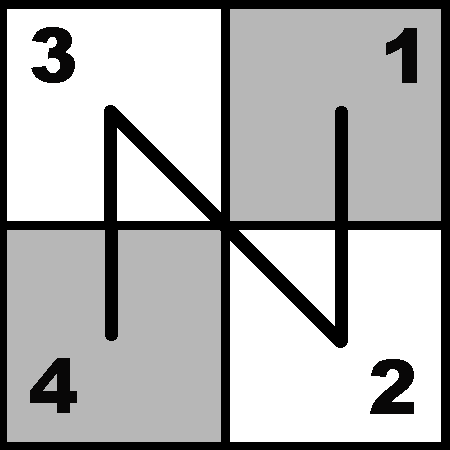
- Preconscious
- Overall Story Signpost 1
Daisy, Jordan, and Nick are concerned with Tom’s telephone conversation with his mistress, Myrtle:
“I couldn’t guess what Daisy and Tom were thinking, but I doubt if even Miss Baker, who seemed to have mastered a certain hardy skepticism, was able utterly to put this fifth guest’s shrill metallic urgency out of mind. To a certain temperament the situation might have seemed intriguing-my own instinct was to telephone immediately for the police.” - Conscious
- Overall Story Signpost 2
Tom and Daisy attend one of Gatsby’s parties, which gives a new perspective of the man and his “whole caravansary” to himself, Tom, Nick, and Daisy:
“Tom was evidently perturbed at Daisy’s running around alone, for on the following Saturday night he came with her to Gatsby’s party. Perhaps his presence gave the evening its peculiar quality of oppressiveness-it stands out in my memory from Gatsby’s other parties that summer. There were the same people, or at least the same sort of people, the same profusion of champagne, the same many colored, many-keyed commotion, but I felt an unpleasantness in the air, a pervading harshness that hadn’t been there before. Or perhaps I had merely grown used to it, grown to accept West Egg as a world complete in itself, with its own standards and its own great figures, second to nothing because it had no consciousness of being so, and now I was looking at it again, through Daisy’s eyes. It is invariably saddening to look through new eyes at things upon which you have expended your own powers of adjustment.” - Memory
- Overall Story Signpost 3
Gatsby’s subjective view of what happened five years ago in Louisville precipitates a row that includes Daisy, Gatsby, and Tom—and causes extreme embarrassment for Nick and Jordan:
“‘She never loved you, do you hear?’ he cried. ‘She only married you because I was poor and she was tired of waiting for me. It was a terrible mistake, but in her heart she never loved any one except me!’
At this point Jordan and I tried to go, but Tom and Gatsby insisted with competitive firmness that we remain-” - Subconscious
- Overall Story Signpost 4
Gatsby’s father comes to grieve for his son:
“After a little while Mr. Gatz opened the door and came out, his mouth ajar, his face flushed slightly, his eyes leaking isolated and unpunctual tears.”
Tom tries to convince Nick of his depth of feelings for Myrtle’s death:
“‘And if you think I didn’t have my share of suffering-look here, when I went to give up that flat and saw that damn box of dog biscuits sitting there on the sideboard, I sat down and cried like a baby. By God it was awful-’”
Nick realizes he cannot continue a relationship with Jordan:
“Angry, and half in love with her, and tremendously sorry, I turned away.”
Main Character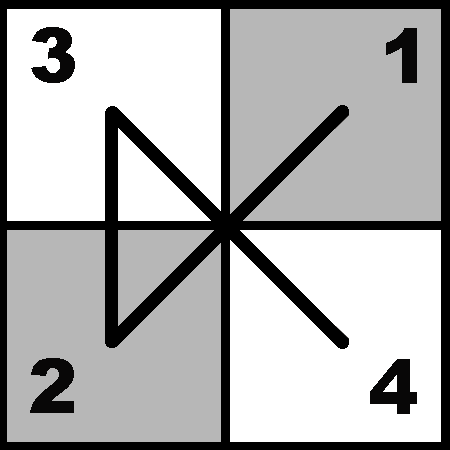
- Being
- Main Character Signpost 1
Nick is concerned with being part of the Eastern lifestyle:
“I was within and without, simultaneously enchanted and repelled by the inexhaustible variety of life.” - Becoming
- Main Character Signpost 2
Nick is concerned with becoming a bond salesman:
“Most of the time I worked…I went upstairs to the library and studied investments and securities for a conscientious hour.”
He is concerned with becoming free of a romantic entanglement back home so that he may begin a relationship with Jordan:
“I knew that first I had to get myself definitely out of that tangle back home…there was a vague understanding that had to be tactfully broken off before I was free.” - Conceptualizing
- Main Character Signpost 3
Nick visualizes his future:
“I was thirty. Before me stretched the portentous, menacing road of a new decade…Thirty-the promise of a decade of loneliness, a thinning list of single men to know, a thinning briefcase of enthusiasm, thinning hair.”
- Conceiving
- Main Character Signpost 4
Nick cannot conceive that those who had called themselves friends of Gatsby’s in life, would not honor his death by attending the funeral.
Influence Character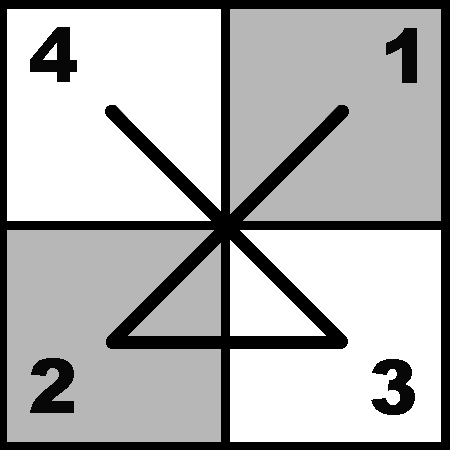
- Doing
- Influence Character Signpost 1
Gatsby gives large parties, in hopes Daisy will attend.
- Obtaining
- Influence Character Signpost 2
Gatsby wants to obtain the favor from Nick of using his cottage for Gatsby and Daisy’s rendezvous.
Gatsby believes if he can recapture the past—he will possess once again the romance he and Daisy shared:
“He talked a lot about the past, and I gathered that he wanted to recover something, some idea of himself perhaps, that had gone into loving Daisy. His life had been confused and disordered since then, but if he could once return to a certain starting place and go over it all slowly, he could find out what that thing was…” - Learning
- Influence Character Signpost 3
Tom’s suspicions concerning Gatsby and his background instigate his investigation of the man:
“‘I’d like to know who he is and what he does,’ insisted Tom. ‘And I think I’ll make a point of finding out.’”
And later:
“‘Who are you, anyhow?’ broke out Tom. ‘You’re one of that bunch that hangs around with Meyer Wolfsheim-that much I know. I’ve made a little investigation into your affairs-and I’ll carry it further to-morrow.’” - Understanding
- Influence Character Signpost 4
Nick compares Gatsby’s lack of understanding the hopelessness of his dream with that of a new world explorer:
“...for a transitory enchanted moment man must have held his breath in the presence of this continent, compelled into an aesthetic contemplation he neither understood nor desired, face to face for the last time in history with something commensurate to his capacity for wonder.
And as I sat there brooding on the old, unknown world, I thought of Gatsby’s wonder when he first picked out the green light at the end of Daisy’s dock.”
Relationship Story
- Past
- Relationship Story Signpost 1
Nick is curious about Gatsby and his past:
“‘Who is he?’ I demanded. ‘Do you know?’
“...I would have accepted without question the information that Gatsby sprang from the swamps of Louisiana or from the lower East Side of New York. That was comprehensible. But young men didn’t-at least in my provincial inexperience I believed they didn’t-drift coolly out of nowhere and buy a palace on Long Island Sound.” - Progress
- Relationship Story Signpost 2
The progress of Nick and Gatsby’s relationship is slow, as Nick feels Gatsby is not honest about himself:
“He looked at me sideways-and I knew why Jordan Baker had believed he was lying. He hurried the phrase ‘educated at Oxford,’ or swallowed it, or choked on it, as though it had bothered him before. And with this doubt, his whole statement fell to pieces, and I wondered if there wasn’t something a little sinister about him, after all.” - Future
- Relationship Story Signpost 3
Gatsby refuses to follow Nick’s suggestion that he leave town until the implications of his involvement with Myrtle’s death have been cleared up:
“Toward dawn I heard a taxi go up Gatsby’s drive, and immediately I jumped out of bed and began to dress-I felt that I had something to tell him, something to warn him about, and morning would be too late…
‘You ought to go away,’ I said. ‘It’s pretty certain they’ll trace your car.’
‘Go away now, old sport?’
‘Go to Atlantic City for a week, or up to Montreal.’
He wouldn’t consider it. He couldn’t possibly leave Daisy until he knew what she was going to do.” - Present
- Relationship Story Signpost 4
Heeding Gatsby’s request from beyond the grave, Nick attempts to track down friends and acquaintances of Gatsby’s to honor his death. Much to his dismay, Nick discovers that those who greedily accepted Gatsby’s hospitality in life, disappeared upon his death.
” ..As they drew back the sheet and looked at Gatsby with unmoved eyes, his protest continued in my brain:
‘Look here, old sport, you’ve got to get somebody for me. You’ve got to try hard. I can’t go through this alone.’”
Plot Progression Visualizations
Dynamic Act Schematics
OS:  MC:
MC:  IC:
IC:  RS:
RS: