Bringing Up Baby
Comprehensive Storyform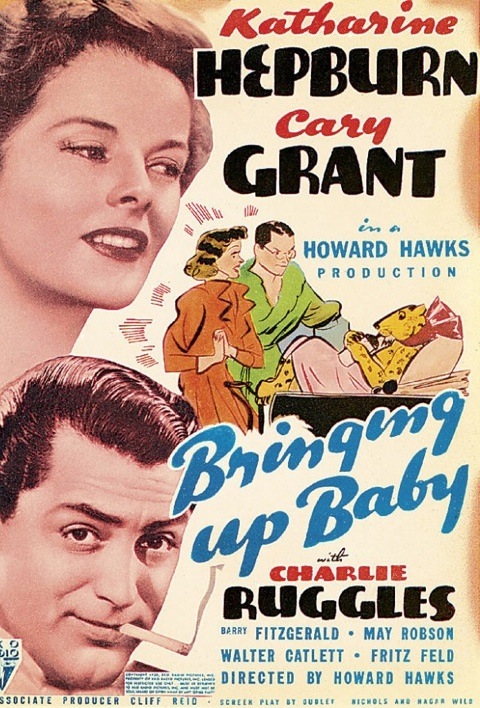
The following analysis reveals a comprehensive look at the Storyform for Bringing Up Baby. Unlike most of the analysis found here—which simply lists the unique individual story appreciations—this in-depth study details the actual encoding for each structural item. This also means it has been incorporated into the Dramatica Story Expert application itself as an easily referenced contextual example.
Story Dynamics
8 of the 12 essential questions
- Change
- Main Character Resolve
The change David ultimately makes doesn’t happen in a leap of faith, but gradually, over the course of the entire film. In the opening shot of the film, David is sitting in his “Thinker” pose, with his attention entirely on his work. At the end, after Alice has left and Susan shows up at the museum, David doesn’t seem to care that she has found the bone and is giving him the million dollars inherited from Aunt Elizabeth. In fact he says that he’s been giving it a lot of thought and the day he spent with her was the best day he’d ever had in his whole life. (nb: in a scene that was ultimately left on the cutting room floor, Alice tells David “...since your experience with that girl you’ve been a changed person. And I don’t appreciate the change.”) A more subtle, visual clue is that in the beginning, David is always wearing glasses (despite the fact that Susan tells him he’s so good looking without them), and at the end he is working on his dinosaur without glasses.
- Start
- Main Character Growth
David ultimately needs to do something about the fact that deep down he really loves Susan. Early on, he admits that “In moments of quiet, I’m strangely drawn to you. But, well, there haven’t been any quiet moments.” When David jumps to Susan’s rescue at the end (after Susan has just dragged in the wild leopard), Susan accepts it has an acknowledgment of his love.
- Be-er
- Main Character Approach
In the opening shot, David is sitting on a scaffold, in perfect imitation of Rodan’s famous “Thinker” sculpture. Although he does quite a bit of protesting, David rarely takes direct action to get what he wants. He quietly accepts Alice’s proclamation that they will have no children. He grudgingly goes along with Susan’s story that his name is David Bone and that he recently suffered a nervous breakdown. When Alice leaves, calling him a butterfly, he simply mutters to himself and lets her go.
- Male
- Main Character Mental Sex
David is not one to see the bigger picture. He has a tendency to look only at the effects and causes of his circumstances and doesn’t appreciate the process until it is all over. He looks at the effects of Susan’s actions and blames her for all of his problems. He does not understand nor have patience for Susan’s decidedly non-linear way of thinking.
- Action
- Story Driver
In the first scene, a telegram arrives telling David of the arrival of the intercostal clavicle. On the golf course, Susan mistakenly plays David’s ball, forcing David to run after her to rectify the situation. At Aunt Elizabeth’s house, George the dog runs off with David’s bone, forcing David to decide between finding the bone, or going back to Alice without it. Baby is accidentally let out of the stall and runs away, and David must choose between not caring or dealing with Susan’s threat of telling Aunt Elizabeth everything.
- Optionlock
- Story Limit
Although a timelock is indicated in the opening scene (Alice reminds David that they will be getting married the next day), that apparent deadline comes and goes while David and Susan are chasing George to get the bone. Since the goal is obtaining the million dollars, David can essentially take as much time as he needs until he either gets the money, or through his actions completely blows the opportunity.
- Success
- Story Outcome
Susan announces to David that she’s received the million dollars from Aunt Elizabeth and is giving it to David for the museum. She also tells him that she has found his missing intercostal clavicle.
- Good
- Story Judgment
This is a good example of the fact that story judgment can sometimes be a matter of degrees. When Susan arrives at the museum after Alice has left, David thanks her for finding the bone and tells her to leave. Susan tells him that she has the million dollars and still David doesn’t seem too thrilled. However, when Susan apologizes for ruining everything, David tells her that he ought to thank her. He says that he has just discovered that it was the best day he had ever had in his life, but more than that, he says, he thinks he loves her.
Overall Story Throughline
""
- Physics
- Overall Story Throughline
The problems in Bringing Up Baby revolve around a variety of activities including trying to obtain a million dollar donation for the museum, searching for the lost intercostal clavicle, hunting for a pair of leopards, singing songs to the leopards, tossing rocks at Mr. Peabody, etc.
- Obtaining
- Overall Story Concern
David and Alice have been waiting for the arrival of the intercostal clavicle. David is attempting to obtain a million dollars for the Stuyvesant museum. Susan has just received a leopard from her brother in South America. David, Susan, Applegate, the gardener and the men from the circus are all at one point or another hunting for leopards. The constable doesn’t believe there are any leopards in Connecticut and furthermore doesn’t believe that Susan has an aunt.
- Approach
- Overall Story Issue
Everyone in the story seems to have an odd approach to going about their business. Susan admits to just doing the first thing that pops into her head; When David is chasing after George and Baby, he’s wearing jodhpurs and carrying a croquet mallet and a butterfly net; Major Applegate enjoys demonstrating his leopard call technique; Dr. Lehman purports to be a rational psychiatrist, but comes across as being a bit crazy himself.
- Attitude
- Overall Story Counterpoint
Susan’s cheerful demeanor contrasts sharply with David’s bitter attitude about the situation he finds himself in. Dr. Lehman’s superior attitude causes problems for David in the restaurant and the next night for Susan when she sings outside his window. Constable Slocum’s impatience and frustration with virtually everyone causes problems for himself and everyone around him.
- Overall Story Thematic Conflict
Approach vs.AttitudeThough not a particularly deep message, the thematic conflict seems to be that as long as your attitude is good it doesn’t matter how crazy your approach is to a given problem.
- Logic
- Overall Story Problem
Throughout the story, errors in logic cause a number of problems for the characters. Alice’s logical decision to cancel the honeymoon, and to not have children goes against David’s dreams of having a family and settling down; When David tries to explain logically to Susan that she is in his car, communication breaks down and she ends up driving away with David on the running board. One of the larger problems is caused by the fact that logically (as Major Applegate points out) “There can be no leopards in Connecticut.” When they are all in jail, Slocum echoes that sentiment, and his faulty logic precludes him from believing anything Susan says, even the fact that Susan has an aunt.
- Feeling
- Overall Story Solution
When Susan enters the jail pulling on the wild leopard, David, reacting in fear for Susan’s life, jumps to her rescue. As a result of his newfound heroism, Susan is overcome with joy (and David promptly faints in her arms). Miss Swallow ends her engagement to David, feeling that he is not the dignified scientist she thought him to be; Aunt Elizabeth acquiesces to her niece’s feelings for David, and gives her the one million dollars that Susan can pass on to the museum; etc.
- Reconsider
- Overall Story Symptom
Much of what happens in the story occurs because David is afraid that Mrs. Random will reconsider donating the million dollars to the museum if she discovers that David “Bone” is really David Huxley.
- Consider
- Overall Story Response
Because of their focus on reconsideration, the characters in “Bringing Up Baby” spend a great deal of effort pondering the situation. David can be seen several times with his chin on his hand, deep in thought, and muttering to himself about what he has gotten himself into; Constable Slocum, after putting in a call to Aunt Elizabeth and determining that Susan doesn’t have an aunt, gives great consideration to just how far this conspiracy of thieves runs; Susan considers the idea that David really loves her and puts her efforts toward getting him to discover this; Aunt Elizabeth wonders who this “friend of Mark’s” is and what it is he doing at her house.
- Self-Interest
- Overall Story Catalyst
When David is playing golf with Mr. Peabody and sees Susan playing his ball, he forgets that he is trying to get money for the museum and runs to get his ball and car back. Susan doesn’t seem to notice or care that she is playing David’s golf ball or stealing his car which puts David into a precarious position with Mr. Peabody. Susan feigns being attacked by a leopard just to get David over to her apartment.
- Responsibility
- Overall Story Inhibitor
Being a psychiatrist, Dr. Lehman believes that it is his responsibility to abduct Susan while she is singing to Baby on the roof, believing that she is clearly crazy. Constable Slocum, also feels it is his responsibility as “the law in these parts,” to protect the world from the “conspiracy” he finds himself uncovering.
- Doing
- Overall Story Benchmark
The progress in the objective story concerns David being able to get back to New York with the intercostal clavicle and the million dollars. However, he is taken away from his golf game as he chases after his golf ball and his car. His attempt to meet Mr. Peabody that night ends with the lawyer being knocked unconscious with a rock. David spends the better part of the next day hunting for a bone and a leopard, and finally trying to explain away the events of the last twenty-four hours while in jail.
- Overall Story Throughline Synopsis
The objective story throughline in Bringing up Baby is decidedly sparse, as the story focuses much more on the relationship and misadventures of Susan and David. The objective story, such as it is, deals with the fact that David and his colleagues want the wealthy Mrs. Carleton Random to donate one million dollars to the museum. When David meets Mrs. Random’s lawyer, he runs into Susan Vance, Mrs. Random’s niece (though he doesn’t at first make this connection). Susan has recently gained possession of a tame leopard named Baby, and needs to take it to Connecticut. Unbeknownst to Susan or David, a circus is in town and a wild leopard has maimed a circus worker. When Baby accidentally escapes, they mistake the wild leopard for Baby and vice versa. Mayhem ensues.
- Overall Story Backstory
Mrs. Carleton Random is considering donating a million dollars to the Stuyvesant Museum. Her nephew, Mark, has sent a tame leopard to Mrs. Random’s niece, Susan, for her to deliver to her aunt.
Additional Overall Story Information →
Main Character Throughline
David — Zoologist
- Mind
- Main Character Throughline
David has a very rigid view of how his life is supposed to unfold. He knows that he will be getting married tomorrow and there is nothing that will change his thinking.
- Subconscious
- Main Character Concern
David has spent his whole life squelching his desires (or having them squelched for him). He would like to get married and have children, but Alice steers him in another direction. Although he thinks that he is driven to get married as quickly as possible, and to get back to the museum and finish building his dinosaur, he finds himself in the position (at least at one point) of having to fight his desire to kiss Susan.
- Hope
- Main Character Issue
Very simply, David hopes to get back to New York, get married, and get back to work on his brontosaurus. No matter what happens to him on the journey, David holds onto the hope that everything will soon return to normal.
- Dream
- Main Character Counterpoint
David dreams of settling down and having a family, but Alice tells him that their marriage “must not entail any domestic entanglements of any kind.” David learns that this particularly means no children.
- Main Character Thematic Conflict
Hope vs.DreamAs the story progresses, David watches as his hopes become distant dreams. All that he had hoped for seems to be eluding him. What seems within his grasp one moment seems impossible the next. For example, how could he ever hope to get Aunt Elizabeth’s million dollars after he has knocked Mr. Peabody unconscious with a rock and proved himself to be a lunatic? His confidence is shaken to the point where he simply does not know what he really wants anymore.
- Logic
- Main Character Problem
David considers himself a very rational human being. He lives in an environment where he is surrounded by rational people. When he meets Mr. Peabody, he very logically explains to him why the lawyer’s client ought to give the museum the money. Unfortunately for David, from the moment he encounters Susan, he is confronted by a series of completely irrational people and circumstances. The logic of virtually everyone he meets is completely off the wall. He struggles very hard to maintain his own sanity in a world, that for him, has gone crazy.
- Feeling
- Main Character Solution
Ultimately, what David needs to satisfy his drive is to admit that he really does have feelings. For example, when he sees Susan tugging on the wild leopard, he finally lets his emotions take over and leaps to her rescue.
- Uncontrolled
- Main Character Symptom
David sees himself as having no control over his own life. He simply accepts the fact that Alice has his life very much under control, and whenever he tries to regain control, events inevitably go awry.
- Control
- Main Character Response
Because of the perceived lack of control over his own affairs, David tries somewhat desperately to regain control wherever he can, to disastrous effect. His attention tends to focus on the minutia that is before him at the expense of keeping his attention on his original goal.
- Hope
- Main Character Unique Ability
No matter what happens, David always holds onto the hope that this entire mess can be resolved and that he can simply get on with his life. It is this quality that forces David to keep moving forward no matter what happens.
- Choice
- Main Character Critical Flaw
David makes disastrous choices. On the golf course, where he could simply make the choice of staying with Mr. Peabody, he runs after Susan to retrieve his golf ball; At the restaurant, where he could make the choice of walking away from Susan and catching up with Mr. Peabody again, he chooses to follow after Susan; After dropping off Susan and Baby he could choose to go back to New York and get married, but instead chooses to take a shower first.
- Preconscious
- Main Character Benchmark
David has a habit of jumping in and taking inappropriate action. When Susan allows David to believe that she is being attacked by the leopard she just acquired, David runs out of the house, carrying his intercostal clavicle under his arm, and taking a flying pratfall when he reaches the end of the phone cord. Throughout the story, whenever David takes some instinctual, unthinking action, it comes off as a bit bizarre (like constantly getting up and stalking George, “like Hamlet’s ghost”). At the end, when Susan comes into the jailhouse with the wild leopard, David’s instincts finally lead him to do exactly the right thing. Just as a lion tamer would, he picks up a chair and guides the leopard into the cage.
- Main Character Description
David is by nature a bookish, reserved scientist. When first seen, he is deep in thought, pondering the proper placement of a bone. He is easily excitable, and often finds himself flummoxed and at a loss when things aren’t going his way. Played by Cary Grant in the film.
- Main Character Throughline Synopsis
David Huxley has every intention of getting married and continuing his work at the museum as he has done for years, but his carefully ordered life is shattered when he runs into Susan Vance. Although David does his best to hold onto everything that he has spent his life working towards, he can only watch as his dignity, his work, and his whole life seem to crumble before his eyes.
- Main Character Backstory
David has been working for four years on the brontosaurus skeleton at the Stuyvesant Museum of Natural History. From all accounts, he doesn’t get out much. At some point he became engaged to his assistant, Alice Swallow, who sees their marriage as purely a dedication to David’s work. David had been under the assumption that their marriage would involve at the very least a honeymoon and children. But Alice quickly squelches that dream.
Additional Main Character Information →
Influence Character Throughline
Susan — Heiress
- Universe
- Influence Character Throughline
The fact that Susan is the niece of the museum’s potential benefactor puts David in a precarious position. Everything he does with Susan is judged by Aunt Elizabeth and Mr. Peabody.
- Future
- Influence Character Concern
Susan informs Aunt Elizabeth that she intends to marry David (“He doesn’t know it, but I am”).
- Delay
- Influence Character Issue
Everything Susan consciously does is specifically designed to either delay David’s getting married or to compel him to realize that he is really in love with her. She believes that she will be marrying David before long (despite the fact that David is scheduled to be married to Alice very soon) and that it is simply a matter of time before David realizes this for himself.
- Choice
- Influence Character Counterpoint
Susan chooses to let David believe she is being attacked by a leopard when she calls to ask for his help. She makes it clear to Aunt Elizabeth (and to her maid in a scene cut from the final film) that she has chosen David, whether he knows it or not. She chooses to tell Aunt Elizabeth that David is crazy, his name is Bone, and he’s a big game hunter. David’s complaint is that she does all these things without informing him.
- Influence Character Thematic Conflict
Delay vs.ChoiceAlthough her motives may be pure, Susan walks a fine line between stalling David so they may be happy together, and utterly ruining his chances at getting back home unscathed because of the unthinking choices she makes.
- Faith
- Influence Character Problem
Susan’s drive is the utter faith that David loves her, even though he really shows no outward signs of such feelings. It is this faith that carries her through to the end.
- Disbelief
- Influence Character Solution
Susan is waiting for David to get over his disbelief that there could ever be anything between them. David repeatedly tells her that he doesn’t want anything to do with her. Susan is ecstatic when David takes down that wall of disbelief and admits that he loves her and enjoyed the time they spent together.
- Reconsider
- Influence Character Symptom
Susan, against all evidence, is convinced that David really loves her, and would realize this simple truth if only he would open himself to reconsider the facts.
- Consider
- Influence Character Response
Susan seems to be constantly considering the fact that she and David belong together. Unfortunately for David, this often leads to her taking impulsive action that inevitably gets him into trouble. After considering the fact that she may have ruined David’s meeting with Mr. Peabody, Susan takes him to Peabody’s house (and inadvertently conks him with a rock); After considering the fact that David wants to go back to New York and get married, Susan sends his clothes to the cleaners to delay him. She must consider the fine line between what will draw David to her and what will ultimately drive him away.
- Delay
- Influence Character Unique Ability
Susan seems blessed with the ability to utterly thwart David’s plans. She does this by constantly forcing his attention away from his actual goals, and onto her. As a result, David keeps missing his appointments (“I’ll be with you in a minute Mr. Peabody!”), and even his own wedding. David tells her at one point, “If you’d planned it, you couldn’t have ruined my plans more completely.”
- Dream
- Influence Character Critical Flaw
Susan’s dreams of a future with David really don’t amount to much more then a pipe dream. He tells her flat out several times that he doesn’t want to see her ever again. Fortunately for her, by her ability to delay his plans, she eventually wears down his resistance.
- Progress
- Influence Character Benchmark
Susan knows that if David finds his bone and goes back to New York, he will get married and she’ll never see him again. Because of this she does everything in her power to slow his progress (sending his clothes to the cleaners, threatening to tell Aunt Elizabeth who he is if he goes, etc.).
- Influence Character Description
Susan Vance is a spontaneous, rather daffy woman from a well-to-do family, and is expecting to inherit a million dollars from her Aunt Elizabeth. When she meets David Huxley she decides that she is going to marry him, whether he knows it or not. Played by Katharine Hepburn in the film
- Influence Character Throughline Synopsis
At the start of the story, Susan is just going about her business, having no idea of the impact she has on others. When she unknowingly plays David’s golf ball instead of her own, she doesn’t realize this will cause David to leave his golf partner in the lurch while he tries to undo the effect of all of Susan’s actions. While she tries to be helpful, she only causes more and more trouble for David. The more time she spends with him, however, the more she realizes that she is in love with him, and that she must somehow make him realize that he loves her as well.
- Influence Character Backstory
We aren’t told much in the film about Susan’s history. She doesn’t seem to have any particular career. She is single and expecting an inheritance, but that’s about the extent of it.
More Influence Character Information →
Relationship Story Throughline
""
- Psychology
- Relationship Story Throughline
Susan and David’s relationship is a study in miscommunication. From the start, Susan misunderstands David when he tries to explain that she is playing his golf ball. When Susan learns that David is to be married, she manipulates every situation to delay him.
- Becoming
- Relationship Story Concern
While David is unaware of what is happening, Susan is trying very hard to change David to the point where he realizes that he can’t live without her. David doesn’t appreciate this until it’s all over, but it works. After the events of the day are over, David can’t stop thinking about what happened to him and that it all happened (and was so enjoyable) because Susan was there.
- Rationalization
- Relationship Story Issue
When David realizes that Susan is Aunt Elizabeth’s niece, he makes her promise not to tell Elizabeth who he really is. “Tell her I’ve got bats in the belfry, just don’t tell her my name is David Huxley.” Susan, meanwhile comes up with seemingly logical explanations for her actions, which simply aren’t true: telling the constable that her car isn’t really hers; telling Aunt Elizabeth that David loves George and can’t live without him; explaining to the constable that her real name is Swingin’ Door Sally, and that she’s the head of a wanted gang. These fabrications, however, are a sore spot for David.
- Obligation
- Relationship Story Counterpoint
David seems to think that he is under some sort of an obligation to Susan. Once David finds out that Susan knows Mr. Peabody, he goes with her to Mr. Peabody’s home, because she promises to make things right between David and him. Susan helps David find the bone, because she expects that he will eventually marry her. David helps Susan look for Baby so she won’t tell her aunt who he really is.
- Relationship Story Thematic Conflict
Rationalization vs.ObligationAlthough both rationalization and obligation seem to cause the friction between Susan and David, David ultimately moves past his own rationalizations and see that their relationship is the source of great joy for him, and that he “never had so much fun.”—all because they were together.
- Support
- Relationship Story Problem
While Susan appears to be trying to help David find his bone and get back to the museum, in truth she never really gives him direct help. For example, when David is looking for George after he has run off with the bone, he searches frantically while Susan follows right behind him merely repeating everything David says. The problem is that David accepts that Susan is really trying to help, but he wishes she would stop.
- Oppose
- Relationship Story Solution
Unlike the relationship between David and his assistant, Alice, which is based on support, Susan really isn’t interested in David’s work. Ultimately, her very presence convinces David to take some time away from his work and find his heart. While Susan doesn’t set out deliberately to destroy his work (or the brontosaurus skeleton), her attempt to help him (bringing him the bone and the million dollars at the end of the story) causes his work to come to a complete stop and forces him into her arms, where he can be truly happy.
- Reconsider
- Relationship Story Symptom
When they first meet, David tries to get Susan to reconsider her conclusion that the golf ball she is playing is her own, but she won’t. She seems convinced that the car she is driving is her own and David tries to get her reconsider that conclusion as well, without much luck. Their entire relationship is focused on ideas that are presented as givens, but truly need to be reconsidered (Susan thinks that David needs to reconsider his impending marriage to Miss Swallow, he thinks she needs to reconsider what she’s going to do with the leopard, etc.).
- Consider
- Relationship Story Response
Susan and David take each new event that happens and weigh its effects as though it were entirely unrelated to previous events. For instance, while David tries to get her to reconsider her actions on the golf course, Susan only considers the fact that David seems to be following her.
- Commitment
- Relationship Story Catalyst
Susan decides that she is going to marry David (“He doesn’t know it yet, but I am”), and to that end, she does things like send his clothes to the cleaners forcing him to stay in Connecticut, and threatens to tell Aunt Elizabeth who David really is if he doesn’t come with her in search of Baby.
- Morality
- Relationship Story Inhibitor
After they have inadvertently released the wild leopard from the circus truck, David tells Susan that she looks tired and suggests that she go home. Susan thinks this means that David doesn’t like her anymore, and cries.
- Being
- Relationship Story Benchmark
As the story progresses, David and Susan find themselves using false personas more and more. David makes Susan promise not to divulge his identity to Aunt Elizabeth, a lie which escalates until they are in jail, and no one seems to believe anyone’s identity. At which point Susan just tells the constable that her name is Swingin’ Door Sally, and that David’s name is Jerry the Nipper.
- Relationship Story Throughline Synopsis
The subjective story throughline is really in the forefront of Bringing Up Baby. Much more so than the objective story throughline. The subjective story deals with the relationship of David Huxley, a bookish zoologist, and Susan Vance, the niece of the Stuyvesant Museum’s wealthy benefactor. From the start, their encounters are a series of misadventures. While David’s intent is to get the million dollar donation for the museum, Susan takes a liking to David and decides she is going to marry him. Through a series of conscious and not so conscious manipulations, she gets David to help her bring a leopard to Connecticut, then sends his clothes to the cleaners in order to delay his return to New York where he is supposed to get married. When David finds out that Susan’s Aunt Elizabeth is in fact the same Elizabeth Random who will be donating the money to the museum, he begs her not to tell Aunt Elizabeth who he really is. Later, when Baby runs off, Susan threatens to tell Aunt Elizabeth everything, and so David goes with her in search of the leopard. On the way, David starts to discover that he really is attracted to Susan, although he doesn’t let himself follow through on his impulses. After they are arrested and Susan escapes and brings the wild leopard into the jail, David rescues her and faints into her arms. His heroism clinches her love for him. She gets him the money, finds his bone, and the two of them will live happily ever after.
- Relationship Story Backstory
Susan and David don’t meet until the incident at the golf course, but it is her affluence and his position at the museum that put them there in the first place.
Additional Relationship Story Information →
Additional Story Points
Key Structural Appreciations
- Obtaining
- Overall Story Goal
Specifically, David is trying to obtain the million dollar donation from Mrs. Carleton Random (Susan’s Aunt Elizabeth).
- Becoming
- Overall Story Consequence
If David blows this opportunity, he will lose his respectability. In fact, David and the others are likely to be labeled as crazy (by the psychiatrist) and put away for a long time, unless they can get everything straightened out.
- Future
- Overall Story Cost
Bit by bit, David watches as all of his plans for the future fly away. He knows that when Mr. Peabody arrives, he’ll tell Aunt Elizabeth who David really is and his chances of getting the donation will be shot forever. Alice herself will not become Mrs. Huxley if David continues on as he is; When Slocum realizes his error, he whistles and clears his throat. “Election next week, too” he observes.
- Subconscious
- Overall Story Dividend
When Susan drops off David after conking Mr. Peabody with the rock, David says that in moments of quiet, he’s “strangely drawn” to Susan. Later there are a few of those moments, including one where he comes very close to kissing Susan (just before hearing Baby’s roar). There is a bit of romance in the air for Aunt Elizabeth and Major Applegate. Applegate is in his element when hunting for the leopard.
- Doing
- Overall Story Requirements
In order to get the million dollars, David has to play golf with Mr. Peabody and convince him and the donor (Mrs. Random) that the museum is a worthy cause. (Actually, that’s the plan, but in fact David gets the money because he leaps to Susan’s rescue and saves her from the killer leopard, which in turn leads to her giving David the money herself.)
- Being
- Overall Story Prerequisites
Alice tells David that it’s very important he remember who and what he is, that is to say, he must play the part of a respectable, dignified scientist. David has to pretend to be “David Bone;” Susan pretends to be “Swingin’ Door Sally;” At the end, it is because Susan mistakes the killer circus leopard for Baby, that David suddenly assumes the role of hero/lion-tamer to save Susan.
- Progress
- Overall Story Preconditions
An example of an unessential restriction imposed on meeting the story’s requirements is that progress must be made in finding the bone that George has buried (they find a total of six boots, among other things).
- Past
- Overall Story Forewarnings
Just before Susan throws the rock that conks Mr. Peabody, David says he knows he should run but for some reason he can’t seem to move; When Susan tells David that Aunt Elizabeth is the one who is donating the money, he begs her not to tell Elizabeth who he is, because he knows that there’s no way to explain his earlier impulsive behavior.
Plot Progression
Dynamic Act Appreciations
Overall Story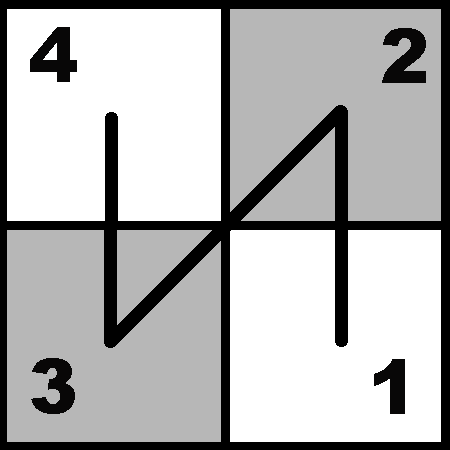
- Learning
- Overall Story Signpost 1
David and Alice have been trying to learn where the last bone in the dinosaur should go. He learns that he is to play golf with Mr. Peabody (in order to get the million dollar endowment), and that his marriage to Alice “must entail no domestic entanglements of any kind” (meaning children). David learns that it’s not Mr. Peabody, but Mrs. Carleton Random who is donating the money. Susan tries to learn the secret to the olive trick from the bartender. Susan asks Dr. Lehman for his learned opinion on David’s strange behavior. Dr. Lehman tries to learn why David has his wife’s purse.
- Overall Story Journey 1 from Learning to Doing
David learns that Susan has just inherited a leopard from her brother, Mark, and when he thinks she is being attacked by that leopard, he leaps to her rescue.
- Doing
- Overall Story Signpost 2
The second act of the objective story deals with the activity of delivering the newly acquired leopard to Aunt Elizabeth’s house in Westlake, Connecticut. After David is (in his words) tricked into going with Susan and Baby, Susan crashes their car into a truck filled with chickens, geese, and swans. When they stop off to buy Baby thirty pounds of meat, Susan parks in front of a fireplug to watch the circus parade through town. When they arrive at the house, David, concerned with getting back to New York stops to take a shower. George takes the intercostal clavicle and runs off with it. Aunt Elizabeth shows up and wants to know what David is doing in her house. David and Susan run off in search of George and the bone. At dinner, David keeps a diligent eye on George (the dog) as Major Applegate and the others discuss hunting and the proper way to imitate a leopard cry.
- Overall Story Journey 2 from Doing to Obtaining
While the gardener, Gogarty, is sneaking drinks behind the house, he sees Baby, and David and Susan realize that Baby has escaped. Meanwhile, Aunt Elizabeth receives a cable indicating that Baby was supposed to be a present for her. The concern changes to engaging in a concerted effort to retrieve Baby.
- Obtaining
- Overall Story Signpost 3
The third act of the objective story deals primarily with trying to get Baby back to Aunt Elizabeth’s house. David and Susan go off in search of George and Baby. Major Applegate understands that there really is a leopard running loose, grabs a gun, and he and Gogarty go in search of the leopard. At the circus, a wild leopard has attacked a trainer and must be brought to Bridgeport to be put to death. Susan and David see the leopard in the truck, and thinking that it’s Baby, set him free. Susan explains to Applegate that the leopard is tame and belongs to Aunt Elizabeth. Applegate sets out capture the leopard. David and Susan try to get Baby down from Dr. Lehman’s roof.
- Overall Story Journey 3 from Obtaining to Understanding
Dr. Lehman, thinking that Susan is crazy (and that she is imagining the leopard to whom she is singing), captures Susan, clearly thinking that he understands what is going on in her psyche much more than she does.
- Understanding
- Overall Story Signpost 4
Primarily taking place in the jail, the fourth act deals with trying to understand exactly what has been going on. If Susan is really lying about having an aunt, as Constable Slocum suspects, then who is she really? What is really going on? And how far reaching is this Leopard Gang conspiracy, anyway? Only when Mr. Peabody and Miss Swallow arrive is everything put into the proper context, forcing Constable Slocum to realize that he may have made an enormous blunder. When Susan brings the wild leopard into the jail, she does so in an attempt to put all of the events into proper context. Later, back at the museum, Alice tells David that she now understands what kind of person David really is (“You’re just a butterfly”), and leaves him.
Main Character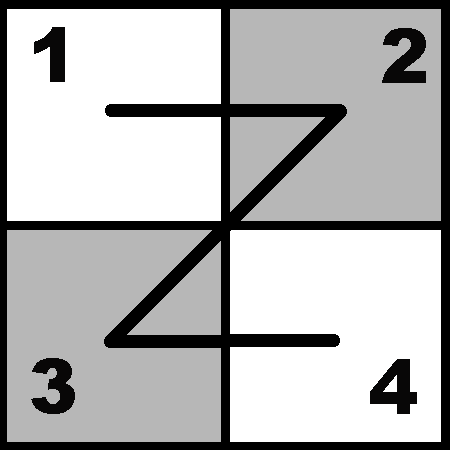
- Memory
- Main Character Signpost 1
In the opening shot, David is sitting with a large bone in his hand trying to figure out where it should go. He asks his assistant Alice if it might go in the tail, but Alice reminds him that he tried it there yesterday. He seems to have forgotten that he will be getting married tomorrow and that he has an appointment today to meet Mr. Peabody about a large donation. As he leaves, Alice reminds him to “Remember who and what you are!” In fact, at the golf course, and throughout his first meetings with Susan, he seems to keep forgetting who he is, and why he is there.
- Main Character Journey 1 from Memory to Preconscious
David receives the package containing the intercostal clavicle, and remembers that he will be getting married later in the day. He tells Alice to meet him at the museum. When Susan calls, and he thinks he hears her being attacked by a leopard, he promptly forgets about Alice and without thinking, runs off to save Susan.
- Preconscious
- Main Character Signpost 2
David refuses to give in to his instincts and tells Susan that the leopard is her problem, but when he realizes that Baby is following him down Park Avenue, he immediately leaps into Susan’s car, and agrees to help her bring the leopard to Connecticut. After they run into the truck full of fowl, Susan tells David that he should have run like she said, but he tells her it’s not easy to run when you’re wrestling a leopard in a pond. When Susan steals his clothes, David grabs the first thing he finds, a frilly bathrobe, and tries to find a way out of his predicament. He says that he is already past caring what he looks like, because his immediate need is to find George and his missing intercostal clavicle. Throughout the dinner, David keeps getting up, without thinking about what he looks like, and wandering after George (“Like Hamlet’s ghost,” observes Aunt Elizabeth).
- Main Character Journey 2 from Preconscious to Subconscious
When David learns that Baby has escaped, he finally stops acting on instinct and gets back to what he knows he must do. He calls the zoo and manages after a bit of struggle to get them to believe that he isn’t crazy, and that there really is a leopard loose in the wilds of Connecticut. Susan tells him that if he doesn’t help her find Baby, she’ll expose him to Aunt Elizabeth. David realizes that he must acquiesce if he is to have any hope of hold onto his dignity and the things he holds most dear.
- Subconscious
- Main Character Signpost 3
In the woods with Susan, David is on a mission. He is determined to bring back the leopard and his intercostal clavicle. When he and Susan are drying themselves off by the fire, after having fallen in the river, David, enjoying the peace and quiet with Susan, suggests waiting there, and letting George and Baby find them. throughout this part of their adventure, he finds himself more and more attracted to Susan, though he does his best to stifle those feelings. After the wild leopard has been let loose, David suggests that Susan go home, when he sees that this suggestion has upset her, he comes very close to kissing her, but stops himself and agrees to let her come with him.
- Main Character Journey 3 from Subconscious to Conscious
In a scene cut from the final film, Susan point blank addresses the fact that David very nearly kissed her, but David tells her it was a conscious choice. “Susan, I couldn’t kiss you accidentally. If I were to kiss you, it would be quite deliberate.”
- Conscious
- Main Character Signpost 4
David, in jail with Susan and the others, is absolutely cognizant of his situation. He knows that there is no way out of his situation and that all is effectively lost. While Slocum tries to get to the bottom of what has been happening, David can only shake his head. He’s been with Susan long enough to know that Slocum hasn’t a chance of getting anything resembling the truth from her. When Alice arrives, he knows that there is nothing he can say to explain or excuse his actions, he only hopes that she will consider the fact that it’s all over now.
Influence Character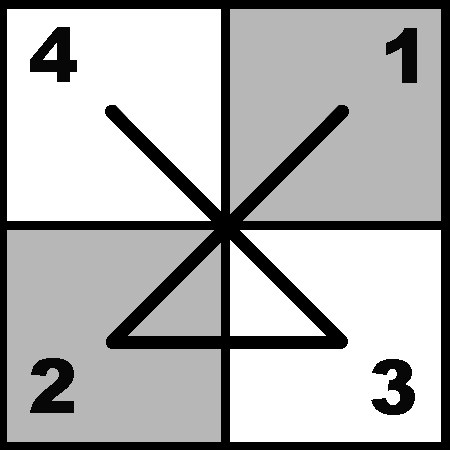
- Progress
- Influence Character Signpost 1
From the start, Susan directly impacts David’s progress in trying to talk to Mr. Peabody about securing the million dollar donation. When David is playing golf with Mr. Peabody, Susan draws him away by taking his golf ball. David returns, only to find that Susan is now taking his car. When David tries to catch up with Mr. Peabody at a restaurant that night, Susan is there, and inadvertently causes David to fall onto his hat and look absolutely ridiculous as he leaves the restaurant. When they go to Mr. Peabody’s house to smooth things out, Susan hits Mr. Peabody with a rock, only it appears that David did it.
- influence Character Journey 1 from Progress to Future
David tells Susan that he plans to get married tomorrow and that his future wife has always regarded him as a man of dignity. Susan reacts to this news, and as David falls from the scene, Susan has a look on her face that can easily be read as a look of newly found determination.
- Future
- Influence Character Signpost 2
The next day, Susan is absolutely aware of the fact that David will be getting married in the VERY near future (today), but calls and insists that he help her with her newly acquired leopard. David refuses, so Susan pretends that she is being attacked. David races to her apartment. When Susan insists that David accompanying her to Westlake, he refuses. She lets the leopard loose and tricks him into accompanying her anyway. She crashes the car into a truckload of fowl, further delaying him. When they arrive at Aunt Elizabeth’s house, Susan suggests that he take a shower. When he does, she takes his clothes and has them sent to town to be cleaned. She opens the box containing the bone, and George takes it and buries it, again ensuring that he will not be getting back to New York any time soon.
- Influence Character Journey 2 from Future to Present
During dinner, Susan tells David that Baby is missing. David says that it’s her problem, but Susan tells him that if he doesn’t help her find Baby, she’ll tell Aunt Elizabeth who he really is.
- Present
- Influence Character Signpost 3
Throughout their foray in the woods, everything that Susan does has the effect of keeping David absolutely rooted in the present moment. Getting them soaked in the river, so they must stop and dry off; Letting loose a wild leopard, so that they must focus on its immediate capture, etc.
- Influence Character Journey 3 from Present to Past
When David tells Susan to go home, she falls over a branch and cries. He comforts her, and she says she can’t bear how nice he’s being to her now, considering all that she has put him through.
- Past
- Influence Character Signpost 4
When they are in jail, and Slocum is trying to make sense of all that’s happened, Susan does very little to help. In fact she deliberately misleads Slocum, which only serves to make matters worse for David, who is trying to bring clarity to the events of the last two days. He finally gives up, realizing that his cause is hopeless. Later, when Susan arrives at the museum, she has fixed everything. All that has gone wrong has been put right. She has found the missing intercostal clavicle, and is donating her million dollar inheritance to the museum. In shattering David’s dinosaur skeleton, she has effectively helped to put his entire past behind him, so that they can now live happily ever after.
Relationship Story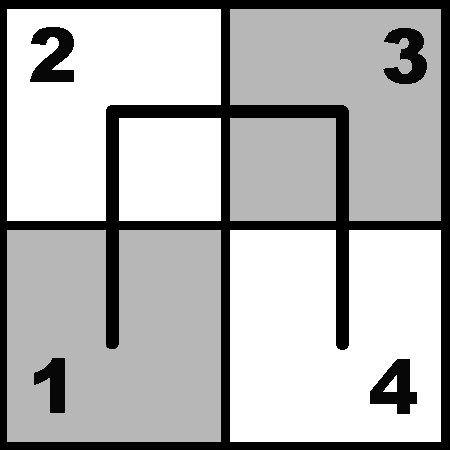
- Becoming
- Relationship Story Signpost 1
As soon as Susan and David meet, David is immediately transformed from a staid, dignified, somewhat quiet, and highly respected zoologist, into an utter buffoon. His reaction to Susan’s taking his golf ball is to follow her in a dismal attempt to get it back. When she takes his car, he again struggles to maintain his dignity, only to have Mr. Peabody see him racing away on the running board of a car (“I’ll be with you in a minute, Mr. Peabody!”). Very undignified. At the restaurant, though David arrives wearing tails and a top hat, as soon as he gets close to Susan, he does a great pratfall and ends up sitting on his hat. When Susan calls David to tell him about the leopard, he at first very rationally tells her that the leopard is her problem and that he will have nothing to do with it. When he hears her being “attacked” however, he, against his nature, leaps into action to rescue her.
- Relationship Story Journey 1 from Becoming to ConceptualizingWhen David arrives at Susan's apartment, he is already becoming a part of Susan's life (whether he realizes it or not). When he resists, Susan lets Baby loose, and the next thing David knows, he is in her car, on the way to Connecticut, trying to figure out what to do with Baby.
- Conceptualizing
- Relationship Story Signpost 2
David questions Susan’s plans, such as they are, wondering why she would want to stop for meat in a town with a circus. He also deals with the fact that somehow this plan involved the stealing of a car, although Susan has the idea of having the gardener return the car later that night. David imagines what Alice will think when she sees him looking the way he does, and Susan suggests that he take a shower. Seeing that David is intent on returning to New York to be married, Susan sends his clothes into town to be cleaned. When David realizes that Susan’s Aunt Elizabeth is in fact Mrs. Carleton Random, he imagines the worst, and makes Susan swear not to tell her Aunt Elizabeth who he really is. Envisioning what will happen if he returns without the intercostal clavicle, David makes Susan help him search for it. Susan and David know they want George to find the bone, but put much of their effort into trying to get George to implement that idea. (Susan: “Ah! See? Now he’s got the idea.”) When David is on the phone with Alice, Susan cuts the call short, trying to get him to imagine what would happen if everyone heard Baby carrying on as he is.
- Relationship Story Journey 2 from Conceptualizing to Being
At dinner, (thanks to Susan’s imagination) everyone seems to think that David is a big game hunter named Bone, but he won’t play along. When Susan threatens to tell Aunt Elizabeth who he really is if he doesn’t help her retrieve Baby, David and Susan act as big game hunters.
- Being
- Relationship Story Signpost 3
David and Susan go into the woods, butterfly net and croquet mallet in hand, doing their best to assume the role of big game hunters, hunting for their lost leopard. Before long they find George and Baby behaving in a way that two natural enemies shouldn’t. They are playing, wrestling actually, and George, the little dog, clearly has the upper hand over the leopard. The next thing David and Susan know, they are in the middle of a river, soaking wet. They argue over the fact that Susan told Aunt Elizabeth that David was crazy and that his name is Bone, and she didn’t tell David. When they see what they think is Baby in the back of the circus truck, Susan suggests that David assume the role of zoologist and talk to the men, while she lets Baby out of the truck.
- Relationship Story Journey 3 from Being to Conceiving
After Susan has broken David’s glasses, David decides that this whole game they’ve been playing must end. He tells Susan that she must be tired and should go home. Susan trips over a branch and cries, realizing that David is being nice to her despite all of the things she’s done to him. David agrees to let her come along with him, and Susan tells him in so many words, that whatever idea he comes up with for her to do, she’ll do it.
- Conceiving
- Relationship Story Signpost 4
David and Susan are in adjacent cells. Susan keeps coming up with ways of getting them out (picking the lock, telling Constable Slocum who she really is, etc.) all of which make David bristle, because he knows what trouble Susan’s ideas cause. At one point she tells Gogarty that she’ll get him out, to which David, still in his cell, replies, “Oh, sure. Look. She got me out.” Susan has the idea of telling Slocum everything he wants to hear, David doesn’t think it’s a good idea (“Susan. It won’t work. Whatever it is, it won’t work.”) Eventually she escapes, having come up with the idea of catching Baby to show them that she’s telling the truth. Unfortunately she captures the wild leopard, so David has to run to her rescue. Later, after all is said and done, Susan shows up at the museum, proud of the fact that she finally came up with a good idea. She has found David’s intercostal clavicle and has obtained the million dollars for the museum, as well.
Plot Progression Visualizations
Dynamic Act Schematics
OS:  MC:
MC:  IC:
IC:  RS:
RS: