Amadeus
Comprehensive Storyform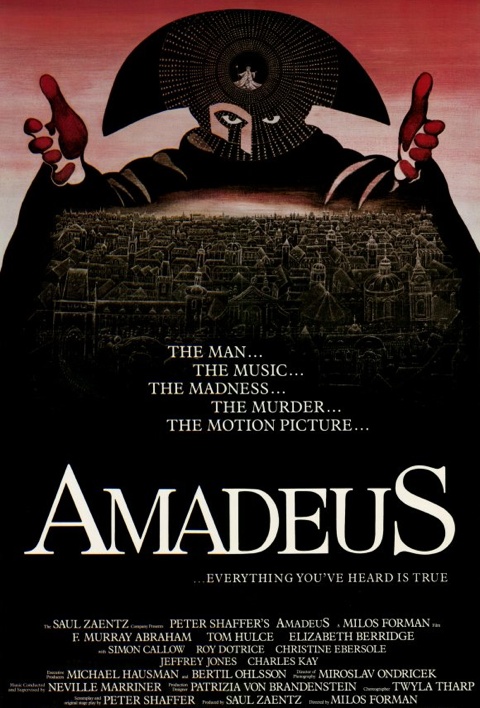
The following analysis reveals a comprehensive look at the Storyform for Amadeus. Unlike most of the analysis found here—which simply lists the unique individual story appreciations—this in-depth study details the actual encoding for each structural item. This also means it has been incorporated into the Dramatica Story Expert application itself as an easily referenced contextual example.
SYNOPSIS: "The incredible story of Wolfgang Amadeus Mozart, told by his peer and secret rival Antonio Salieri - now confined to an insane asylum." Synopsis Source: IMDB.com
Story Dynamics
8 of the 12 essential questions
- Steadfast
- Main Character Resolve
Once he declares his war, his intent to destroy Mozart, he remains steadfast to the end. He had offered to trade a recommendation to the Emperor on Mozart’s behalf if Constanze will have sex with him. After he declares his war, he isn’t interested. He tells us, “I wanted nothing petty…..My quarrel wasn’t with Mozart. It was through him! Through him to God, who loved him so.” As Salieri listens to the “Magic Flute,” he finds that a bit of pity might be entering his heart, but he resolves, “Never!” In the end, Salieri even attempts to take his own life to spite God’s punishment- that is, Salieri’s lack of recognition.
- Stop
- Main Character Growth
Salieri must Stop Mozart, his music, his fame. He must stop God in His choice of Mozart as His Voice. He must stop his own adherence to his part of the bargain he made with God.
- Be-er
- Main Character Approach
Salieri prefers to deal with his world indirectly, internally. He manipulates his world. He waits years to get the job of First Kappelmeister. He is willing to flatter; to be self-deprecating. Even with Mozart, in his war with God, he prefers to manipulate those around him rather than challenge Mozart directly. When he has the opportunity to sleep with Constanze, he refuses, preferring to adapt to his new sense of his world. This harkens back to his statements that he always wanted to sleep with his pretty students, but because of his bargain with God, he had to be chaste.
- Male
- Main Character Mental Sex
Salieri solves his problems using cause and effect techniques. Once he has perceived Mozart as the problem, he methodically begins his years long campaign of destruction. And he is sure that it will result in resolving the problem.
- Decision
- Story Driver
From the outset, as the play is a memory, we see that Salieri made a decision to oppose Mozart. All the action follows, including Salieri’s decision to tell us the story as “Ghosts of the Future!” He also decides to attempt suicide. In the objective story, the Emperor decides to change his habit and visit a rehearsal of “Figaro.” This results in the Emperor restoring a dance which the Director of Opera to the court had removed. The Director, Rosenberg, becomes Mozart’s enemy. Also, Mozart decides to go against his father and marry Constanze, resulting in his father refusing further financial assistance.
- Optionlock
- Story Limit
Salieri has run out of options to further Mozart’s ruin, so he contrives to impersonate the ghost of Mozart’s father to frighten Mozart to death. At the end of the story, he attempts suicide to outwit God.
- Failure
- Story Outcome
Salieri is ultimately able to contribute to Mozart’s death. However, it does not resolve his problem. Mozart’s music continues past his death. Salieri is praised for work which he knows is “mediocre.” He ultimately attempts suicide to resolve the problem, and he fails at that.
- Bad
- Story Judgment
Salieri’s defeat is total, and he is both forgotten as a composer, and thought by the public to be insane. He never resolves his conflict of faith. It is his destruction.
Overall Story Throughline
"War Against God"
- Mind
- Overall Story Throughline
The play is a memory play. It is fixed in Salieri’s mind. This is his recollection, his argument, his justification. However, within the objective story, the characters are fixed in their attitudes. The Court is fixed in its ways, the Emperor is fixed in his ways. Salieri is fixed in his desire for fame. Mozart is fixed in his personality and his thinking. Even Constanze is fixed in her regard for Mozart, and her desire to help him.
- Memory
- Overall Story Concern
Mozart is constantly comparing his life in the play to his life as a child. The Emperor tells stories of Mozart from his memory. He even asks before telling an oft-told story to the court if he has told the story before. His courtiers always respond that it is the first time they have heard it. The members of the court defend their status quo by comparing “current” life to the past. Music is compared to what has gone before.
- Falsehood
- Overall Story Issue
Salieri lived his entire life believing he was secure in his bargain with God. He is distressed to find that the true voice of God seems to emanate from “an obscene child.” He struggles with his perception of God’s falsehood. He therefore creates as much falsehood about Mozart as possible. He seeks to take any truth and point out a falsehood about it. He is the single character in the play who knows the truth of Mozart’s music, and yet he focuses on creating a false picture of the music. Clearly, Salieri could choose at any time to show the world the truth about Mozart’s music, but he chooses to stay in falsehood.
- Truth
- Overall Story Counterpoint
- Overall Story Thematic Conflict
Falsehood vs.Truth - Equity
- Overall Story Problem
Salieri is driven to destroy Mozart because of the nature of his agreement with God. He asked to be a composer, with just enough fame to enjoy it. This he has. But the advent of Mozart upsets the balance. Salieri feels betrayed by the very balance he finds himself in. Further, in the rest of the objective story, the Court is suffocating under a balance that the principles seek to maintain. It is Mozart who sees this and attempts to change the status quo. Ironically, Mozart has already upset Salieri’s status quo.
- Inequity
- Overall Story Solution
If Salieri were able to accept the inequity of talent between Mozart and himself, the objective story problems would be resolved.
- Projection
- Overall Story Symptom
Salieri looks to the future to see the impact of Mozart’s music. He draws the conclusion that his course of action will destroy Mozart, ensure his own fame, and defeat God. Mozart complains of where his life is headed without money; without his father’s help. Even the Court ministers focus on what they are sure will be the result of giving into Mozart’s demands.
- Speculation
- Overall Story Response
From the outset, the objective characters speculate on Mozart, his music, his effect on the Court. The author has even included two characters called Venticelli, whose purpose is to spread gossip and speculation. Salieri comments to the audience how important it is to keep up with the current rumors. Salieri falsely uses speculation with Mozart to assure him that the Masons will like “The Magic Flute.” Mozart speculates on the significance of the appearance of The Ghost. He and his wife are continually at odds as to what the future holds.
- Truth
- Overall Story Catalyst
Salieri’s realization of the truth about Mozart’s music starts the story toward its conclusion. When Salieri reads the manuscripts, he sees how perfect Mozart’s music is. When the Masons learn the truth about “The Magic Flute,” they shun Mozart. At the end of his life Salieri realizes the truth about God’s vengeance. It moves him to attempt suicide.
- Situation
- Overall Story Inhibitor
Salieri is tied to the Court of Joseph II. He must work within the boundaries of that court. He knows the Emperor likes Mozart, so he must work within the situation to achieve his ends. All the members of the Court have to maintain their position, their situation, above all else.
- Subconscious
- Overall Story Benchmark
We watch the changes in Salieri as he gives in to his desires. We see Mozart fall further into his fears. The Emperor’s court is manipulated into their own justifications for turning their backs on Mozart.
- Overall Story Throughline Synopsis
Antonio Salieri describes his memory of the events leading up to the death of Wolfgang Amadeus Mozart. When Salieri discovers that Mozart, not he, has been chosen to be God’s voice through music, Salieri declares war on God, and uses Mozart as the battlefield. He succeeds in destroying Mozart, but fails to stop Mozart’s music which torments him until the end of his life.
Additional Overall Story Information →
Main Character Throughline
Antonio Salieri — Composer to Court of Emperor Joseph
- Psychology
- Main Character Throughline
The play is the story of Antonio Salieri’s manipulation of Wolfgang Amadeus Mozart and the Court of Emperor Joseph of Austria. The play shows us not only the depths of his manipulation, but also the evolution of the attitudes of the people in the Court. Salieri successfully manipulates Mozart’s death. But he fails to contain the music or Mozart’s fame.
- Conceptualizing
- Main Character Concern
Salieri continually tries to find ways to thwart Mozart, and win his war with God. As conditions change, he must change his tack and come up with new ideas.
- Sense of Self
- Main Character Issue
The action of the play is driven by the contrast of the man Salieri thought himself to be with the man he is willing to become. He behaved in a rigidly moral way as a part of his bargain with God until he realized he was not able to write Divine music like Mozart.
- State of Being
- Main Character Counterpoint
- Main Character Thematic Conflict
Sense of Self vs.State of Being - Ability
- Main Character Problem
Salieri is “the only man alive in this time who shall clearly recognize Your (God’s) Incarnation.” This is the source of his problem. Mozart has superior ability in music and the ability to be the “Voice of God” in his music, which renders Salieri jealous beyond imagining.
- Desire
- Main Character Solution
Salieri gives in to his worldly desires to win the war with God. His desire to be God’s voice is stripped from him and he gives into the desire to defeat God.
- Projection
- Main Character Symptom
Salieri continually projects what will happen next. When he made his childhood bargain with God he decided what his future would be. When Mozart arrives, he begins to see what the changes will be. When he hears the music, he becomes focused on stopping the music. He knows that the music will always remind him of his own mediocrity, so it must be stopped. He projects the result of every action he takes, hoping that he can stop Mozart.
- Speculation
- Main Character Response
Salieri speculates that if he can stop Mozart, he can stop the music. This is a mistake, but he stays pointed in this direction.
- State of Being
- Main Character Unique Ability
It is Salieri’s coming into the flourishing of his true self that allows him to achieve his goal of destroying Mozart. Ironically, it is his unique ability to hear the voice of God in the music that is at the heart of Salieri. It is not enough to hear it, he must be the one to create it, or he must destroy the one who can.
- Evidence
- Main Character Critical Flaw
Salieri sees that he is flourishing in his life once he goes to war with God. He is even successful at killing Mozart. However, the evidence he sees does not show him that Mozart’s music will live on and become beloved, nor can he see that he will become obscure.
- Becoming
- Main Character Benchmark
Salieri sees that the more depraved he is, the more ruthless he is, the better his life is. He becomes the opposite of what he thought God wanted him to be, and he sees that there is a corresponding deterioration in Mozart.
- Main Character Description
Witty, sophisticated, selfish, controlling, manipulative, malevolent when crossed.
- Main Character Throughline Synopsis
The Main Character Throughline is the focus of the play. We watch the darkly human frailties of one man’s sense of who he is cause the destruction of another. Salieri’s throughline is the story of his manipulation of the Court of Emperor Joseph to turn against Mozart. Believing himself to be in a war with God, because God has betrayed him, Salieri will stop at nothing. The playwright allows us to see into the mind and imagination of Salieri as he schemes and plots Mozart’s demise. Salieri will change his fundamental character to achieve his goals. We as the audience get to see that Salieri is only coming into his true nature.
Additional Main Character Information →
Influence Character Throughline
Wolfgang Amadeus Mozart — Composer
- Physics
- Influence Character Throughline
Mozart is a flurry of activity. He is even describes as being unable to sit still. He writes music at a furious rate, plays at a furious rate, and speaks at a furious rate.
- Understanding
- Influence Character Concern
Mozart is continually placed in the position of understanding the Court, what they want, how to get along with them, how to make a living. The world is a mystery to him, and he is now married, has children, and tries to understand how to support them.
- Conditioning
- Influence Character Issue
Mozart was conditioned by his father to think that he could behave the way he does. He was spoiled, and it always gets him in trouble. This is at odds with his instinct that his music is remarkable. He struggles to be agreeable with people who cannot hear what he hears.
- Instinct
- Influence Character Counterpoint
- Influence Character Thematic Conflict
Conditioning vs.Instinct - Equity
- Influence Character Problem
To the Court musicians and composers, there is an order and balance to the status quo. The traditional standards of music imposed by the Court constrain Mozart’s creativity. Upon hearing Mozart’s first piece written for the Court, the Emperor says, “Too many notes.” Mozart strains at the formal manners of the Court and manages to offend nearly everyone. He complains bitterly that his life is unfair.
- Inequity
- Influence Character Solution
Mozart creates music that upsets the status quo of the Court, and the sensibilities of his patrons. His most extraordinary work, comes out of the chaos of his life.
- Order
- Influence Character Symptom
When Salieri sees Mozart’s musical scores with no corrections, he realizes that the music is perfect. Any change would make the music less. It is the perfect arrangement of Mozart’s music that finally drives Salieri to declare war with God.
- Chaos
- Influence Character Response
Even though Mozart’s life has been one of chaotic, rude, self-centered living, he is the chosen voice of God.
- Instinct
- Influence Character Unique Ability
Mozart’s music IS his instinct. It keeps rising to the top and raising Mozart with it. Also, he has an instinctive timing in many points of the story, like getting the Emperor to come to a rehearsal. This leads to the Emperor thwarting a plan of Salieri’s and the others at the court.
- Prediction
- Influence Character Critical Flaw
Mozart is blindly sure that his music will save him. He believes everyone will love “Figaro,” but they do not. He is sure the Masons will love “The Magic Flute.” They are so outraged that he is completely cut off by them.
- Obtaining
- Influence Character Benchmark
As Mozart tries to understand how to make a living, he is constantly seeing that he is only getting in worse condition. He cannot keep pupils, sell music, or even hold onto his friends. He can’t even achieve notoriety with his work.
- Influence Character Description
Mozart is silly, giggly, profane, loud and nervous. He speaks in a high voice and laughs like a hyena. He is disagreeable and unlikeable. He makes enemies of almost everyone.
- Influence Character Throughline Synopsis
Mozart provides the outer manifestation of the God’s betrayal of Salieri. No matter what Mozart suffers, no matter how many enemies he creates, his music is always pure and true. It is this fact that continues to inflame Salieri. Symbolically, Mozart is the Music, and therefore the Voice of God.
More Influence Character Information →
Relationship Story Throughline
"The Destruction of Mozart"
- Universe
- Relationship Story Throughline
The relationship between Mozart and Salieri is played out in the situation. Salieri’s effect on Mozart is directly in Mozart’s “situation.” Salieri keeps Mozart from having the position of tutor to Princess Elizabeth. He undermines Mozart’s situation with the Masons, who have been giving him money. Salieri’s “situation” both allows him to discredit and destroy Mozart. And Salieri’s anger comes from the realization that his “place” with God is not as high as he thought. It is Mozart’s position of being the voice of God that causes Salieri to make the choices he makes.
- Past
- Relationship Story Concern
Salieri’s recollections of the past events are the focus of the play. Further, he bases his understanding of the way things should have been during the time he dealt with Mozart on his earlier (past) bargain with God. It is Salieri’s past bargain with God that he feels has been betrayed.
- Destiny
- Relationship Story Issue
By staking out Mozart as the battlefield between himself and God, Salieri seeks to define his own destiny, despite the fate that may await him. Further, as he is the only one who can see that Mozart is the voice of God, he is determined to alter Mozart’s destiny and become the architect of his fate.
- Fate
- Relationship Story Counterpoint
- Relationship Story Thematic Conflict
Destiny vs.Fate - Equity
- Relationship Story Problem
Mozart’s presence has upset the balance of Salieri’s life, as well as the Court’s. Salieri had a bargain with God that he was peacefully living up to. He never touched the students he lusted after, because he had a bargain with God. He wrote music only to glorify God. Mozart’s arrival, and Salieri’s awareness of what he really is, destroys the balance and the reasons for the balance.
- Inequity
- Relationship Story Solution
By creating as much imbalance as possible, Salieri can destroy Mozart from a distance. Once Salieri begins his mission to upset Mozart’s life, every event in Mozart’s life compounds the issue. When Mozart’s father dies, the man is already in dire straits. So the new event furthers the imbalance and takes Salieri closer to his goal.
- Ability
- Relationship Story Symptom
Mozart’s ability as the voice of God is where Salieri puts his attention. Salieri’s ability as the only person alive who can hear it creates the greatest tension for him. The first time he hears it, he must run out into the street to get away from it.
- Desire
- Relationship Story Response
Antonio Salieri is the only person alive who can hear Mozart’s music for what it truly is. Further, he wants more than anything to be the voice of God himself. Mozart, despite his shortcomings, is the only focus of that divine music.
- Fate
- Relationship Story Catalyst
Salieri is fated to hear in Mozart’s music his own shortcomings. Mozart’s nature will continually create problems for him - he makes enemies everywhere. The death of his father moves him closer to his own destruction. The choices he makes in his music push him farther away from those who could help him. Salieri has only to stand by and take advantage of the fate that befalls Mozart.
- Senses
- Relationship Story Inhibitor
The very impact, the very effect of Mozart’s music consumes Salieri. When he hears The Magic Flute, he comes close to compassion for the man. Even though Mozart irritates everyone, his music keeps him afloat. By the end of the play, it is the Mozart’s music that has endured, driving Salieri to attempt suicide.
- Future
- Relationship Story Benchmark
It is Salieri’s desire for fame that ultimately drives him. He is constantly looking to the future to see how that is unfolding. Mozart looks to his own future when he writes his Requiem. He and Constanze worry about the future if he has no money. Even the Venticelli gossip about the future of Mozart’s children. This all shows Salieri that his plan is unfolding the way he wants.
- Relationship Story Throughline Synopsis
The Subjective Story is the continuing situation of Salieri’s attempt to undermine Mozart. Mozart is Salieri’s unwitting pawn in his war with God. Salieri grows to hate Mozart intensely and seeks every chance to harm him. It is the driving force of Salieri’s life. He goes so far as to pretend to be Mozart’s only friend in order to find ways to defeat him. Even at the end of the play, Salieri attempts suicide in a vain attempt to become famous as the man who killed Mozart.
Additional Relationship Story Information →
Additional Story Points
Key Structural Appreciations
- Memory
- Overall Story Goal
We are exploring Salieri’s memory of the events that took place. He sets the stage for our experience: “The age is still that of the Enlightenment: that clear time before the guillotine fell in France and cut all our lives in half.” Because this is a memory play, all the characters are behaving in accord with Salieri’s memory. It is Salieri’s specific goal to be remembered for his music. This goal is not achieved, and what is worse for Salieri, is that his nemesis, Mozart, will never be forgotten for his music.
- Past
- Overall Story Consequence
Salieri is stuck with his past bargain with God. As he relates his story to us from a “future” time, we see that he could not escape the bargain. His past literally catches up with him.
- Understanding
- Overall Story Cost
Salieri must come to an understanding of who he really is. He understands what he believes is the true nature of God, not the falsehood he had lived with. This undermines his world. His understanding is shown to be flawed. He cannot defeat God.
- Conceptualizing
- Overall Story Dividend
Salieri finally figures out how to have the fame he craved. During his “bargain” days, he was relatively obscure. But once he launches his war, he sees how to have the good life, how to destroy Mozart, how to manipulate the Emperor to get what he wants. Mozart learns how to accomplish his goals, but is undermined by himself and Salieri.
- Subconscious
- Overall Story Requirements
Salieri is forced to see his life in light of his shortcomings. His intense anger at being betrayed by God, causes him to go to the depths of his true nature. The music itself moves him to the core. He must appeal to the other objective characters at the level of the subconscious so they can come to a negative opinion on their own. He appeals to the Emperor’s basic stinginess to keep him from giving Mozart money. He convinces Mozart to use the practices of the Masons in “The Magic Flute, which will offend the Masons at a subconscious level. And he ultimately must hit Mozart in the subconscious in the guise of the ghost of Mozart’s father.
- Future
- Overall Story Prerequisites
Salieri must control Mozart’s future. He thwarts any effort to make Mozart’s future look bright. When he is attempting to get the Emperor to slight Mozart, he must attend to the Emperor’s future. The Emperor worries that in the future he will be seen badly: “I won’t have him say I drove him away. You know what a tongue he has.” Even at the end, Salieri chooses to attempt suicide to ensure his piece of the future.
- Obtaining
- Overall Story Preconditions
Salieri must ultimately obtain Mozart’s death. He must obtain knowledge of Mozart’s weaknesses to defeat him. He must obtain fancy furniture to live the life of a popular composer. He obtains Mozart’s trust in order destroy him. He must obtain a young mistress he avoided before his “war.” He must obtain the help of all the objective characters to starve Mozart to death.
- Becoming
- Overall Story Forewarnings
Salieri reaches a point where he might give in to pity for Mozart after being deeply moved by “The Magic Flute.” He feels the possible transformation and fights it. Further, he watches Mozart’s continued growth as the Voice of God in his music. The experience drives him toward his goal.
Plot Progression
Dynamic Act Appreciations
Overall Story
- Memory
- Overall Story Signpost 1
Act 1 establishes that the play is a Memory Play. Salieri tells us that he is recounting history. Further, he sets the scene by recounting events further back than the time of Mozart in Vienna by telling us his past and Mozart’s past. We learn from various characters what HAS gone on before Mozart arrives in Vienna. Most importantly, we learn the nature of Salieri’s childhood bargain with God. In the beginning of the play, the scene is set with characters remembering events in the past. When we meet Salieri in the first moments of the play, he tells us that he is recounting the past.
- Preconscious
- Overall Story Signpost 2
Mozart’s behavior is unthinking, selfish, instinctive and thoroughly irritating to those around him. He cannot help himself, and those around him have just as immediate reflexive responses to him. They can’t stand him. He is vulgar, conceited, rude, and insulting.
At the same time, his music is just as instinctive. As Salieri describes it, “It seemed to me I had heard a voice of God…” Mozart’s music is something mystical that comes from beyond himself. And Salieri is the only one who can hear it for what it is. And it is Salieri’s instinctive response, his instinctive understanding that Mozart’s music is so rare that drives Salieri to the edge of despair.
- Subconscious
- Overall Story Signpost 3
We see Salieri’s basic motivations rise to the surface. He will now destroy Mozart to defeat God. He wills himself to become the opposite outwardly of what he was. He plays on the subconscious drives of those around him to ruin Mozart. And yet he comments that he is still driven to pray to God, hoping to have some relief. Salieri attends the disastrous premiere of “The Marriage of Figaro,” where he is the only one to be moved by the music. But Mozart’s arrogance quickly brings Salieri back to his driving passion to defeat God. Mozart falls into decline, fearing starvation, fearing the loss of his family. The Court is retrenching in the values it has always had and is shutting Mozart out, all with the intervention of Salieri.
- Conscious
- Overall Story Signpost 4
With the premiere of “The Magic Flute,” and its presentation of Masonic rituals, Mozart is almost finished. Salieri has conspired to bring Mozart’s last benefactors to the premiere and they are permanently outraged. The reality of Mozart’s condition has driven his family away, he is literal starving to death as Salieri wanted. To complete his plan, Salieri goes to Mozart’s house dressed as “the Messenger of God.” All the motion of the play is brought to this climax that leads to Mozart’s death. It is a thoroughly considered move by Salieri. He knows precisely the consequences and he proceeds.
And this leads to the Author’s Proof. The last scenes of the play show Salieri’s failed attempt at suicide - his bid for immortality. This is followed by Salieri living for two more years in torment. Thus the author brings us from the Conscious of the “past” to the Conscious of the “present.”
Main Character
- Being
- Main Character Signpost 1
Physically, in the beginning of the play, we literally see Salieri as an old man who adopts the physical being of a young man to tell his story. Then we learn that Salieri will BE whatever is necessary to achieve his end of being a great composer. He pretends to be Mozart’s friend to get close to him. He pretends to agree with the emperor when necessary. And it is his suspicion that his pretense at morality was for nothing that begins to turn him against God.
- Becoming
- Main Character Signpost 2
Act 2 shows us Salieri’s drift toward his war with God. He tries to become a seducer of Mozart’s wife, but he merely looks ridiculous. He becomes the avowed enemy of God.
- Conceiving
- Main Character Signpost 3
Salieri continues to plot against Mozart in every way. He sees potential in every situation. He conceives of a plan to deny Mozart money from the Emperor, while managing to keep Mozart as a friend. He convinces Mozart to use the secret rituals of the Masons in “The Magic Flute.” He knows it will infuriate the Masons and they will abandon Mozart.
- Conceptualizing
- Main Character Signpost 4
Salieri Conceptualizes his final blow on Mozart. He appears as the Messenger of God to Mozart to push him over the edge. Mozart dies.
Influence Character
- Doing
- Influence Character Signpost 1
The history of Mozart is dedicated to his accomplishments. Upon his arrival he tries to impress everyone. He insists on re-writing Salieri’s march.
- Learning
- Influence Character Signpost 2
Mozart begins to learn that for the first time in his life, people don’t like him. He learns what marriage means. He tries to learn how to get along at Court.
- Obtaining
- Influence Character Signpost 3
Mozart tries desperately to get money, work, food, respect, friendship. And he tries to understand what is going wrong.
- Understanding
- Influence Character Signpost 4
Mozart comes to misunderstand the nature of what is happening to him. He believes he has angered God and thus he will die. Then he comes to truly understand that it was always Salieri trying to kill him.
Relationship Story
- Past
- Relationship Story Signpost 1
Salieri has made a bargain with God that he feel’s entitles him to be God’s voice with his music. He has lived an immaculately moral life as his part of the bargain. When Salieri sees the despicable kind of person Mozart is - “an obscene child” - he feels betrayed by God. Salieri begins to question the value of his moral life.
- Progress
- Relationship Story Signpost 2
Salieri watches Mozart’s progress and begins to think of ways to undermine him. Mozart’s fame irritates Salieri. Mozart’s personality works against him. Events put Salieri in a position to help or hinder Mozart. He tries to blackmail Mozart’s wife into a sexual liaison. He fails, but has the opportunity to see Mozart’s manuscripts. To Salieri the work is Divine. This leads to the climactic moment when Salieri challenges God to a war.
- Present
- Relationship Story Signpost 3
Salieri’s life flourishes, even though he has resolved to defeat God by destroying Mozart. He grows in fame, while Mozart is becoming destitute. Salieri does everything possible to harm Mozart. But he is able to make Mozart believe they are friends. The “war” is going well for Salieri.
- Future
- Relationship Story Signpost 4
The final destruction of Mozart has Salieri begging Mozart to “die and leave me alone.” As the climax moves to the author’s proof, we learn that Salieri’s future was a two edged sword. He achieved great fame, but lived to see himself drift into total obscurity. He even tries to kill himself to become famous. He fails.
Plot Progression Visualizations
Dynamic Act Schematics
OS:  MC:
MC:  IC:
IC:  RS:
RS: